Showing posts with label mercedes. Show all posts

18 July 2026

More than an old car #233: Mercedes W136 170

The beauty of car spotting is that nice cars can be literally anywhere, and it was one of the days where I came across this 1952 Mercedes W136 170 V by pure chance! 

The Mercedes Type 170 V was developed back in 1931, and made its debut at the International Automobile and Motorcycle Exhibition in 1936 at Berlin. It replaced the Type 170 (designation W15) and the V designation indicated the engine was in front, compared to the rear-engined 170 H (W28). Customers could choose from several body variants: 2 and 4-door sedans, a 4-door convertible sedan and a cabriolet. There was also delivery van and ambulance variants on top of that as well. Mercedes also explored a Kubelwagen/off-road military vehicle version which saw increased usage during the war.

Post-war production restarted in May 1946, where initially the panel vans and small flatbed trucks were built again. The civilian convertible versions were no longer available; sedans were made starting from 1947. In May 1950, the 170 V (petrol) and 170 D (diesel) received a power upgrade with a larger 1.8 litre engine, and safety was improved with the introduction of telescopic shock absorbers, a wider rear track and stronger brakes. The luggage compartment was finally accessible from outside and the passenger cabin was given wider seats. The naming convention was also changed to 170 Va and 170 Da.

A further upgrade happened in May 1952, accompanied by new suffixes for the name. The Mercedes-Benz 170 Vb and Mercedes-Benz 170 Db now featured new single piece bumpers. The two rows of vertical ventilation slats that were on the sides of the bonnet/hood were replaced by a pair of horizontal slats on each side, and the windscreen wipers which had hitherto been attached at the top of the windscreen frame were now attached at the bottom. In 1953, the Type 170 became quite outdated and sales started to decline, along with another rebranding to 170 S-V and 170 S-D.

The 170 Vb was powered by a 1767 cc M136 i4 engine, allowing it to reach a top speed of 116 km/h with an acceleration of 40.1 seconds [0-100 km/h]. It had dimensions of 4285 x 1630 x 1610 mm, with a weight of 1120 kg and a fuel consumption of 9.7 litres / 100 km.

Production of the W136 ended in 1955 where it was replaced by the Ponton-bodied Mercedes 180. About 200,000 were made, of which ~140,00 were the 170 V models produced after the war; this made the W136 the best-selling Mercedes model of its era. W136s were also sold in Singapore in 1951, where a newspaper article stated that a batch of six 170Ds were imported by Cycle & Carriage Co (which is still the Mercedes dealer today). 170 Vs retailed at $8,100, with the 170 D at $8,550 and 170 S at $9,875.

This unit was imported and registered in 2018, but I had not seen it until it randomly appeared in my school one day! I was rushing for class but was able to squeeze out a few minutes to hang around this relic, and managed to express my admiration to the owner who had just returned. While I have not seen it again, I believe it is still around even though the number plate is no longer registered. To the best of my knowledge, there are at least 3 units of the 170 here and hopefully, you'll get to catch a sight of them soon!


11 April 2026

More than an old car #230: Mercedes Benz C215 CL55 AMG


Given the huge backlog of cars that I have, there may be a likelihood that some cars which I have seen before are no longer here, and this 2000 Mercedes Benz C215 CL55 AMG is unfortunately one of them...

Launched at the Geneva Motor Show in March 1999, the C215 was the second generation of Mercedes’ luxury coupe (CL comes from Coupe-Luxury). The CL name had appeared in June 1996 (1997 for the American market) on the W140 series on the CL 500 and CL 600 models. 

It was the first car in the world with Active Body Control active suspension, which minimises rolling, pitching, and squatting movements of the body. Designed by Bruno Sacco, it also featured a unique pillar-less design with no B-pillar. It was also the first car in the world with both low beam and high beam High Intensity Discharge headlamps. Various engine types were offered with the lowest capacity in the CL500; there was also exclusive versions such as an F1 Limited Edition of the CL55 AMG, featuring carbon-ceramic brake discs. The C215 had a facelift in 2002, featuring a revised grille and taillights, along with engine upgrades.

It was powered by a 5439 cc M115 V8 engine, allowing it to reach a top speed of 250 km/h with an acceleration of 6 seconds. It was 4993 mm long and weighed 1795 kg, with a fuel consumption of 13.4 litres / 100 km.

Production of the C215 ended in 2006 where it was replaced by the C216 generation; 47,984 were made of which 6,380 were the CL55 AMG. CL55 AMGs were brought in by the Mercedes dealer Cycle and Carriage, though it did not appear to be advertised openly. 

This unit is a pre-facelift model and was the last unit left here before it was most likely exported. C215s are considered rather obscure, especially so when they were also very expensive upon release: the open market value of a CL500 was S$123,617 in 2000, which was only overshadowed by the Ferrari 360, Porsche 911 and Aston Martin DB7 at that time. I last saw it in 2019 and it was one of the cars that I wanted to write about, just that I didn't have the time previously. While this car may not be here anymore, I hope that this will be a lasting snapshot of this unicorn that used to roam our shores!


12 April 2025

More than an old car #220: Mercedes W210 Binz E280 XL


In yet another car off my bucket list, chancing upon this 2000 Mercedes Binz E280XL was entirely accidental! I was just walking by the area which I had not been for a while, to just see what sort of cars were around. Imagine my surprise when I laid eyes on this unique limousine that I had always wanted to see for a while!

The W210, introduced in 1995 as the second-generation E-Class, marked a significant shift in Mercedes-Benz design. It featured the now-iconic oval headlights, and was built with a focus on improved aerodynamics, comfort, and safety. While it was less boxy than its W124 predecessor, it was a link towards a more sophisticated look for subsequent models. The W210 came in a variety of trims and engine options, ranging from economical four-cylinder models to high-performance AMG variants. There were also advanced safety features, such as side airbags and stability control, setting new industry standards for executive sedans. In 2000, there was a facelift with changes to the grille, bumpers and taillights, along with a revised transmission system.

The E280, made between 1995 and 2002, was powered by a 2799 cc M112 V6 engine, allowing it to reach a top speed of 230 km/h with an acceleration of 8.9 seconds [0-100 km/h]. The base model was 4818 mm long and weighed 1535 kg, with a fuel consumption of 10.8 litres / 100 km

While the W210 was already known for its blend of comfort, performance, and prestige, the German coachbuilder Binz Karosserie took it a step further with the E280XL. Binz GmbH & Co. KG was founded in 1936 by Michael Binz, where it established itself as a coachbuilder on standard vehicles. After the war, Binz pivoted towards Mercedes vehicles as a base, to modify them into taxis, station wagons, ambulances and even hearses. Binz GmbH filed for insolvency in 2012, and it was sold to the Thai RMA group, where it is now rebranded as Binz Ambulance and Environmental Technology GmbH.

The E280XL was now stretched to a whopping 5788 mm, leading to significantly more legroom for the passengers and an additional pair of seats. This unit is noted to be a Vis-à-Vis model, where the middle section does not have door handles on the outside but could be opened from the inside. Binz also allowed for customisation, which included curtains for the rear portion, darkened windows, a cooler box and even a LCD screen on the ceiling.

Production of the W210 ended in 2003, where it was replaced by the W211 series. Given its niche market and limited production, the E280XL by Binz remains very rare today, and this unit is the only one here! Many of these stretched E-Classes were used in fleet or chauffeur services, meaning that surviving examples in pristine condition are few and far between. This car was actually used as a typical daily driver and changed hands some years back (judging from the number plate age). While it used to be silver, it has been repainted into this curious blue-and white paint scheme. Based on the tapes, it seems to be at the workshop for some panel work.

Limousines are few and far between in Singapore, making this E280XL a unicorn especially its age. It represents an interesting blend of practicality, luxury, and exclusivity, which is something that is lacking in our car scene today. Hopefully you will come across this true hidden treasure of automotive history one day!


11 February 2022

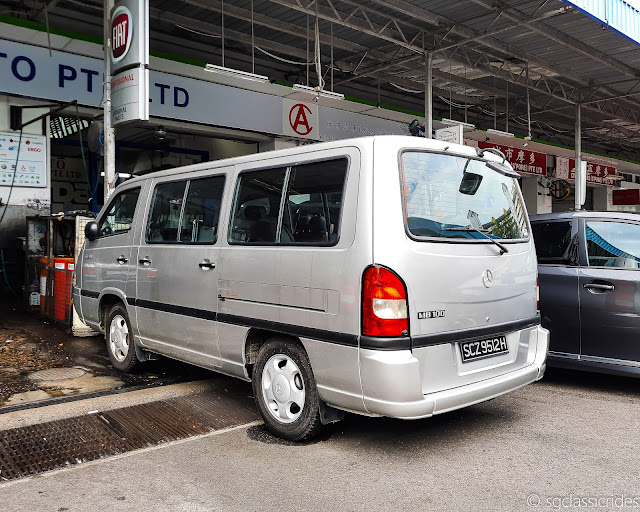
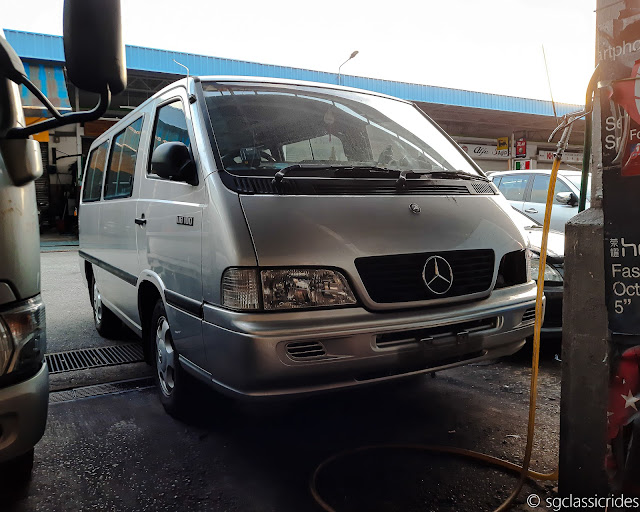
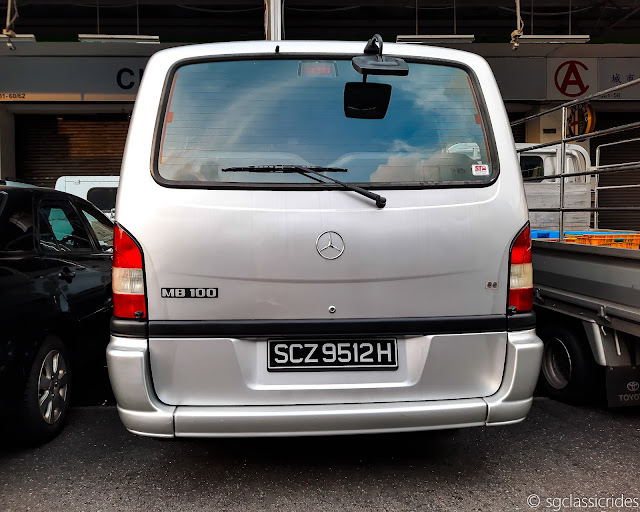
More than an old car #187: Mercedes MB100

Some time back, I was passing by a primary school and naturally took notice of the school buses that were waiting for their pupils. This brought back a sense of nostalgia when I recalled the buses that were present during my time, and one that caught my attention was a particular minibus with a Mercedes logo. Having associated the 3-pointed star with the noveau-rich, it was pretty strange to see one used as a children-carrier. Incidentally, I was quite fortunate to find that a piece of my history still remains with this 1999 Mercedes MB100 / Ssangyong Istana!

Ssangyong originally started out as 2 companies: Ha Dong-hwan Motor Workshop and Dongbang Motor Co, which merged in 1963 into Ha Dong-hwan Motor Co. It started out making special purpose vehicles, trucks and buses. In 1984, it was renamed to Dong-A Motor and was acquired by Ssangyong (Korean for 'double dragon') Business Group in 1986, though the name change to Ssangyong Motor happened in 1988.

Ssangyong entered into a technology partnership with Mercedes in 1991: this was to help Ssangyong develop an SUV with Mercedes technology without having to build their own infrastructure in view of the then-booming SUV market. It turned out that Ssangyong benefited greatly from this union: many of its future models drew on Daimler designs. In 1997, Daewoo Motors (now GM Korea) bought a controlling stake from the Ssangyong group but the subsequent Asian Financial Crisis put a spanner to the works: a majority stake was sold to Chinese automobile maker SAIC in 2004. This was not a happy alliance: amidst strikes and accusation of technology stealing, Ssangyong was acquired by the Mahindra group in 2011.

Ssangyong was able to record its first net profit after 9 years with the introduction of the Tivoli in 2015. Unfortunately, the good times did not last long and Mahindra cut its funding due to its outstanding debt, forcing Ssangyong to file for receivership in 2020. The first Ssangyongs were sold in Singapore in 2003 as the Musso truck, and despite being less regarded compared to Hyundai and Kia, it continues to plod on and exist in the local car market. For some reason, they see regular usage as private hire vehicles and those that are under private ownership are not numerous.

In 1995, DaimlerChrysler introduced the MB100/MB140 to the Australian and Pacific markets: it was a larger derivative of the W631 series of vans. They were made under licence by Ssangyong, where it received the surprisingly familiar name of 'Istana' ('palace' in the Malay language) in the Korean market. As such, its VIN indicates the place of manufacture as Korea. It was sold in both van and minibus versions: the minibus versions had sliding windows, concealed air-conditioning and even an electric step that would slide out for the convenience of passengers. 

The MB100 was powered by a 2235 cc M161 i4 engine (uniquely for Ssangyong) allowing it to reach a top speed of 145 km/h. It was 4890 mm long and weighed 1775 kg, with a fuel consumption of 15 litres/100 km. MB140s were longer at 5340 mm, although both variants were available in the 2.2 litre and 2.9 litre engine versions.

Production of the Istana/MB100 ended in 2004, although Chinese production by Shanghai Huizhong Manufacturing Co began at that time and ended in 2010: Chinese-market units were sold as Sanxing SX6492 or SHAC SH6492. They were sold in Singapore under the Mercedes brand instead of Ssangyong and thus were distributed by Cycle and Carriage. An overwhelming majority of them were registered as minibuses and thus only had a 20-year lifespan. The number of MB100/MB140s should be countable on one hand now, and this unit is the last one that still carries a private car registration. It is currently owned by a charitable organisation and the lifespan has been extended to 2030: this is a testament to how much it has been treasured throughout its life. The mileage of 78,000 km (as of this year) is actually remarkable: some classic cars have clocked longer distances than this 'plain Jane'...

Although it may be 'just a random bus' to most people, I find greater pleasure in documenting the less remarkable parts of our automotive history (as you may already know based on my posts). Since no one would probably write about it, I figured that this could be a nice refresher for you: perhaps you have travelled in one to school in your younger days? There is no hurry to catch this 'magic school bus' on the roads since it is not going to be scrapped any time soon, but I hope you will be able to see it again!


30 October 2021

Miscellaneous classics #8: Mercedes Atego


I guess it's one of those moments where I have to clear my backlog, and that this has been sitting in the archives for a long while. Being caught up with work also means that I have less time to work on the blog, so it would have to be something that does not take up much resources in planning on what to write. Speaking of this, I naturally thought on writing about the few commercial vehicles that I have seen, and I was reminded of this 2001 Mercedes Atego 1517/5360 that I saw some time ago!

The Atego (internal code W970) was introduced in 1998 as the successor to the LK series. It was made available in different cab sizes, from S to L high-roof version, along with different wheelbases between 3020 mm and 6260 mm. Different tonnages were available and designated in the following format: 7xx for 6.5 tonnes, 8xx for 8 tonnes and so on. The 'X's following the designation is the engine horsepower but given as a tenth. Thus, this particular unit thus has a tonnage of 11.99 tonnes based on its 15xx designation with a horsepower of about 170 hp, and its wheelbase was 5360 mm long.

In 2000, a heavy version of the Atego chassis was brought to the market, with designations 1533 and 1833. A year later, the Axor truck replaced the heavy Atego chassis and became a standalone model. The Atego, which remains in production today, went through a facelift in 2004 with wider indicators and a revised front end to be more aligned with the Actros. This Atego was powered by a 4249 cc OM904 94 engine, with a maximum power of 174 hp. It was 6900 mm long and had an unladen weight of 6080 kg, with a gross weight of 11990 kg.

Production of the first-generation Atego ended in 2004 with about 170,000 made, where it was followed by the second generation. It is likely that there are no first-gen Ategos left in Singapore, although a handful of second-generation units still see service under the fire brigade. This particular unit was owned by an art logistics company, which makes sense for it to be so huge. It was fortuitous running into this truck as I only took the picture since its number plate was relatively old. I was therefore pleasantly surprised to find out that it was already a classic this year. However, that also meant that its lifespan was up and sure enough, it had been scrapped.

To be honest, I was not expecting anyone to even know that this actually existed here, such is the general perception of heavy-duty vehicles. As always, I will continue to give these workhorses their much-deserved spotlight just because I would like to. Now that you have heard of this, I hope that you may be able to recognise it in the future..


25 June 2021

More than an old car #174: Mercedes W140


The 90s was a transition period: cars were becoming less angular and increased safety regulations led to many radical changes both inside and outside. Amidst all this change, the various car manufacturers also had to consider how this would impact their sales. With the well-heeled customers becoming more discerning of their tastes, various vehicles rose to the challenge such as this 1996 Mercedes W140 S420L!

The genesis of the W140 began back in 1981 with the project being helmed by Bruno Sacco. Several design proposals were studied from 1982 to 1986, and various engine designs were also considered in 1987. The overall design of the W140 took cues from other luxury cars of the period, such as the BMW E32 and the Jaguar XJ40. However, with the introduction of the Lexus LS400 in 1989 and BMW's development of their own V12 engine, Daimler-Benz were forced to make adjustments in order to ensure the W140 remained competitive: this led to cost overruns and a delay in release as a result.

However, when it finally debuted in 1991 at the Geneva Motor Show, the wait felt well-deserved. It was replete with luxuries such as heated seats, double-paned soundproof glass, leather interior and the introduction of rear-parking markers (later replaced by the Parktronic/parking assistance guide). The braking system was also improved and the Electronic Stability Program (ESP) made use of on-board computers to help with vehicle response during difficult driving conditions. 

As with the W126, the sedans were available in short and long-wheelbase versions along with a coupe (which subsequently became known as the CL class). Various engines were offered, from 2.8 litres all the way to 6 litres. All models were renamed in 1993, becoming S_ _ _ regardless of wheelbase length, body style and engine type. In 1994, there was a first facelift which featured wider headlights and radiator grille, while the rear headlights were joined by a bar running across the width. Another facelift happened in mid-1996 (like this unit) with the rear indicators now clear instead of amber, along with the introduction of front passenger airbags and xenon headlights. 

The S420L had a 4196 cc M119 V8 engine, allowing it to reach a top speed of 245 km/h with an acceleration of 8.3 seconds [0-100 km/h]. It was 5213 mm long and weighed a rather hefty 2000 kg, with an equally thirsty fuel consumption of 14.2 litres / 100 km. All things considered, it was faster than it looked: the V8 engines did its job well in providing a sedate ride for the mostly upper-class passengers. There was much criticism about how bloated it was although the sheer luxury of the interior mitigated some of the unhappiness: how could you not resist sinking yourself into those sofa seats?

Production of the W140 ended in 1998, where it was succeeded by the W220 series. More than 432,000 units were made, of which 35,191 were the extended wheelbase S420 sedans. There are still a handful of lower-end S280/S320 units which can still be found once in a while, although higher-capacity engines like this unit could very well be the last man standing. The W140 was also a popular choice for the movers and shakers of its day: well-loved by CEOs, celebrities, dictators and even gangs. Princess Diana died in one and the Japanese yakuza were so often seen in them that the "yakuza/VIP style" modifications arose from it.

Interestingly, I saw this particular unit just 1 day apart: it turned up at a carpark near my area although the owner does not reside here. It is still out and about, although finding what would probably be the last one in Singapore may prove to be a tall order. Seeing a 90s barge on the road is nonetheless a sight to behold...perhaps you may see this one day!

13 July 2020

More than an old car #149: Mercedes W108/W109


Mercedes has often been associated with elegance and wealth, and this reputation has been well-entrenched back in the 1930s. It is therefore of no surprise that this 1966 W108 300 SEb and the 1972 W109 300 SEL 3.5 are stalwarts of this proud tradition!

The W108/W109 first debuted at the Frankfurt Auto Show in 1965, featuring three W108s (250 S, 250 SE, and 300 SEb) and a sole W109 (300 SEL). Made only in sedan form, it succeeded the preceding W111/W112 as a result of changing fashion trends: while the styling cues was still by famed designer Paul Bracq, the W108/W109 lost the distinctive fintails although the windscreen was noticeably widened.

Initially, the W108 was designated for the standard wheelbase while the W109 had a longer one, and the smaller inline-6 engines were assigned to the W108 only, with the exception of the 300 SEb. Other than that, they looked alike externally. Both models eventually featured the larger V8 engines in 1967 (for W109) and 1970 (W108). The W109 had more luxurious items than the W108, such as burled walnut dashboards, automatic transmission, and power windows along with optional air conditioning system. Furthermore, the W108 had steel coil springs while the W109 featured self-leveling air suspension.

The W108 300 SEb was powered by a 2996 cc M189 i6 engine, allowing it to reach a top speed of 195 km/h with an acceleration of 12 seconds [0-100 km/h]. It was 4900 mm long and weighed 1575 kg, with a fuel consumption of 18 litres/100 km. On the other hand, the W109 300 SE 3.5 had a 3499 cc M116 V8 engine, allowing it to reach a top speed of 210 km/h with an acceleration of 9 seconds [0-100 km/h]. It was 5000 mm long and weighed in at 1670 kg, with a fuel consumption of 13.2 litres/100 km.

Production of the W108/W109 ended in 1972, where it was replaced by the W116 series. Out of the 383,361 built, only 2,737 were the 300 SEb and 9,483 were the 300 SEL 3.5. The more common 250 and 280 S were sold by Cycle and Carriage, where they were assembled locally at a factory in Hillview. The 300 SELs, however, were specially imported.

Both units happen to be very rare in the world, making them pleasantly surprising spots. I understand that the red W108 (most likely an import) has recently changed colour to white. While you have a higher chance of spotting a W108 in Singapore, the W109s are more desired and thus less common to pick out. However, it exudes class no matter which angle you look at it, and it is no surprise that W108/W109s were often associated with the rich and famous. I hope that you will be able to see these beauties some day!

3 February 2020

More than an old car #132: Mercedes W114/W115


Singaporeans love their Mercedes, partly due to their high-end status and because they look really nice. It is time to turn back the clock and see these 1971 Mercedes W114/W115 back in their heyday!

The W114/W115 was introduced in 1968, as a replacement for the W110. It was marketed as the New Generation Models, hence their ID plates received the designation '/8' due to the 1968 launch year. It was revamped from the previous generation, where it received an improved, simpler suspension system. The car body was designed by Paul Bracq, a decorated automotive designer: the subtle tail-fin design from the W110 could still be observed. However, the simpler body shape meant that more additional options were available, such as a car radio, electric windows and headrests. As such, a car fully equipped with these add-ons could be 3 times as expensive as a no-frills version. In 1973, it received a facelift, with modifications done to the grille, headlights and bumpers among others.

W114s received the more powerful inline-6 engines while W115s were geared for utilitarian usage, hence it featured inline-4 engines. Initially available as a sedan or limousine (Pullman), the coupe version was introduced in 1969 featuring a 'pillarless' window design (ie there is no bar blocking the driver window and the smaller window at the back). A variety of engines were offered, from 2 litre to 2.8 litre engines, and a choice of petrol or diesel.


The W114 250CE coupe had a 2496 cc M114 i6 engine, allowing it to reach a top speed of 185 km/h with an acceleration of 10.8 seconds [0-100 km/h]. It was 4685 mm long and weighed 1390 kg, with a fuel consumption of 13.6 litres/100 km.
The W115 200 sedan had a 1988 cc M115 i4 engine, allowing it to reach a top speed of 160 km/h with an acceleration of 15.2 seconds [0-100 km/h]. It was 4685 mm long and weighed 1330 kg, with a fuel consumption of 12.3 litres/100 km.
The W114 230 limousine had a 2292 cc M180 i6 engine, allowing it to reach a top speed of 175 km/h with an acceleration of 14 seconds [0-100 km/h]. It was 5335 mm long and weighed 1525 kg, with a fuel consumption of 14.6 litres/100 km.

Production of the W114/W115 ended in 1976, where it was replaced by the W123 series. A total of more than 1.9 million cars were made, of which 288,785 were the 200 sedan21,787 was the 250CE coupe and only 1,082 were the 230 limousine. There are quite a handful of W114/W115 cars in Singapore, where they were sold by Cycle and Carriage from 1968. Recently, there are increasing numbers of units that have been imported such as this 250CE coupe. Their timeless design continues to attract people, and it is impressive that they have survived for so long. If you happen to see one, just take the time to admire it and see how different they are from the cars of today!


16 September 2018

More than an old car #80: Mercedes W126 380 SEC


Mercedes has always remained a perennial favourite among classic car lovers, and even in Singapore it is by far the most-represented among the old cars here. 2-door Mercs are somewhat less common, but some are more rare than others...how many of you have seen this 1983 Mercedes W126 380 SEC?

The W126 was borne from Mercedes' project to develop cars with better handling, an improved ride and better fuel efficiency. Its body design was supposed to be more aerodynamic and subsequent testing showed that it could save up to 10% fuel compared to its predecessor, the W116. At the same time, there was greater emphasis on safety, such as the introduction of driver-side airbags, traction control, crumple zones and fluted taillights, which maximised the rear visibility even when the lights were dirty.

The W126 was unveiled in 1979 and the coupe version, known as the SEC [S-Klasse-Einspritzmotor-Coupe] premiered in 1981. Throughout the whole lifetime of the W126, there were 4 different types of SECs made, which corresponded with its engine capacity. The 380 SEC was powered by a 3839 cc M116 V8 engine, allowing it to reach a top speed of 210 km/h with an acceleration of 9.6 seconds [0-100 km/h]. It was 4910 mm long and weighed 1585 kg.

Production of the W126 ended in 1992, but out of the 70,000-odd coupes made, only 11,267 were the 380 SEC variant. There seems to be 3 of them on the roads and I had the privilege to see 2 of them, including this one! This picture was taken back in 2015 near a hospital, so I presume a doctor isusing it as a daily driver. Some of you would have noticed the more numerous 300 SEL sedans that are still going strong, but considering how rare the coupe version is, it feels more satisfying finding even one in the wild!

13 August 2018

Special feature #1: Michael's Mercedes W123 200


Recently, I went to a Cars and Kopi session held at Dempsey Hill on a bright Saturday morning. In case you are wondering, Cars and Kopi is our local version of the Cars and Coffee meets held worldwide in various forms. Normally, cars of all makes and ages will pull up, and owners could interact with each other such as checking out each other's rides. Although I had to wake up quite early to reach the place on time, it was a joy seeing so many old cars turn up as well.

It so happened that there was a 190SL that was parked away from the main area, and when I went to admire it, an older man also stopped to take a few pictures. He remarked that it was really beautiful, which I agreed wholeheartedly. Out of curiosity, I asked whether he had driven his car here as well. As a result, I got to know Mr Michael and his 1978 Mercedes W123 200 sedan!

Previously, I had written about the W123 and this time round, I will jump in to this beautiful machine that was in front of me. I hope to introduce more of such personal features in the future, as I feel it will give these retro rides a more human touch. Do let me know if you are interested for a feature too!

Michael was really passionate about his car, and I could tell from the way he spoke about its intricacies and quirks. He revealed that he had owned a W123 previously, and this unit is the 2nd one he has owned. Apparently, he chanced upon it while at a car park about 20 years ago, and he went to talk to the previous owner. They exchanged contacts and the previous owner had also expressed his wish to sell this car. However, 3 years had passed when Michael was contacted again! From then on, he has owned it throughout and I doubt he will let go of this easily. The longest drive he had made in this was all the way to Kuala Lumpur, some 300 km away and he also desired to go further than that in the future. It still sports its original registration number, adding a nice touch to the overall classic look.

Michael graciously allowed me to check out the interior and I was blown away at the tastefully furnished leather interior. It had this distinctly familiar "old-car" smell which reminded me of the old taxis that I used to sit in last time. Well-worn steering wheel? Check. Classic dials? Check. Manual transmission? Bonus check!


Next, he popped the hood open by pulling a lever near the passenger-side door. I was surprised to see this action and he explained that since European cars were mostly left-hand drive, the dashboard had to be converted to a right-hand drive format but the lever remained where it was.

What appeared below indicated his care and attention to detail.


Most of us would be turned off by the formidable tangle of wires and I was equally confused by where each wire went. Yet, what really impressed me was that Michael was a hands-on person: he would tinker with the engine and try to remedy any failures in the system, only bringing it to the mechanic if he could not find a solution. The 1988 cc M115 i4 engine was surprisingly robust and he shared that the car had only broken down once along the highway due to a carburetor problem. The engine bay has remained stock, except that Michael had changed the air-con cover to the one currently in red. If you had noticed that there seems to be a lot of space, this is true as it is designed to hold the larger 3-litre V6 engine.
He also shared that the diagnostic socket [the little cap thing partially hidden by the yellow oil tank] had stopped functioning, but this was also because he "never had to use it", he said with a smile. I could feel the pride he had in owning such a clean-looking classic!

Yet, all is not a bed of roses as Michael revealed that it suffers from rust under the floorboards and the hinges. He would try to remove the rust by applying protective coatings to it. The car's headlights are also not original as it was hard to find the quad-headlight version. Since it is made of glass, finding replacement parts for it was also tricky. When I queried him about the expenses required in owning an old car, he wryly replied that one would need to have a somewhat substantial amount of money available. Spare parts are not that much of a problem--though they are not common, they can still be found. He also lamented that modern cars are harder to tinker with due to the reliance on electronics, making it difficult to determine the problem at hand.

Unfortunately, Michael had to leave quite early, but I was treated to his very smooth engine start-up as he left. I was thankful to have such a wonderful opportunity to interact with a classic car owner, which had happened by accident. Thank you Michael for getting to know you better and all the best in your future journey with your 200!

10 July 2018

More than an old car #76: Mercedes W124 260E Limousine


Having spotted classic cars for a few years, I am positive that the humble Mercedes W124 series is the most common old car here. Even in my neighborhood, there are around 2 or 3 that are still plodding on. Previously, I covered the W123 limousine and it turns out that it has a spiritual successor: this 1991 Mercedes W124 260E limousine.

The W124 was first launched in 1985 and it was intended by the engineers to last as along as possible. Firstly, its suspension system featured a 'multi-link axle' which is common in modern cars today. Next, it had an aerodynamic body, as evidenced by its low drag coefficient of 0.28 [the lower the better]. Furthermore, it had a single window wiper that could cover almost the entire car windscreen due to an eccentric mechanism. Here, its angular body was built to withstand impacts at 35 mph (56 km/h) without any serious impact to passengers. Safety features included driver-side airbags, use of lightweight high-strength steel and an impact-absorbing dashboard. All in all, this contributed to the W124's image of being indestructible. If you take a closer look at the drivers behind the wheel, you may notice that they are predominantly middle-aged people...I jest, but you could appreciate the confidence such a vehicle would instill in drivers.

The long-wheelbase version, also known as the V124, was developed in collaboration with Binz and revealed in 1990. Essentially a stretched version of the sedan, it had 6 doors and could seat 8 people. Three versions with different engines were made and the 260E was one of them. It was powered by a 2599 cc M103 i6 engine, allowing it to reach a top speed of 200 km/h with an acceleration of 11.3 seconds [0-100 km/h]. It was 5540 mm long and weighed 1655 kg. With that length, it would not be able to fit into a standard car park space of 4800 mm long--you can see that the ends are jutting out.

Production of the V124 ended in 1993 with only 1006 made for the 260E. What is more amazing is that we have at least 2 others here: 1 in blue and 1 in white. It really boggles my mind as to why there are people who own limousines here. It is so impractical to park at for example, a multi-storey carpark where the parking lots are quite small. Even the simple functions of turning and parking it takes a lot more effort. However, you could easily attract attention for being such a baller. Have a lot of people but too lazy to get another car? Squeeze everyone inside! I really respect the owner for continuing to take it out on the roads, perhaps you can find it too!

31 May 2018

More than an old car #68: Mercedes C107 450 SLC


All of you would be familiar with the Mercedes brand, although not necessarily all its models. I do not know about you, but perhaps you may have seen a similarly-shaped old Mercedes out and about. This specimen here is not just another old car, but a 1978 Mercedes C107 450 SLC.

Back in 1971, Mercedes produced two different models, namely the R107/SL 2-seater and the C107/SLC 4-seater. The SLC was the first time Mercedes had based a coupe off a roadster platform rather than a sedan. SLCs were only available in coupe format while its shorter sibling had both coupe and convertible versions. A clear identifying sign was the louvres at the rear pillar. It was powered by a 4520cc M117 V8 engine, allowing it to reach a top speed of 215 km/h with an acceleration of 9.3 seconds [0-100km/h]. It was 4.75 m long and weighed 1630 kg.

Production of the 450 SLC ended in 1980 with 31,739 made. I have seen quite a few of its less powerful sibling, the 280 SLC but this seems to be the only one here. This specimen is still sporting UK plates--it has been imported here most likely for restoration. However, nothing has happened to it for at least 2 years already. I do not know what the owner here is planning to do with it, but I hope s/he will revive it to traverse our roads, which is what it was destined for!

25 December 2017

More than an old car #46: Mercedes W121 190 SL


Mercedes has always been a dream car for many, including me. By now, you would have deduced that my dream car has to be older than 1990, and yet practical enough to take it for a spin. This 1959 Mercedes W121 190 SL is one that I can only imagine being in my possession.

Mercedes-Benz as we know today was formed as a result of a merger between 2 companies in 1926: Benz & Companie Rheinishce Gasmotoren-Fabrik [founded by Karl Benz and others in 1883] and Daimler Motoren Gesellschaft [founded by Gottlieb Daimler in 1890]. The Mercedes name is Spanish for "godsend" and was the name of a buyer's daughter. Its three-pointed star logo signifies the company's goal of developing engines for "land, water and air". After the war, Mercedes focused its efforts on producing vehicles that would wow the world many times over, along with the buses that has served many of us today.

The 190 SL [with internal designation W121] arose as a result of pressure by Max Hoffman, the US importer of European cars. He desired a street version of the famous 300 SL and both cars appeared at the New York Auto Show in 1954. Perennially overshadowed by its more famous sister and lacking in power in comparison, it was relatively ignored back then. However, as prices of the 300 SL can easily exceed $1 million nowadays, the 190 SL has returned to the fore as a cheaper alternative for Mercedes' exquisite design.

The 190 SL did not excel on the track and was seen as a "lifestyle car for the road". However, it had an aesthetically pleasing styling with its aerodynamic bullet-shape, down to the "eyebrows" over the wheel arches. This car is the less vivacious, yet beautiful girl unnoticed by many, for a lack of better comparison. It was powered by a 1897cc inline-4 engine, allowing it to reach a top speed of 180km/h with an acceleration of 12.7 seconds [0-100km/h]. It was 4.22m and weighed 1140kg.

Production ended in 1963 with 25,881 made, of which only 562 were in RHD. Surprisingly, I have seen at least 5 on our roads, which is 1% of the entire RHD population! It has a very unique style that is unfortunately not seen in cars today. The 190 SL is also associated with notable celebrities such as designer Karl Lagerfeld [who crashed it into a tree], Prince Rainier of Monaco and Beatle Ringo Starr. Although it may not be as sporty as the 300 SL, you could imagine yourself behind the wheel and enjoying the wind in your face. It set the groundwork for Mercedes to produce cars that never fail to captivate us along with the ubiquitous star. Do keep a lookout for them and appreciate the beauty of German engineering!

27 October 2017

More than an old car #41: Mercedes W123 250 Limousine


Limousines are a rare sight despite a glut of luxury automobiles in our tiny red dot--they would not be very practical and parking would be a feat on its own. It is therefore impressive to see this 1984 Mercedes W123 250 limousine casually hanging out with other vehicles as well!

The W123 series is a range of executive cars made by Mercedes from 1976, and it was the most successful model at 2.7 million sold before it was replaced by the W124. These cars came with either 4 unequal round headlights or rectangular ones, and they were longer in exterior dimensions compared to previous models. For the long-wheelbase versions ["Lang"], it came in a 7 or 8-seater format, with the middle seats folded down as and when necessary. It was powered by a 2525cc 6-cylinder engine, allowing it to reach a top speed of 185km/h with an acceleration of 11.9 seconds. It was 5.36m long and weighed 1570kg.

Production ended in 1985 with 5180 made, although I believe few of them were in right-hand drive. I am aware of one other unit in Singapore that is black in colour. Owning a car is already very taxing, not to mention a limousine which would require even more care from errant drivers or overly curious people. Such vehicles are easily associated with the wealthy as they go about in class; when was the last time you saw a limo on our roads? Kudos to the owner for continuing to maintain such an unlikely Mercedes--it would pass off so well as a wedding car and I hope you get a chance to see it too!

21 August 2017

More than an old car #32: Mercedes-Benz W116 450SEL 6.9


Mercedes-Benz has been associated with the rich and famous, or 'towkays' in the local context. It has become so well-known even among the uninitiated--practically anyone can recognise the 3-pointed star. With the glut of modern models on our roads, older models are a treat to spot, especially when the one you are seeing is a 1979 W116 450SEL 6.9 model.

The 450SEL 6.9 is the high-performance top-of-the-line edition of the W116 series of Mercedes cars. Visually, it is indistinguishable from other W116 models other than a "6.9" badging at the rear. When it was released in 1974, it was touted as the flagship of Mercedes cars. It featured a unique suspension system that allowed the car to travel smoothly on rough terrain, and the car could be raised an additional 50mm to provide for better ground clearance. As seen in the picture, it had headlight wipers, a feature that would look rather strange today. The function was to remove dirt and grime from the car headlight, just like what a normal windscreen wiper does. As its name suggests, the car was powered by a 6834cc (6.9l) 8-cylinder engine, allowing it to reach a top speed of 225km/h and an acceleration of 7.4 seconds [0-100km/h]. It was 5.06m long and weighed 1935kg.

Production ended in 1981, with only 7380 made. This specimen has been imported from the UK as it still features UK plates. Beneath its unassuming brown paint a powerful beast lurks, waiting to be unleashed. I do not know whether it has been registered as of today, but having a variety of classic Mercedes cars on our roads is always better, given that the majority are the W123 models. Despite it being popular among diplomats and people in power, I believe many would overlook its existence. Do keep your eyes open for this rare gem!

6 June 2017

More than an old car #13: Mercedes L-Series truck


I believe many of you have come across these type of trucks in Malaysia, whether it is carrying timber along Genting Highlands or transporting produce. You may also notice how noisy and polluting they can be, when you hear the loud braap sound and see black smoke spewing out from the overhead exhaust. However, these 'generic' road-runners have a name-- the Mercedes-Benz L-series truck.

It is also known as the 'short-bonnet' truck or Kurzhauber in German, as the engine intruded into to cabin under the windshield in order to fulfill German regulations at that time. First introduced in 1959, production was surprisingly long as it ended in 1995. During its existence, it was exported all over the world, thereby contributing to its longevity. Iran is still producing them even until today!

The L-series had many variants and was classified based on its weight and the engine horsepower. It was powered by the Mercedes OM352 5675 cc inline-6 engine [6-cylinder engine]. The one in the picture is believed to be a 1980s L911 model, where '9' means 9 tons and '11' means 1100 horsepower. A distinguishing factor which I noticed between the newer and older trucks is the absence of a line dividing the centre grille. Note that the truck in the picture only has a flimsy piece of wood/metal as a door--this gives a whole new meaning to open-air driving!

Mercedes engineered these trucks such that it became rugged, being capable of handling harsh terrain and even carrying up to 3 times its maximum weight. It proved to be very popular in the Middle East during the oil exploration period, as most roads back then were not paved. Speed was not the crucial factor, so it only had a top speed of 90 km/h.

Singapore did have these trucks back in the 1980s based on pictures, but it has become extinct due to regulations. All is not lost as you can still see them across the Causeway, but do remember that they are living pieces of history!