Showing posts with label alfa romeo. Show all posts

9 March 2025

More than an old car #218: Alfa Romeo Alfasud

While I did not post much on my blog, I was still going around spotting cars. As luck would have it, I chanced upon this 1983 Alfa Romeo Alfasud Ti 1.3 by accident: it was something that I had not seen before and naturally it grabbed my attention for the rest of the day.

Launched in 1971, the Alfasud was the result of Alfa Romeo's work in building a smaller front wheel drive car. It was manufactured at a new factory at Pomigliano d'Arco in southern Italy, hence the car's name, Alfa Sud (Alfa South). However, unlike many economy cars of its era, the Alfasud was engineered with a keen focus on driving dynamics. Its engine allowed a low hood/bonnet line, leading to an aerodynamic profile, a low center of gravity, and noteworthy road-holding and handling.

Initially available as a saloon, the hatchback and a 3-door estate (Giardinetta) followed soon after. A 3-door coupe known as the Alfasud Sprint was released in 1976. 1980 saw a facelift with a new instrument panels, headlights and plastic bumpers. The Ti (Turismo Internazionale) model added a sporty touch to the lineup, featuring a more aggressive front end, additional aerodynamic tweaks, and a set of stylish alloy wheels. The 1.3 Ti was powered by a 1351 cc Boxer H4 engine, allowing it to reach a top speed of 170 km/h with an acceleration of 11.4 seconds [0-100 km/h]. It weighed 895 kg and was 3995 mm long, with a fuel consumption of 8.2 litres / 100 km.


Unfortunately, Alfasuds were plagued by rust due to improper maintenance and storage of the car bodies (given that the factory was quite close to the sea). Production of Alfasud hatchbacks ended in 1983 while the Sprint lasted till 1986. Of the 1 million made, about 37,000 were the 1.3 Ti hatchbacks. 

Alfasuds were sold in Singapore back in 1974 where it retailed at S$15,000; this was noted to be more expensive than other cars in the 1001-1200 cc range. Interestingly, Alfasud assembly existed in Malaysia but all were in the 4-door bodywork. I was also aware of an original Singapore unit that was scrapped a few years back. This particular unit has been imported from the UK, still sporting its former dealer's decal Roger Simpson of Highworth. While the Alfasud may not be the most famous Alfa, it is certainly one of the most underrated; for the owner to even be aware of this car's existence and bring it is no mean feat. Hopefully you will be able to see it on our roads some day!


6 January 2022

More than an old car #184: Alfa Romeo Alfa 6

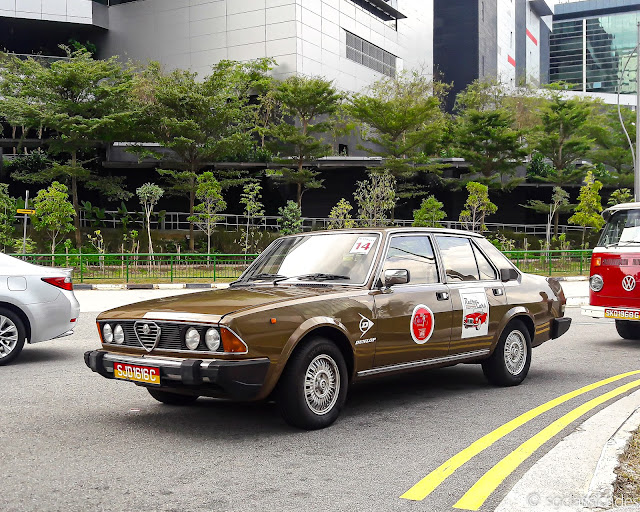
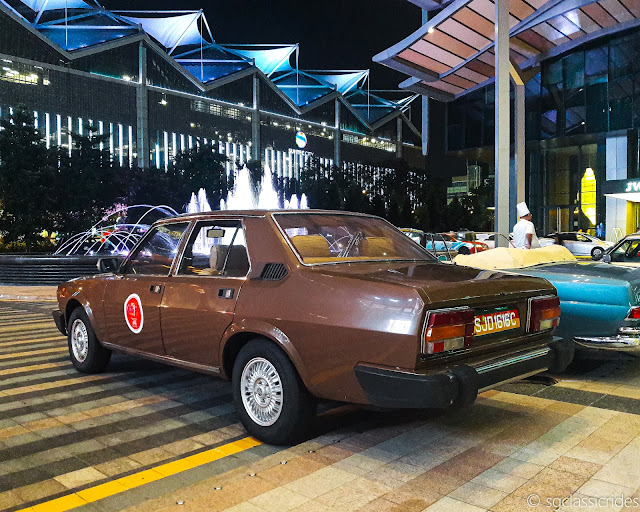
Happy 2022 to all my readers! It is my hope that on the 6th day of this year, life will be able to go back to some sense of normal and that you will be able to fulfill your New Year resolutions! This leads me on to a car which I have have been wanting to write about for a while now (where its name may or may not be coincidental): this 1982 Alfa Romeo Alfa 6!

The Alfa 6, also known as the Alfa Sei (6 in Italian), was conceived back at the end of the 1960s and production was slated to begin in 1973. Alfa Romeo desired to return to the market segment of large 6-cylinder sedans, and wanted to position it as an Italian Rolls Royce so to speak. The new car (with internal code 119) was designed to share parts with the lower-end Alfetta: the overall design with its 4 round headlights and the C-pillar intake were clear indications. Interestingly, the Alfa 6 was designed earlier than the Alfetta, but due to the 1973 fuel crisis the car only debuted in 1979. 

It featured a 2.5 litre V6 engine designed by Giuseppe Busso with 6 single-body carburetors, power steering, central locking and braking circuits from BMW among other equipment. This made the 6 competitively priced compared to similar saloons of its time, where such equipment would have been costly to add on. It also featured new safety features such as a shock sensor in the boot that would cut off the fuel supply during a crash. 

Unfortunately, the 6 was doomed from the start: the rear light clusters were deemed too large, the bumpers too dated and the C-pillar air intake was judged to be inelegant. On top of that, there were many issues such as a non-working speedometer, loose spotlights and badly-mounted door panels. The potent V6 engine with its carburetors (though powerful on paper) was tricky to work on and maintain for the average user. Even when Alfa Romeo tried to promote the robustness of the car body, it was dispelled by a bad accident from actor Gino Bramieri in 1981.

At the end of 1983, the 6 underwent a redesign: the quad round headlights were replaced with squarish ones, bumpers were now fully in plastic, the grille was changed and aerodynamic spoilers were fitted in the bumpers. The carburetored 2.5 litre engine was downsized to 2 litres, while 2.5 litre turbodiesel and fuel-injection variants were introduced. However, the 2-litre engine was noted to have poor fuel consumption and the image of the 6 as a rather pointless car was further reinforced. This unit is powered by a 2492 cc V6 engine mated to a 3-speed automatic transmission, allowing it to reach a top speed of 185 km/h with an acceleration of 11.5 seconds. It was 4679 mm long and weighed 1390 kg, with a fuel consumption of 12.7 litres/100 km.

Production of the Alfa 6 ended in 1986 with just 12,070 units leaving the Arese plant: it was a far cry from Alfa Romeo's target of 30,000 per year. Among them, 5,748 were the pre-facelift version like this unit. It is estimated that only about 400 of them still exist today: while exact figures for RHD units are not known, it is likely that the numbers are even fewer. 6s were sold in Singapore by City Motors Pte Ltd, the former distributor for Alfa Romeo where they retailed for an eye-watering $105,000 back in 1980; one was even owned by the Italian embassy. None of them still exist today: this particular unit was imported a few years ago. 

Getting to know about this ordinary-looking unicorn was a big surprise: I had no idea that this even existed until I saw it and this line of thought appears to be prevalent even among Alfa Romeo enthusiasts. Its poor sales and generally forgettable performance does not evoke any kind of memories. Furthermore, spare parts for the 6s are almost non-existent since Fiat destroyed everything that was related to the 6, Arna and 90 when they took over the plant. The fact that one of them made its way here is a miracle in itself, though it would be interesting to know why this was brought in. Now that you know that this is more than an old car, perhaps you may get to admire this unique survivor some day!


29 January 2021

More than an old car #163: Alfa Romeo 146


I was asked to do a post about 'rare cars' in Singapore and to be honest, I have a hard time struggling to decide what to write about. Through my time, I have seen many of them and my posts have covered quite a few accordingly. But as you may have known, I tend to favour non-exotic cars since people don't pay much attention to them in the first place. This will not be any different with this 2000 Alfa Romeo 146 1.6 TS!

The 146 was first introduced in 1994 at the Bologna Motor Show as a 5-door hatchback, where it was intended to be a replacement for the ageing 33. The development of this project, known as Tipo 930B, took 3 years and was aimed at the more traditional AR clientele compared to the outgoing 33. A 3-door hatchback known as the 145 was sold around the same time as well. 

It was available in a variety of engines ranging from 1.4 litres to 2 litres, and 2 different trim levels. In 1997, the entire range was revised with the arrival of new Twin Spark engines in response to the new Euro 2 engine regulations. External differences were limited to a new design for the alloy rims, while internal changes included new seat fabrics and a better air-con system. A facelift was carried out in 1999, featuring a revised front end with body-coloured bumpers, round fog lamps and narrow protection strips. This unit was powered by a 1598 cc Twin Spark i4 engine, allowing it to reach a top speed of 197 km/h with an acceleration of 10.5 seconds [0-100 km/h]. It was 4235 mm long, weighed 1190 kg and had a fuel consumption of 11.3 litres / 100 km

Production of the 146 ended in 2001, where it was replaced by the Alfa 147. A total of 233,295 units were made, although no detailed breakdown between the engine types and RHD/LHD are available. The 146 was sold here in 1996 by Massa Motors and someone even won one as a lucky draw prize that was organised by Takashimaya. However, reviews have lamented its poor build quality and the 146 is generally seen as less desirable than the 145. 

This unit no longer exists and I would dare say that none remain here anymore. Even in the UK, only an estimated 100 are still on the register. While times may change, I think I was fortunate to be in the right place and time to record its existence. Whatever journeys and ownership it has gone through will remain a mystery, but I hope that this still fits the theme of 'rare cars': seeing a now-extinct car would definitely be more rare I suppose?

12 September 2020

More than an old car #153: Alfa Romeo Alfetta


Alfa Romeo (AR) has remained a prominent brand among the classic cars circle. Naturally, some models are more well-received than others, but today I would like to give a shoutout to this comparably obscure 1976 Alfa Romeo Alfetta Berlina!

The Alfetta was conceived in the face of increased competition from new stylistic trends, and it was recognised that customers would not want the design to deviate too much for their liking. Designed in-house by Centro Stile Alfa Romeo and led by Giuseppe Scarnati, its name was a throwback to AR's sporting glories in the 1951 F1 Grand Prix in a bid to convince customers that the brand was still as strong as ever.

Introduced to the public in 1972, the Alfetta adopted a squarish look but retained the iconic twin round headlights and grille, along with 3 chrome bars flanking it. The rear, however, was quite high: it contributed aerodynamic advantages and large boot space, although it could not be fully exploited as the bodywork could be damaged. The interior was also true to the AR tradition: the driving position aimed to be as comfortable as possible, the instrument panels could be read easily and there was more space given to the front seats by rerouting the gearbox. 

The Alfetta underwent a facelift in 1975, featuring a single pair of headlights. In 1977, new engine ranges were introduced along with the introduction of rectangular headlights that remained until the end of production (with the exception of the Quadrifoglio Oro between 1982-1984). Along the way, changes were made to the bumpers and rubber strips were added as well. This unit was powered by a 1570 cc Twin Cam i4 engine, allowing it to reach a top speed of 175 km/h with an acceleration of 11.5 seconds [0-100 km/h]. It was 4240 mm long, weighed 1040 kg and had a fuel consumption of 11.9 litres/100 km

Production of the Alfetta Berlina ended in 1984 with more than 448,000 made, of which 77,103 were the 1.6 litre version. This was 1 of 2 that exists here, with the other being a recent import from 1978. Interestingly, it had been deregistered for quite some time and was awaiting a new windscreen. Unfortunately, I am aware that it had been scrapped/exported recently as the lay-up period had been exceeded. Alfettas were sold here in 1974 by City Motors Sdn Bhd, with a starting price of S$22,490. As can be seen, the steering wheel has seen better days and it sports rare classic Fondmetal wheels: while it bears a strong resemblance to the iconic BBS rims, I have never seen any other car sporting this particular brand.

Given how uncommon it is, I understand that most people would not have been aware of it, especially this unit that hasn't seen the road for a while now. While this has disappeared forever, please do keep a lookout for the other unit: now at least you would know what you are looking at!


23 March 2020

More than an old car #137: Alfa Romeo 2000 Berlina


It always puts a smile on my face when I come across classics that are driven regularly on the road: the juxtaposition between it and the newer cars is interesting to look at, and I believe your eyes would be drawn to it as well. A fine example would be this 1972 Alfa Romeo 2000 Berlina which I had the pleasure of seeing quite a few times already!

The 105 series 1750 Berlina (sedan) was introduced in 1967 at the Turin Motor Show, in response to the problems that AR faced at that time: increased labour costs and difficulties in continuous technical development made the production of high-class cars uneconomical, and that more consumers were ditching AR cars for other domestic/foreign competitors due to their increased wealth. As such, then-president of AR Giuseppe Luraghi chose the commercial strategy of using the well-tested Giulia chassis to accommodate larger engines, and to make it compatible with the new production lines in its Arese plant.

While the 1750 Berlina was technically supposed to be designated as the '1800' (car manufacturers usually round up the engine displacement for their model names), the '1750' convention was thought to recall the past glories of its successful 6C back in the 1920s, and to accentuate the prestige of the new car. Designed by Marcello Gandini at Bertone, it was based off the original Giulia sedan of 1962 although there were numerous subtle differences. For instance, the Berlina had a sloping nose, flared front wheel arches and a generally plain, boxy look. The windscreen was fairly vertical and wrapped around the side (although subtly). Uniquely, the car body was built all in one piece with the chassis and almost everything was welded together (other than the doors, car boot and bonnet).

Some time in 1971, the engine increased its size to a 1962 cc twin-cam i4 engine, allowing it to reach a top speed of 191 km/h with an acceleration of 8.75 seconds [0-100 km/h]. It was 4390 mm long and weighed 1110 kg, with a fuel consumption of 9 litres/100 km. There was also a facelift done: the quad headlights were now smaller but of equal size and the grille designed was modified. Comfort was also emphasised to make it more attractive for the average buyer: amenities included front head restraints, extensive use of carpets and velvets, a larger instrument panel and even air-conditioning, which was unthinkable for an AR car a few years ago.

Throughout its lifetime, it experienced remarkable success in sales but not as well as expected, due to labour unrests and the 1973 oil crisis that discouraged buying of 'thirsty' cars. Production ended in 1977 with 191,723 units made, of which 89,840 were the 2000 Berlina version. This unit still sports its original registration in 1977 and it should be the only one left with regular plates, although there is another unit that was recently imported from Australia. It was sold in Singapore starting from 1973 by City Motors Sdn Bhd, with a retail price of S$16,810.10 [S$49,588 in today's money]. Although Singapore had already gained independence from Malaysia by then, it was still common to have these Malaysian-registered companies still operating here at that time.
I also found out that the 2000 Berlina could also be won just by entering a contest...imagine winning a car just by sending in the entry form and a Milo coupon! Although I was also equally impressed that the top prize was a Mercedes W115 and the 3rd prize, a highly prized Datsun 1600 SSS.

It is very impressive that such an old car can still be daily driven on the roads, based on my sightings and that of others too. This car must be really treasured in the family for them to constantly renew its COE and extend its lifespan here. Having said that, it still looks well-maintained and the weather-beaten look gives it an added layer of authenticity. I understand it resides around the Bras Basah area and I hope that you can see it too to understand what I mean!

17 June 2019

More than an old car #106: Alfa Romeo 2600 Spider


Once a while, I do come across old cars that turn out to be special in their own way, be it their rarity, their styling or sometimes both. This 1964 Alfa Romeo 2600 Spider ticks all boxes when I chanced upon it unexpectedly!

The 2600 (internal code Tipo 106) was first introduced in 1962, as a replacement for its predecessor, the 2000 (Tipo 102). The main difference was the larger-capacity engine along with minor facelifts to the various body types: sedan (Berlina), convertible (Spider) and coupe (Sprint). For the Spider, it featured a revised grille pattern and a single hood scoop, compared with 2 previously.

However, the 2600 did not sell well in general: it did not stand out from the current crop of Alfa cars and had poorer handling due to the heavier engine. The styling for the Spider was perceived to be more aristocratic, with comparisons made with Ferraris of that time. As such, 2600 Spiders have become more collectible today. It was powered by a 2584 cc straight-6 engine, allowing it to reach a top speed of 200 km/h with an acceleration of 9.8 seconds [0-100 km/h]. It was 4500 mm long and weighed 1280 kg.

Production for the Spider ended in 1965, while the entire 2600 range was ended in 1968. 2,255 Spiders were made, of which only 103 were in RHD! This particular unit has been imported from the UK, still carrying its original registration, and it should be the only one here currently. I do not know whether it has been registered in Singapore as of yet between the 2 years since I saw this, although it is likely that the lucky owner may let it free on our roads due to its rarity. However, finding spare parts and restoration works for this car would be quite tedious, since they were made in small amounts. Perhaps you may see it soon..!

28 May 2018

sgclassicrides turns 1!


Over the past year, this journey of car spotting and blogging has been a refreshing one for me. It felt like only yesterday when I started to create this blog to document the vintage and classic cars in Singapore.
This is a throwback to the very first picture I took of an old car, back in 2011. I didn't even know about this picture until I was looking through my old photos on Facebook! However, I did not do any spotting only until in 2014, and sometimes I regret not car-spotting back in 2011...who knows what other oldies I might have seen? This is quite a pertinent issue for me, as the Alfa Romeo 2000 GTV above for example doesn't seem to exist here anymore sadly...

Ever since I was young, I was somehow fascinated by old cars as I was attracted by their boxy shape. My first exposure was actually from Malaysian cars: back then I tried to look out for non-Singapore plates and I noticed that most Malaysian cars were of the older variety. This sparked a love for classic cars in general, but I was hampered by not having a camera phone at that time. In 2013, I began my journey of spotting, first by chancing upon a Jaguar that had been parked near my school for quite some time. It exploded the next year when I went for my first classic car display [2014 Heritage Day at the Bosch building here]. Gradually, I began to research more about potential places to find them, and this has led me to discover that certain car workshops are the best places to find them. However, quite a fair bit has come from random spots when I am on the road, thus it takes some luck and observation skills too!

Through my years of spotting, I have observed that most people prefer to fawn over luxury cars and supercars, which is perfectly normal. Even I will make concessions to take a picture of a Pagani or a Koenigsegg simply because they are not your typical supercar. However, I started this blog when I realised that not many people were giving much attention to old cars here, where some of them are even older than your parents! Also, with the glut of supercar spotting accounts popping out, I figured it would be easier to focus on this niche area.

Initially, this blog was just a photo dump with only a brief caption of the car. It was only in 2017 when my friend suggested writing more about the car, in such a way that he (as a non-car person) could understand. I proceeded to revamp my blog and elaborated more about the old car in question, and at the same time I started an Instagram account since it is pretty popular with many people today.

I chose "sgclassicrides" as my username as I wasn't keen on including the word 'photography', and it was concise enough. Previously, I had also searched Instagram to see whether there had been anyone from Singapore who had started something similar. I would say I was fortunate to leverage on the first-mover advantage. I was conscious of the audience I wanted to target, which is basically the general public: thus I cut down on technical data and focused more of the car's origins.

I didn't experience instant success as it took time for people to discover my content. The number of followers even fell when I did not post anything during my exam period. After the exams ended, I started discovering classic car spotters from all over the world, and I was happy that there were other people who shared my interests. I also began to "advertise" my website by encouraging people to check out my page, but I did not buy any form of advertising. Neither did I spam my friends to like my page: if someone is interested in old cars in Singapore, he/she would discover my page sooner or later. I did not want to attract people who were uninterested in my content in the first place.

I felt that this blog really took off from last year until now, as I began to be more active in generating content and utilising Instagram to increase awareness. A Facebook page came later as I realised some users would not have Instagram, so I did not want them to miss out. It has been a exciting journey so far as I saw cars that I did not expect to see here eg a Corvette and a Citroen DS! Sometimes, my followers share places where they have found these old cars, which I take note for future visits.

Currently, I also use this platform as a way to increase awareness about Singapore's unique car culture: despite being known as an infamous place to own cars, it is really impressive that there are people who continue to hold on to these oldies! I also joined a local retro car group and the users sometimes post about even cooler cars that existed on our roads before I was born. It is really interesting to hear things from the older generation who have seen more than I do.

I hope to keep this going for as long as possible. The past year has been fantastic, and I hope it will be more amazing for you all in the years to come! Although the appreciation for classic cars has been growing over the years, they would become obsolete in the near future with the advent of self-driving cars. It is quite therapeutic to write about old cars that I have seen, because it is interesting to read up on how the cars came about and disappeared as time went by. I continue doing this in the hope that future generations will have a glimpse of cars in our past, which they would never find again. I am merely doing my part to preserve a piece of history that is less discussed, and I hope you readers will continue to appreciate and spot them on the road!

4 April 2018

More than an old car #62: Alfa Romeo 2000 GTV


Alfa Romeo has been steadily gaining in popularity as it continues to wow people over with its Italian beauty. It is also not as ubiquitous as a Toyota or a Nissan, thereby retaining its somewhat upper-class image. However, this was only possible with the cars that paved the way, such as this 1972 Alfa Romeo 2000 GTV.

The AR 105/115 series coupes were a range of cars made between 1963 to 1977. It was designed by Giorgetto Giugario for Bertone, a car styling/coachwork company. The 2000 GTV [GT Veloce (fast in Italian)] had visually pleasing features: a perfect mix of metal, curves, creases and glass, and the protruding horizontal blocks on the grille forming the distinctive heart outline of AR.

The 2000 GTV was introduced in 1971, which replaced the earlier 1750 series. It is easily distinguished by the aforementioned horizontal grille bars with protruding blocks. The quad round headlights will also narrow down your guesses. I admit I was easily confused by AR's naming of its cars and the fact that there were so many models under the 105 series--the body shape looks so identical! Hopefully, this has helped you to clear your confusion and be a better car spotter!
It was powered by a 1962cc AR Twin Cam i4 engine, allowing it to reach a top speed of 195 km/h, with an acceleration of 8.7 seconds [0-100 km/h]. It was 4100 mm long and weighed 1040 kg.

Production ended in 1976 with 37,459 2000 GTVs made. I believe there are still a few of them in Singapore, though I don't know the exact number. This specimen has not been out on the road since December last year, as its road tax has yet to be renewed. Hopefully it is not scrapped or something--it will be a pity if it doesn't exist here anymore! It just gives off this classy vibe which still fits perfectly today--I hope you will be able to spot one some day!

17 June 2017

More than an old car #22: Alfa Romeo Giulietta


Alfa Romeo cars are instantly recognizable by the triangular-shaped grille with its logo inside it. It is relatively common on our roads--you or your parents may have driven one before. Yet, this 1983 Alfa Romeo Giulietta 1.6 [Tipo 116] is not something you will get to see here often.

Alfa Romeo, an Italian car maker, initially started out surprisingly as a French firm [Società Anonima Italiana Darracq (SAID)] in 1906 which was backed by Italian investors. The company came under the direction of entrepreneur Nicola Romeo in 1915 and was subsequently renamed A.L.F.A Romeo--a combination of the original name "Anonima Lombarda Fabbrica Automobili" and the last name of Nicola Romeo. It is now owned by the conglomerate Fiat Chrysler Automobiles since 2007. 

The Alfa Romeo Giulietta was launched in 1977 and production ended in 1985, with around 380,000 made. The 'Tipo 116' [Type 116] refers to this particular generation as there was a previous model which was called the Giulietta also. This specimen was equipped with a 1570cc Alfa Romeo Twin Cam 4-cylinder engine, allowing it to reach a top speed of 175km/h with an acceleration of 11.3 seconds [0-100km/h]. It was 4.21m long and weighed 1070kg. It may look similar to many cars in the 1980s, but a defining difference was the short car boot length and a small aerodynamic spoiler that was merged in the car body. 

Only 2 currently exist here as far as I know and it seems the owner has preserved it ever since it was bought here, due to the period-correct number plate. These older cars do have a higher chance of breaking down and having this specimen survive until today is an achievement. You can consider it your lucky day if you see this in person!