Showing posts with label suzuki. Show all posts

22 April 2022

More than an old car #190: Suzuki Wagon R+

The 90s was a game-changing period for Japanese cars: the variety of vehicles churned out continues to fascinate the world even till today. Amidst it all, there were many others that flew under the radar such as this 1998 Suzuki Wagon R+!

First introduced in 1993, the Wagon R was revolutionary in the mini vehicle market. Until then, most of them were either short or uncomfortable (as they were based off commercial vehicle models). The Wagon R featured raised seats, which reduced the feeling of oppression without the need to bend one's legs, and a single step was also incorporated which made entry and exit smooth. It also shared parts with many other Suzuki vehicles in the name of cost control, which was partially inspired by Volkswagen. Its name is a wordplay on 'wagons also are', since there are sedans but there are also wagons. The R also stood for 'revolutionary' and 'recreation', which made reference to the reason why the car was designed in the first place.

Initially, the Wagon R was only available in '1+2 door' format (i.e. without the rear right door) and came without headrests. The regular 5-door version was introduced in 1996 and a facelift was applied to the front end in 1997. It was also around this time that a wider and longer version known as the Wagon R+ / Wagon R Wide was introduced. Initially, it had four horizontal slats for the front end, before it was facelifted in 1998 to resemble that of the regular Wagon R. No longer a kei car, the Wagon R+ was powered by a 996 cc K10A i4 engine, allowing it to reach a top speed of 140 km/h. It was 3410 mm long and weighed 845 kg, with a fuel consumption of 7.6 litres / 100 km

Production of the 1st-generation Wagon R+ ended in 1999, where it was succeeded by the next-generation model (also known as the Solio). The R+ was sold here in 1998, and it was around this time that the COEs for small cars was in short supply. There are about 3 units that still remain; this particular one was scrapped shortly after I saw it. Though it may look inconspicuous at first glance, there is something about its ordinariness that has always caught my eye. Its van-like shape belies its age and makes the realisation all the more better. Perhaps you will be able to catch the remaining ones on the road someday!

17 October 2020

More than an old car #156: Suzuki Baleno


As mentioned previously, I have always focused on both exotic and non-exotic classic cars, for both play an important role in forming the history as you know it. It thus gives me great pleasure to introduce this rather nondescript 1998 Suzuki Baleno, which you might not have noticed back then...

The Baleno (Italian for 'flash'), also known as the Cultus Crescent in Japan, was first introduced in 1995 as a successor for the popular supermini Cultus/Swift. It marked Suzuki's first foray into the competitive compact car market and was marketed as a distinct model, although it shared many internal components with its smaller sibling. Initially available as a 3-door hatchback and a 4-door sedan, a wagon version (a first for Suzuki) was introduced in 1996.

A facelift was carried out in 1998 for Japan cars, featuring a rounder grille and larger headlights, along with a renaming to Cultus. At the same time, a larger 1.8 litre engine was also introduced to the range. The Baleno was powered by a 1298 cc G13BB i4 engine, allowing it to reach a top speed of 160 km/h with an acceleration of 12.5 seconds [0-100 km/h]. It was 4195 mm long and weighed 890 kg, with a fuel consumption of 6.6 litres/100 km. Interestingly, while the 1.3 litre engine was supposedly exclusive to the 3-door hatchback, the sedans sold in Singapore had them too.

Production of the Baleno ended in 2002 for the Japanese market with a total of 122,978 units sold, although it was made as late as 2007 in India. The hatchback was phased out in 2000, followed by the sedan in 2001 and the wagons in 2002. It was succeeded by the Aerio/Liana, and also the Chevrolet Optra which was imported and sold by Suzuki. It was sold in Singapore from 1998 by Champion Motors, which still remains as our Suzuki dealer and was retailing at S$86,950 for the sedan and S$96,950 for the wagon.

I understand that there is a blue pre-facelift wagon still around and it is most likely the last one standing. This sedan is long gone unfortunately, but it is still impressive that the owner had kept it for so long. This is an example of a classic that would have flown under the radar for many of you, and even I was quite lucky to snap a shot while it was at a red light. Though I never saw it again, I feel that it is good enough that this picture even exists, and I hope that this has been informative for you!


13 May 2019

More than an old car #101: Suzuki Swift (Cultus)

It is common knowledge that Singapore is not a friendly place for cars, and this has led to the demise of many old family cars. Comparing pictures of street scenes in the 1990s and today, you will be hard-pressed to find any regular old cars that have persisted for so long, such as this 1991 Suzuki Swift (Cultus) here!

The Suzuki Cultus (badged as the Suzuki Swift in Singapore) was first introduced in 1983 as a replacement to the Fronte 800, which helped Suzuki to establish itself in the Japanese compact car market. The 2nd generation of the Cultus appeared in 1988, continuing the company's plan for an inexpensive 'global car'. Hatchback and sedan styles were available, along with engine capacities between 1 litre to 1.3 litre. Its global nature was proved by its success in the US as the Geo Metro, and in India as the Maruti 1000. This unit was powered by a 993 cc G10 i3 engine, weighed 820 kg and was 4095 mm long.

Production of the Suzuki Cultus ended in 2003, where it was replaced by a revamped model known as the Cultus Crescent. This unit is a facelifted model due to the grille gap, and remarkably there are still a handful that have survived till today, even though this one in question has been scrapped. It looks to have been well-maintained given that the stock wheels had been changed to a sportier type. The Swift was relatively affordable at that time and quite a number of people had this as their family/first car, due to its cheap maintenance expenditure.
I feel it is unfortunate that many people will forget that this existed here, so hopefully years from now people can have a walk down memory lane. Do keep a lookout for the remaining ones here!

6 June 2017

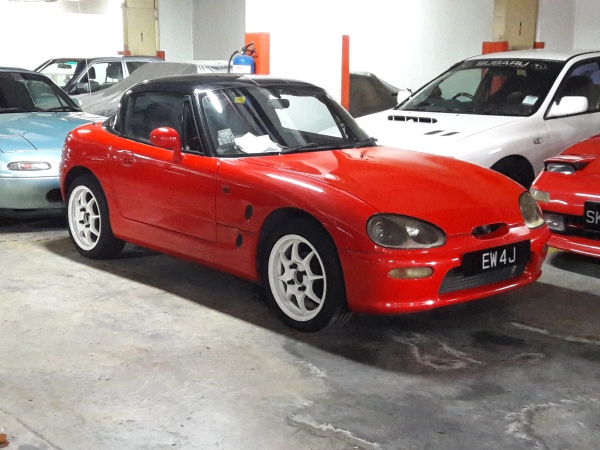
More than an old car #12: Suzuki Cappuccino

20160510_155926

Say the name 'cappuccino' and you will immediately think of Starbucks or basically any up-market cafe. However, this Suzuki Cappuccino SX306 is not a drink by Suzuki Coffee Company, but rather a cute little car that is an absolute head-turner.

The idea for the Cappuccino came about in 1987, when Suzuki wanted to create a sporting image. It was initially released for the Japanese market only in 1991 as it fulfilled the 'kei car' requirement: length less than 3.3m and width less than 1.4m. The SX306 refers to its designation number. It was only later on that Suzuki decided to export it to Europe and also Hong Kong, and production ended in 1997.

The Cappuccino was powered by an I3 engine [engine with 3 cylinders], allowing it to reach a top speed of 150 km/h, with an acceleration of 9 seconds [0-100km/h]. It was only 3.29 m long and weighed 679 kg, and it had either a 5-speed manual transmission or a 3-speed automatic transmission. The hard-top roof could be removed, thus it could either be a normal coupe or a convertible.

The Cappuccino proved to be a modern classic as it attracted the attention of many enthusiasts. It also featured in the manga 'Initial D' along with the eponymous anime. Only 28,010 were made and if I am not wrong, there are only 2/3 present in Singapore. You would have better luck looking for a Ferrari compared to this, but hopefully you will get to see one!