Showing posts with label miscellaneous classics. Show all posts

13 June 2026

Miscellaneous classics #14: Hyundai Porter H100


Many people may not make a second glance at the numerous lorries/trucks on our roads, except when they are going too slow for our liking. However, as my aim is to try and document old vehicles in Singapore, I felt it was appropriate to spotlight this humble 2000 Hyundai Porter H100 that is no longer around...
 
The Hyundai Porter (also known as the H-100) was first released in 1977 as a truck or minibus. The second-generation model was a rebadged Mistubishi Delica, after the restriction on South Korea's automobile industry was lifted. Round headlights were installed on the third generation and the steering wheel was similar to the Sonata during that time. 
 
For the fourth generation, it was called the New Porter and a facelift was given. The cab was changed to be the same as the Hyundai Grace van and Anti-Lock Brake System were applied. Side decals and automatic transmission were made available in 1999. A few engines were offered, with this unit being powered by a 2476cc D4BF i4 engine. It was 4750 mm long and had a net weight of 1580kg, with a maximum weight of 2850kg.
 
Production of the fourth-generation Porter ended in 2004, though you may be able to see the similar-shaped Inokom Lorimas which was licenced-built in Malaysia from 2000. While the fourth and fifth-generation Porters were sold in Singapore, none are known to be left as they have passed the 20-year statutory lifespan; you would probably have better luck seeing them in Korea or developing countries. Even though people may not care too much about trucks, this picture will serve as a memory to the time these workhorses plied our roads!

30 December 2025

Miscellaneous classics #13: Condiesel LARC 'Ducktours'


While it has been said that there is not much to do in Singapore, I always see throngs of tourists at our attractions. One may also have noticed the bus tours run by Big Bus Singapore, where open-top buses bring tourists to various attractions. You may have noticed the huge boat-shaped vehicles with a duck face at the front: one moment cruising through city streets, the next splashing into the water. The Ducktours have become so ubiquitous of our tourism landscape over the years, and after much research, I was able to understand more about the history of the 1973 Condiesel LARC-V

Developed by the US Army Transportation Research Command in the late 1950s, the 'Lighter, Amphibious Resupply, Cargo, 5-ton' or LARC-V was first produced in 1963 by Le Tourneau-Westinghouse and later Consolidated Diesel Electric Corporation. There were also 2 other types of LARCs, namely the XV and LX; for brevity further mentions of 'LARC' refer to the V version. 

LARCs were initially intended for use in rivers and protected waters in support of amphibious operations, which later evolved to surf zone salvage and survey diving operations. They were made from aluminum alloy, for enhanced corrosion resistance and lightweight buoyancy. Based on publicly available US Army manuals, they were also capable of traversing sand and coral beaches, go off-roading and operate in both arctic and tropic climates. Interestingly, LARCs were not developed as a dive platform, thus it was unable to provide optimal dive support.

LARCs were extensively used during the Vietnam War, as support for logistics and manpower build-up. This involved the shuttling of ammunition, fuel and general supplies. Its amphibious nature allowed the US Army to reduce the dependence on compromised harbours. As the US withdrew from Vietnam, many units were destroyed to prevent the North Vietnamese forces from using them. Post-Vietnam war, LARCs were also deployed elsewhere such as Argentina during the Falklands War, though they are not used as much within the US.

LARCs were powered by a 903 cubic inch (14,798 cc) Cummins V-903C V8 engine, producing 295 horsepower. It could reach a top speed of 30 mph (48 km/h) on land, and 9.5 knots (17.6 km/h) in water. It was 35 ft (10,668 cm) long and 10 ft 2 in (310 cm) tall, with a maximum gross weight of 30,000 pounds (13,607 kg).

About 968 LARCs were made, though it is estimated that less than half still exist. Today, LARCs are still used by Australia (for Antarctic resupply operations and soldier training exercises), the Philippine navy, Portugal and Singapore. Approximately 100 are privately owned and used for tourism such as our Ducktours, though it is believed that the Singapore Army still has a small fleet of LARCs. 

The LARCs that are currently used by Ducktours were made between 1973 to 1977, for use by our army. 7 units were withdrawn between 2000 to 2002 and subsequently converted by VMD Pte Ltd, the first two units entered service in June 2002. It appears that the engine was also changed along with the installation of chairs and canopy: engine capacity was noted to be 9500 cc, with an unladen weight of 10,960 kg and maximum laden weight of 13,140 kg. Only 5 Ducktours LARCs remain as of writing, and all will be deregistered in late 2026. 

I had the opportunity to ride one of the LARCs recently, especially when I knew that they would be deregistered soon. LARC 'Katrina' as indicated was the conveyance for the day; two others were named 'Darlene' and 'Orlene' while the last two had no names. It was surreal to finally ride on this unique classic; incidentally we were allocated to sit right behind the driver. Naturally, the LARC did not have power steering so I was able to see the driver wrestle with the steering wheel when making turns. 

Our tour guide for the day was engaging and the route brought us to the iconic Singapore landmarks. I was mildly surprised to know that there were quite a few locals on board as the ticket was S$53 per person (on weekends). Everyone whipped out their phones to record the moment when the LARC drove into the water and I got slightly wet. We were able to view Gardens by the Bay, the Singapore Flyer, the Merlion and Marina Bay Sands all from the water which was pretty neat. The ride was about 1 hour long and we were sorry to disembark, though we were also starting to get hungry.

The LARC-V plays a special role in our automotive history, especially when it continues to entertain guests despite its rather dated looks. Amphibious vehicles are few and far between, and the Ducktours LARC would be the only way to experience it currently in the civilian setting. It is unfortunate that the LARCs will be replaced, apparently by an electric version from Seahorse Amphibious Vehicles. Hopefully, you will have a chance to take a ride on it soon and feel the unspoken stories of its history!


24 August 2025

Miscellaneous classics #12: Iveco Eurotrakker

As a connoisseur of old vehicles, I am always on the lookout for them and coming across this 1996 Iveco Eurotrakker MP380 was entirely accidental, yet intriguing! I had no idea that we still had it here (although registered as a concrete pump), especially since Iveco is not exactly prominent in Asia at least.

Iveco was incorporated on 1 Jan 1975, with the merger of five different brands: FIAT Veicoli Industriali (with headquarters in Turin), OM (Brescia, Italy), Lancia Veicoli Speciali (Italy), Unic (France), and Magirus-Deutz (Germany). It is an acronym for Industrial Vehicles Corporation. Numerous vehicles were sold under the Iveco brand with almost 600 versions in 1979. In 1986, Iveco entered into a joint venture with Ford of Europe's truck division and also purchased 60% control of Spanish industrial company ENASA in 1990, which owned the industrial vehicle builder Pegaso. Iveco trucks continue to be made today; although it maintains a presence in Singapore, it does not have much brand recognition here.

First introduced in 1993, the Eurotrakker was the successor to the Iveco 330 model. It was well-suited for off-road conditions where standard road trucks would struggle, such as in construction sites, quarries, and heavy transport applications where reliability was paramount. As it was designed for worldwide sales, the Eurotrakker was made in both LHD and RHD configurations. Stylistically, the front grille recalled the family look of the Iveco range of the time and was similar to the Eurotech road model from which it inherited the cabin and some mechanical components. 

It had a facelift in 2000 and an automatic transmission was introduced in 2001. This unit was powered by a 13,798 cc Fiat 8210 inline-6 engine, making 380 horsepower. It weighed 28,120 kg unladen with a maximum laden weight of 38,000 kg.

Production of the Eurotrakker ended in 2004 where it was replaced by the ongoing Trakker model. Interestingly, this unit has been registered under the restricted usage scheme as a concrete pump, although it would not have made much of a difference if it had not been registered; it has to be towed at all times when traveling on the roads. On the other hand, there is no lifespan restriction unlike regular commercial vehicles and it is exempted from road tax as well. I am aware of another unregistered Eurotrakker but I am not sure what happened to it currently.

Based on old newspaper records, Zenith Engineering Pte Ltd was the distributor of Iveco products in 1981, although it is unclear how this unit was brought in. Champion Motors Pte Ltd was also noted to be the distributor of the Iveco Daily range of vans, though old advertisements did not make reference to Iveco trucks being sold on the second-hand market. Regardless of the lack of information for old Iveco trucks, seeing this unusual relic is always a treat and I hope you may catch a glimpse of it some day!


12 May 2025

Miscellaneous classics #11: Hino Ranger FC


It has been a while since I had written about old trucks on this blog, as naturally there were so many more cars to cover. However, I had always wanted to write about this 2001 Hino Ranger FC, which I saw entirely by chance - since the majority of trucks have a lifespan of 20 years, seeing one that was older than the lifespan is always a treat!

Hino Heavy Industry Co. Ltd was spun out as an independent company in 1942, where it made various armoured carriers during the war. The 'Heavy' name was dropped and the company took its name from the location of its headquarters in Hino city (within Tokyo prefecture). Hino made both trucks and cars, but car manufacturing ended in 1969 when it amalgamated with Toyota. Establishing itself as a manufacturer of heavy vehicles, Hino entered into various partnership agreements in various countries over the years. Today, Hino trucks continue to be prevalent in Singapore and to a lesser extent, buses.

The fourth-gen Hino Ranger appeared in 1989, where it was known as the Cruising Ranger. A facelift occurred in 1994 known as the Rising Ranger, where headlights became more rounded and grille design was changed. A final facelift happened in 1999, where it was now known as the Space Ranger. Rangers came in various sizes, denoted by different alphabets; for light medium trucks, they were designated as FC, FD, FE and GD. This unit is a Rising Ranger FC (despite being manufactured in 2001), and was powered by a 5307 cc J05C i4 diesel engine. It weighed 6440 kg and had a maximum laden weight of 10100 kg.

This particular unit is currently owned by the Singapore Civil Defence Force, where it saw service as a Large Monitor Vehicle (LMV): it is equipped with a water cannon at the back. It was put into action during a large fire at an oil refinery in Pulau Bukom in 2011 and still sports the older SCDF vehicle livery. Currently, it is off the road: as a fire-fighting vehicle, it is apparently exempt from being scrapped after 20 years even though the current LMV is a newer Isuzu Forward truck.

https://blogger.googleusercontent.com/img/b/R29vZ2xl/AVvXsEgTatCjBdNUHxVp0EeuKcLLgQOuKkzB0bo5l_gSYj4zqQhySz5wTzl_BCRfMPDyxRbxlJdObhrOxPJ3TJsDXrruKaJOQ8SUCJlXE6RWNLgnD7uxdcKOGgfCrzz9Q04gJjgcfCXo3E8tHmw/s1600/image_20111002msM5R6vYI9Db.jpg

Production of the fourth-gen Ranger FC ended in 2001, although export models and special use versions continued to be manufactured until 2004 at least. Similar Rangers of this generation also existed in Singapore, though all were gone after 20 years. It is amazing that this humble Hino Ranger has seen service through fierce fires and that SCDF has continued to preserve it till today. I am not sure when it will be coming out again, but hopefully this has been informative in the existence of this life-saving truck!

18 March 2023

Miscellaneous classics #10: Scania 3-Series P113


I realised that it has been a very long time since I wrote about a commercial vehicle. While I am aware that it may not be very 'sexy' or good-looking, this 1995 Scania 3-Series has been on my spotting bucket list for a long while! I always have a weakness for boxy/squarish vehicles, and it was a goal of mine to see one of these Scanias so that I could write about it. Being able to come across this unique registered truck (and one which I could run my checks) was entirely coincidental on that day: the truck was no longer there when I passed by the area again 1 week later.. 

AB Scania-Vabis was formed in 1911 as the result of a merger between Södertälje-based Vabis and Malmö-based Maskinfabriks-aktiebolaget Scania. Vagnfabriks Aktiebolaget i Södertelge (Vabis) was established as a railway car manufacturer in 1891, while Maskinfabriks-aktiebolaget Scania was established as a bicycle manufacturer in 1900. Vabis was running into financial difficulties unlike Scania, and the senior management of Scania made the offer for a merger. Development and production of engines and light vehicles were set to Södertälje, while trucks were manufactured in Malmö. The company's logo was redesigned from Maskinfabriks-aktiebolaget Scania's original logo with the head of a griffin, the coat of arms of the Swedish region Scania (Skåne), centered on a three-spoke bicycle chainset. Initially the headquarters were located in Malmö, but in 1912 they were moved to Södertälje.

Scania-Vabis had produced cars up till 1919, where it focused completely on trucks and buses, including bus chassis. After WWII, Scania-Vabis expanded its dealer network and country-wide specialist workshop facilities, enabling it to maintain a huge market share. It also turned towards the export market and by 1960, exports were 50% of output. Subsidiaries continued to be established in places such as Brazil and the Netherlands, and in 1968 the company was rebranded as just Scania. Scania is currently wholly owned by the VW Group ever since VW acquired a stake in 2000. 

The Scania 3-Series was introduced in 1987, succeeding the 2-Series and was available in a variety of engines and body types. The most notable changes were a redesigned bumper and front fascia incorporating a lower-drag grille design. This P113 was powered by a 11,021 cc DS11 inline-6 engine, with a power output of 320 hp. The concrete pump is noted to be from Schwing GmbH, and was apparently made in 1996; both components must have been fitted together to be registered in time on Nov 1996. Its maximum weight including the concrete pump topped the scales at 32,000 kg

Production of the 3-Series ended in 1998, where it was replaced by the 4-Series. While there are plenty of Scania trucks and buses here, older vehicles tend not to be kept for long under our rules. This particular unit continues to survive because it is registered as a 'restricted usage' vehicle, identified by the green-red plate. It cannot be driven on public roads at all times, so these have to be towed from place to place. I also understand that one cannot just register any car under this scheme in order to exempt it from scrapping: the ones I have come across so far are usually related to construction or special usage. Although it may not be as eye-catching as a typical classic car on the road, I hope that this has given an insight on this special truck...maybe you could be lucky to spot it some day!

6 May 2022

Miscellaneous classics #9: Daihatsu Delta

It has been a while since I wrote about non-car vehicles. Being enamoured with all things angular/squarish, I had always wanted to write about this 1985 Daihatsu Delta V78 ever since I saw it!

The Daihatsu Delta was a rebodied version of the U10 Toyota Dyna and was first introduced in 1970. Daihatsu had previously entered into a business alliance with Toyota Motor Corporation in 1967 and naturally, the Delta shared many parts with its brother car Dyna. The 3rd generation Delta appeared in 1984: it differed from the Y50 Dynas by its 4 rectangular headlights compared to round headlights, although the Dynas received quad rectangular headlights in 1989. Interestingly, there was also a van version of the Delta: it was essentially a truck chassis fused with a typical van.

Various versions with different cab sizes and functions were released. This unit, known as the V78 Delta was powered by a 3431 cc Toyota 3B i4 engine. It had dimensions of 4695 x 1695 x 1995 mm with a weight of 2360 kg.

Production of the 3rd-generation Delta ended in 1995, though it was continued to be made exclusively for export markets with a facelift to the grille. It was only in 2010 that production stopped entirely. A small handful of Deltas still remain here, with some still seeing usage as tow trucks. This particular unit has an interesting history: it was previously owned by a Hindu temple services company specifically to tow a silver chariot during certain Hindu festivals. Despite sporting an early 90s number plate, it is noted that the original registration was in 1986: it is likely that it could have towed cars before being converted.

While old trucks do not get the same amount of love and affection from many others, I have tried to bring a spotlight on them all this while. I hope that next time, you might be able to recognise them for their role in our motoring heritage!


30 October 2021

Miscellaneous classics #8: Mercedes Atego


I guess it's one of those moments where I have to clear my backlog, and that this has been sitting in the archives for a long while. Being caught up with work also means that I have less time to work on the blog, so it would have to be something that does not take up much resources in planning on what to write. Speaking of this, I naturally thought on writing about the few commercial vehicles that I have seen, and I was reminded of this 2001 Mercedes Atego 1517/5360 that I saw some time ago!

The Atego (internal code W970) was introduced in 1998 as the successor to the LK series. It was made available in different cab sizes, from S to L high-roof version, along with different wheelbases between 3020 mm and 6260 mm. Different tonnages were available and designated in the following format: 7xx for 6.5 tonnes, 8xx for 8 tonnes and so on. The 'X's following the designation is the engine horsepower but given as a tenth. Thus, this particular unit thus has a tonnage of 11.99 tonnes based on its 15xx designation with a horsepower of about 170 hp, and its wheelbase was 5360 mm long.

In 2000, a heavy version of the Atego chassis was brought to the market, with designations 1533 and 1833. A year later, the Axor truck replaced the heavy Atego chassis and became a standalone model. The Atego, which remains in production today, went through a facelift in 2004 with wider indicators and a revised front end to be more aligned with the Actros. This Atego was powered by a 4249 cc OM904 94 engine, with a maximum power of 174 hp. It was 6900 mm long and had an unladen weight of 6080 kg, with a gross weight of 11990 kg.

Production of the first-generation Atego ended in 2004 with about 170,000 made, where it was followed by the second generation. It is likely that there are no first-gen Ategos left in Singapore, although a handful of second-generation units still see service under the fire brigade. This particular unit was owned by an art logistics company, which makes sense for it to be so huge. It was fortuitous running into this truck as I only took the picture since its number plate was relatively old. I was therefore pleasantly surprised to find out that it was already a classic this year. However, that also meant that its lifespan was up and sure enough, it had been scrapped.

To be honest, I was not expecting anyone to even know that this actually existed here, such is the general perception of heavy-duty vehicles. As always, I will continue to give these workhorses their much-deserved spotlight just because I would like to. Now that you have heard of this, I hope that you may be able to recognise it in the future..


9 July 2021

Miscellaneous classics #7: Mitsubishi Fuso Fighter


It has been a while since I wrote about commercial vehicles, and these days I have been paying attention to them more. There are a few gems that I have found which naturally most people would be hard-pressed to notice. I don't mean this in a negative way, just that these are vehicles that would be rarer than the exotic cars on the street. Since they are out there 'for the picking' and usually ignored, why not learn more about them? It was by accident that I discovered this 1990 Mitsubishi Fuso Fighter FM557F in a random corner, and it took quite a while to get more details due to the lack of identification marks...

The Fuso Fighter appeared in 1984, as the successor to the aging FK series of medium-sized trucks. Positioned between the small Canter and the large The Great, it adopted the same headlights, doors and rear panels of its bigger sibling. Some export markets featured 4 round headlights, although units in Singapore were fitted with square headlamps. In 1987, a panel moulding was attached to the top of the radiator grille, although it is noted that this feature was not necessarily applied to all units. Depending on the market, there were even variations in the logos: some units featured the word "Mitsubishi" on the grille, while other units had "Fuso". Japanese-market units had the words on the panel moulding mentioned previously, so the only way to get the actual age was to check the vehicle registry...

Compared to cars, there were a lot more truck body variations, each with its unique chassis identification. This unit is recorded as a FM557F, which could be deduced to represent a short wheelbase, and I believe the B10M label is not original. The Fighter was powered by a hefty 7545 cc Mitsubishi 6D16 inline-6 diesel engine, but as with all commercial vehicles here, its speed was capped to 60 km/h. It was 6,635 mm long and weighed 6,150 kg due to the towing apparatus, but its overall towing capacity could reach 16,000 kg

Production of the 1st-generation Fighter continued until 1992, where it was replaced by the 2nd generation which is still in production today. A cursory look at the heavy vehicles plying the roads here would reveal a majority of Fuso Fighters: dump trucks, cement mixers and others. However, almost all of the 1st generation Fighters have disappeared here mainly due to age, emission controls and relative lack of comfort. This could very well be one of the last survivors, as I am only aware of just 1 other old Fighter that is under restricted use in construction! Even this unit is not often seen on the road...

Older tow trucks technically do not have a lifespan limit based on the registry: they are only hindered by the owner's willingness to extend its COE, or its right to be on the road. While it is natural that people tend to use these heavy vehicles for hard work and have less sentimental value towards them, I think it is still remarkable that this unit continues to defy the odds and continue to serve its purpose. It may still be second nature to brush off these old clunkers since they do not look glamorous, but just take a minute to appreciate this relic if you do see it!

26 September 2020

Miscellaneous classics #6: Volvo FL 10

Spotting old cars has become something like second nature to me, and I am sure there are others out there who also possess this keen eye to detail for cars in general. However, to date, I have never seen any peer that has remotely featured the 'uncool, loud and dirty' workhorses. It has been a long while since I wrote about atypical classic vehicles, and I figured why not be a trendsetter yet again and introduce this unlikely behemoth of a 1998 Volvo FL 10 tow truck/wrecker

The FL series is Volvo's smallest truck and is thus suitable for construction work, local and regional distribution and garbage collection. It was introduced in 1985 in response to decreasing global competitiveness in the heavy truck market. Its name stands for 'Forward Control Low-Level Cab' and was available in various drivetrain configurations. This unit is a six-by-four (6x4), meaning that it has a drivetrain of 3 axles (6 wheels) delivering power to 2 wheel ends on 2 axles (4 wheels).

As expected from Volvo, the FL trucks featured top-notch safety systems, such as a Z-Cam wheel brake. Furthermore, the spacious cab length of 250 cm and an advanced cab suspension provided much comfort for the driver. The FL 10 was powered by a humongous 9603 cc D10 inline-6 diesel engine, allowing it to reach average speed of 79 km/h, with an acceleration of an eternally-long 68 seconds [0-60 mph]. However, as with commercial vehicles here, its speed limit is restricted to 60 km/h. It weighed 10900 kg, with a maximum laden weight of 24000 kg and had a fuel consumption of 37 litres/100 km. Judging from its size, I would presume it to be around 7 m long.

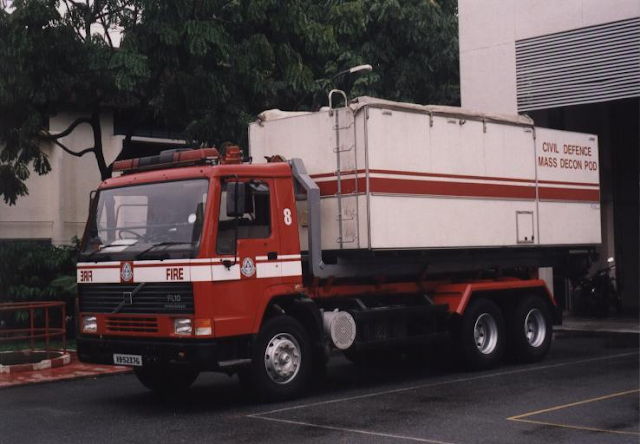
Production of the FL 10 ended in 1998, making this unit possibly one of the last of its kind before it was succeeded by the FM series. However, FL trucks still remain in production though with smaller engines. This particular unit, owned by Yishun Towing, was registered on March 1999 and it will no longer exist after 2022 when its COE expires. It has seen regular action towing all kinds of vehicles, such as this picture below. I was drawn to it by its squarish angles and it looked quite run-down, and was therefore gratified to see that it was indeed as old as it looked.

I would believe that this is the last one remaining here, unless I hear of other units still around. FL 10s were mainly used by our fire brigade (shown below) and as prime mover trucks. Information on heavy vehicles are generally harder to find, so apologies for not being able to write as much as I wanted. Interestingly, there was a Volvo Trucks plant in Malaysia and this unit could very well have come from there also. 

This is indeed a very left-field subject matter as I am sure no one would give a second look to trucks in general. While I am the first to actually write about this unique piece of history, I hope this has been informative in some way: I don't really expect people to go gaga over them but at least I have done my part in documenting its existence. If you are lucky, try to catch it on the move before it is gone forever!


22 June 2020

Miscellanous classics #5: Bugatti Type 38A


When I was in Seoul recently, I made it a point to visit any place that had cool cars, be it classic or modern. Previously, I was aware that South Korea had a very bland car scene, both in terms of colour and variety. Although this statement remains true to a large extent, it was nevertheless fascinating to see Korean cars that never made it to Singapore, nor even around the world. I was also fortunate to drop by the Samsung Transportation Museum at Yongin (near Everland theme park) and the collection there was a sight to behold, notwithstanding that it was the 1st car museum I ever went to. Along the way, I will feature some of the cars that I have seen in this museum. Let me start off with this exquisite 1927 Bugatti Type 38A!

Automobiles Ettore Bugatti was first established in 1909 by its eponymous founder, in the then-German city of Molsheim (located in the Alsace region of France). Mr Bugatti was born into an artistic family and demonstrated an instinctive understanding of motor vehicle construction. Even before the company was founded, Bugatti had already developed around 10 cars while working under the influential de Dietrich family. During World War 1, the company designed aircraft engines but it was never put to use. It experienced much success for developing some of the fastest, most luxurious and technologically advanced road cars back in the day, such as winning the first-ever Monaco Grand Prix in 1929.

In 1939, Ettore Bugatti's son Jean Bugatti died while testing a Type 57 tank-bodied race car near the Molsheim factory, and this marked a turning point in the company's fortunes. After World War 2, the factory was in ruins and Ettore passed away in 1947. The Bugatti company fell into decline and ceased all operations in 1952. Subsequent attempts were made to revive the brand but they failed. In 1987, Italian entrepreneur Romano Artoli acquired the brand and established Bugatti Automobili S.p.A: during this time it became famous for its EB110 sports car but due to the recessions in the late 90s, its operations stopped again. The Volkswagen group then acquired the Bugatti brand in 1998 and currently, it is well-known for its Veyron and Chiron hypercars, of which we have some right here in Singapore...

The Type 38, introduced in 1926, was the successor of the Type 30. Its wheelbase was extended by 27 cm and it had larger brake drums on all 4 wheels. It was available in either a 4-seater convertible or a 2-seater coupe version. As with cars of that era, the body was supplied by coach-builders: in this case it was the French coach-builder Lavocat et Marsaud. The convertible has a fixed roof made of interlaced wooden slats, giving the illusion of a soft top. Some cars like this unit had split windscreens which helped to ventilate the cabin, while the dashboard featured the characteristic 4-spoke steering wheel. All units were powered by a 1991 cc inline-8 engine, but a few had a supercharger fitted on it and were known as the Type 38A. It was 4320 mm long and weighed in rather substantially at 1200 kg.

Production of the Type 38 ended quickly in 1927, where it was replaced by the Type 43. Out of the 385 units made, only 39 were the Type 38A, making this car a remarkable rarity. Old Bugatti cars are often forgotten as they are overshadowed by their admittedly more impressive modern brothers. They are also more removed from what people are familiar with, as Bugatti never made a relatively 'mainstream' car. This unit still sports its French registration number plate from Paris (albeit a relatively newer one), although I am aware that it has been here for many years now.

Bugattis were never sold in Singapore to the best of my knowledge, so it was a treat to see this machine in Seoul of all places. I believe there are also no unregistered units here, but who knows? While it may be harder to appreciate these pre-war vehicles, especially when this is not in Singapore, I will still make it a point to try to educate all of you about what I have seen. Hopefully, this has been an eye-opening piece for you about this special Bugatti!


14 May 2020

Miscellaneous classics #5: Daihatsu Hijet S91


It has been a while since I covered our humble work vehicles, so I decided to bring the spotlight on this forgotten workhorse: a 1999 Daihatsu Hijet S91!

The S90/S100 Hijet succeeded the S80 model when it was unveiled to the public at the Tokyo Motor Show in 1993. Its wheelbase had been extended by 100 mm, and was praised for its large indoor volume and quietness at high speeds. Interestingly, Daihatsu also entered the Indonesian market, where all its vehicles were sold by PT Astra Daihatsu Motor. This particular unit is more accurately known as the Daihatsu Zebra Espass, which was a 'Completely Built Up' model: JDM cars never had these rounded headlights.
They were available in both truck and van models, although I do not know why these Indonesian-market vehicles were imported in the first place. It was powered by a 1295 cc HC-C i4 engine, but as with commercial vehicles here, its top speed was limited to 70 km/h. It was 3395 mm long, had an unladen weight of 830 kg and a laden weight of almost twice is mass at 1655 kg.

Production of the S90 Hijet ended on 2007, although its successor, the S200 was introduced back in 1999. They were sold by Sin Tien Seng, our local Daihatsu dealer between 1997 to 2000. Uncommon to begin with, none are known to exist today in Singapore, although one can still see a handful of its Malaysian equivalent known as the Perodua Rusa.

Back then, I had always wondered what this unusual-looking truck was back when I was younger, and I was fortunate to be able to snap a shot of this classic before it got scrapped last year. I am sure that no one else would have bothered about an old, beat-up truck, much less photograph it. To be honest, I do not know how many of you would appreciate its existence, but I hope I have done my part in capturing a forgotten slice of history!

23 September 2019

Miscellaneous classics #4: Ford Econovan/Mazda Bongo E2500


It has been a while since I wrote about old trucks here, and after finding out that Ford Econovans/Mazda E2500 trucks are getting rarer, it compelled me to at least acknowledge their existence in Singapore!

The Ford Econovan, primarily known as the Mazda Bongo/E2500, was first introduced in 1966 with van and truck versions available. Its name is derived from the bongo, a species of antelope living in Central Africa. From 1977, it was exported to other countries such as South Korea and known by a variety of names. The 3rd generation of the Bongo appeared in 1983, and over its lifespan, it was subjected to facelifts and engine upgrades.

This particular unit is a 1999 model and it featured a 2499 cc Mazda WL i4 engine, but as with commercial vehicles here, its speed is restricted to 60 km/h. It was 4475 mm long and weighed 1490 kg while unladen, but could accommodate almost twice its weight with an overall laden weight of 2860 kg. Curiously, it sports a relatively new registration number: it could have changed hands recently to be used till its lifespan was up. The Mazda truck is a 1997 model and while it had the same specifications, it has a different front-end design since it was made under Mazda licensing. It had also been deregistered when I saw it, but somehow it still ended up on the road.

Production of the Econovan/Bongo ended in 1999, where it was replaced by a newer generation. I may be sentimental, but personally it looks better than the current lorries these days due to its simplistic, angular looks. Whatever units that are left here are certainly very minuscule and are due for scrapping in the next 2 years. Certainly, it is a vehicle that many would not bother with since it is so dispensable, but at least I have captured its flickering existence in its 20-year lifespan here. Maybe this will allow you to take a closer look at our commercial vehicles here and see them before they are gone!


1 April 2019

Miscellaneous classics #3: Nissan Cabstar F23


As a continuation of my old lorry appreciation posts, I will be sharing about one of the most common trucks on our roads. Nissan trucks have always been one of the crucial movers of our economy: the intermediate goods that contributes to the end product among our midst [such as barrels, ladders, paint cans], not to mention the ferrying of migrant workers that help to build our infrastructure that we take for granted. This humble 1998 Nissan Cabstar F23 has been through a lot, but none of you would recognise the importance it has in our history.

The Nissan Cabstar, or technically known as the Nissan Atlas in Japan, is a small and medium-duty truck sold by Nissan Motors. The Cabstar name was used to refer to another series of trucks made between 1968 to 1982. The "Atlas" name refers to the Greek god Atlas, who carried the world on his shoulders; it alludes to Nissan's aim of having this truck carry the country, both figuratively and literally.

Currently, there are 3 generations of the smaller Cabstar/Atlas and I am sure most of you have seen them before. The 2nd generation was known as the F23 series and was made between 1992 to 2007. It was powered by a 3153 cc QD32 i4 diesel engine and was 4460 mm long. Its unladen weight was 1620 kg while the maximum laden weight was more than twice at 3350 kg.


Some of you may be wondering why this particular truck is considered a classic when there are still many of them on the road. Let's compare the above with this model here made in 2005. There was a facelift done in 1999, and as you can see, the lights became trapezoidal rather than rectangular, while the Nissan logo was now part of the grille. The bumpers were also changed as a result although it is hard to see from here. Another clue is by looking at the number plate: GQ to GT plates were issued between 1998 to 2000, while GU to GZ plates were issued between 2000 to 2005.

A check on the database revealed that the lorry had been scrapped on October 2018, since it has already reached its 20-year lifespan. This makes it all the more pertinent to see them before they are definitely gone in a few years time. It is a pity that most people do not care about lorries simply because they are not as cool as a car. I hope this has been informative to you and personally, I feel I have done my part in capturing a piece of history that future generations could look back at [if we are not using lorries anymore]...

10 September 2018

Miscellaneous classics #2: Mitsubishi L200


Mitsubishi is pretty well-known here, but as with my previous post on the Toyota Dyna, I feel compelled not to forget the workhorses among us like this 2000 Mitsubishi L200 lorry. And no, I'm not trolling if you expected to see more conventional cars instead...

The L200 is a pick-up truck that has been made since 1978, and you may also see the present version, known as the Mitsubishi Triton. This unit over here is the predecessor of the Triton, also known as the Strada [Italian for "road"]. 2 generations were made, although this one was the export market version. Typically, the trucks that were made had off-road capabilities and were much larger in size. Interestingly, all the L200s since then have been made in Thailand. It is powered by a 2477 cc 4D56 i4 engine and was 4890 mm long. It weighed 1390 kg while unladen and had a maximum laden weight of 2550 kg. As with all lorries here, it can carry up to 6 people at the back: the shelter and guard rails are required by law to make it more safe for the people behind.

If you observe the lorries more carefully, you would realise that the older ones are not as common as you think. Since vehicles with the G plate can only be driven for 20 years, this one here may be taken off the road very soon. It is also a shame that they can only be registered by businesses, since I believe there are private buyers out there who would love this gem. Just try to see as many of them before they disappear from the roads, but at least I have preserved a snapshot for future viewers...

11 June 2018

Miscellaneous classics #1: Toyota Dyna Y100


I noticed that while many of you have been fascinated by the variety of old cars on the road, none of you have taken a second look at a less glamorous mode of transportation--the humble lorry/pick-up truck. You may probably associate it with foreign workers sitting at the back of the lorry, and this by the way, is a legal form of transportation. Those of you from outside Asia may be quite surprised, since you don't see anyone travelling on trucks. Thus, I decided to write a special feature on this 2000 Toyota Dyna 150, as I feel it is old enough to be a classic soon. There are practically no old pick-up trucks like this here as they cannot be registered as a private vehicle, and I felt compelled to pay homage to this icon.

The Toyota Dyna is a compact truck for commercial use, and its name is derived from the word "dynamic". It is available in a variety of formats, from the small 1-1.5 tonners to larger 2-3 tonner models. Its competitors include the Nissan Cabstar, Mitsubishi Fuso Canter and the Isuzu Elf/NHR. The first Dyna was made in 1956, known as the Toyopet Route Truck, and Dynas are still in production today. These trucks, or lorries as we call them, have been a mainstay in our road history: it is an alternative mode of transport for the many migrant workers since ordering buses can be too cost-intensive. Coupled with its natural function for transporting goods, it is easy to see why they are very handy for most companies.
This particular model is powered by a 2986 cc i4 diesel engine, but as with all commercial vehicles with the G-plate, its speed is limited to 70 km/h. It is 4690 mm long and weighs 1490 kg, but its maximum laden weight is more than twice the amount at 3350 kg.

A quick check on the database reveals that it will be taken off the road in 2020, since such vehicles only have a lifespan of 20 years. This model is the earlier Y100 series as seen by the quad round headlights; the one beside it is the facelifted Y200 version, which only appeared around 2003. These vehicles have received a bad rep due to the glaring lack of safety equipment for people sitting at the back, and people have been injured in accidents involving them as well.

More often than not, you may associate this lorry with a very old man hunched behind the wheel and a lot of junk at the back. Actually, I have sat in one before and while it is cool to feel the wind in your hair, you do feel quite exposed to the traffic around you. I believe this pick-up version only exists within the Asian continent, which is our unique alternative to the Ford/Dodge/Ram trucks elsewhere.

I had been captivated by their quaint headlights and quickly realised that they are pretty old compared to our car population. The fact that they will be gone in the next few years without anyone caring about them made me decide to preserve this piece of our automotive history in this blog. There are still quite a number of them but they are getting rarer as days go by. Do keep a lookout for them before they are gone!