Showing posts with label volvo. Show all posts

24 March 2022

More than an old car #188: Volvo S70

Some time back I did a poll to check on what types of cars people would like to see being featured. Having too many of them to write about and limited time, deciding on what to cover is actually difficult. One of the requests was to write about Swedish classics and I was reminded of this 1998 Volvo S70 that I had seen many years ago...

First introduced in late 1996 for the 1997 model year, the S70 was essentially a revised version of the 850. Featuring about 1,800 modifications from its predecessor, changes included a more rounded body style, redesigned front end with new lights, clear indicator lenses for the rear lights and a redesigned interior. Standard equipment such as remote central locking, 4 airbags and power windows were made available on every car. A variety of trims and engine types were available, with the R model (available only in some European countries) being the highest specification.

The S70 had a mild facelift in 1999, with a small change to the badge on the front grille. A better side airbag and Volvo's proprietary whiplash protection system (WHIPS) was made standard. While available only as a 4-door sedan, a wagon version known as the V70 was sold separately. Specialised versions for taxi and police usage were also sold. This unit was powered by a 1984 cc B5204T2 inline-5 engine, allowing it to reach a top speed of 215 km/h with an acceleration of 9.3 seconds [0-100 km/h]. With dimensions of 4722 x 1761 x 1403 mm and weighing in at 1370 kg, it was rather compact and would not look out of place among cars today. Its fuel consumption of 10.1 litres / 100 km puts it at a decent rate of trips to the petrol station.

Production of the S70 ended in 2000 where it was succeeded by the S60. With 243,078 units made, it was sold in fewer numbers compared to its fellow siblings. It is believed that this is just 1 of 2 that still exist in Singapore, with the other being a less common 2.4 litre variant. S70s were sold here in 1997, and a few were actually owned by the government for official duties. Many did not survive partly due to high COE prices and better options available on the market for compact executive cars. I am not sure if you are able to find them on the road, but hopefully this has been informational for you to recognise its existence...


20 August 2021

More than an old car #176: Volvo S40


It would be reasonable to say that even though I generally know quite a fair bit of old cars, there are still some which slip through the cracks. Being able to find relatively unknown models within famous brands is refreshing, and my thoughts would invariably go "We have this here?" and "How is this still alive?" Seeing this 2001 Volvo S40 evoked the same reactions, especially when it was on campus!

The first S40 was developed and manufactured in collaboration with the Mitsubishi Carisma, an Europe-only model and was intended to replace the 440/460 series. Initially, Volvo wanted to call the cars 'S4' and 'F4' (for the wagon), but Audi had already claimed a trademark on the S4 name. As such, it had to rename them as S40 and V40 respectively, where the V stood for 'versatility'. Designed by Peter Horbury, it debuted at the Frankfurt Motor Show in September 1995 and many of them were produced at the Nedcar factory in Born, Netherlands. This also marked the last Volvos to be produced at the Born plant. 

3 different engines (with 1.6 litre, 1.8 litre and 2 litre capacities) were available; Singapore received the 1.8 litre and 2 litre turbocharged (T4) variants, where the latter was used by the Traffic Police Expressway Patrol. In mid-2000, the S40 underwent a facelift and subsequent cars were called 'Phase 2'. Other than external changes such as larger headlights, modified front bumpers and front wings, there were technical improvements such as revised suspensions and larger tyres. Another update came in 2003 with chrome mouldings and a button on the tailgate. This S40 was powered by a 1783 cc B4184 S2 i4 engine, allowing it to reach a top speed of 200 km/h with an acceleration of 10.5 seconds [0-100 km/h]. It was 4516 mm long and weighed 1255 kg, with a fuel consumption of 11.5 litres / 100 km

Production of the 1st-generation S40 ended in 2004 where it was replaced by the 2nd generation, with a total of about 1 million made. This unit was an unexpected find as it first appeared in school out of nowhere. Gradually, I realised that the owner was apparently a student as well, although I never had a chance to find out more. It has been given an extended lease of life, although whether for 5 years or 10 years remains to be seen. A further check on this car also revealed that it used to be black, before being painted red some time in 2019. While I am hesitant to claim that this is the last one here, it would be prudent to maintain that the number of 1st-gen S40s remaining can be counted on 1 hand. 

S40s were sold here by SM Motors, retailing at S$132,888 in 2000. While Volvo's reputation has been greatly boosted by the legendary 200/700/900 series, the S40 tends to be a 'forgotten child': the loss of its traditional boxy look could have been a factor. Not many would have been aware of its existence and it appears that others have faded out quietly as well. It may look so ordinary that you could have missed it out, but now that you have learnt about this, I would hope that you may be able to recognise it!


26 September 2020

Miscellaneous classics #6: Volvo FL 10

Spotting old cars has become something like second nature to me, and I am sure there are others out there who also possess this keen eye to detail for cars in general. However, to date, I have never seen any peer that has remotely featured the 'uncool, loud and dirty' workhorses. It has been a long while since I wrote about atypical classic vehicles, and I figured why not be a trendsetter yet again and introduce this unlikely behemoth of a 1998 Volvo FL 10 tow truck/wrecker

The FL series is Volvo's smallest truck and is thus suitable for construction work, local and regional distribution and garbage collection. It was introduced in 1985 in response to decreasing global competitiveness in the heavy truck market. Its name stands for 'Forward Control Low-Level Cab' and was available in various drivetrain configurations. This unit is a six-by-four (6x4), meaning that it has a drivetrain of 3 axles (6 wheels) delivering power to 2 wheel ends on 2 axles (4 wheels).

As expected from Volvo, the FL trucks featured top-notch safety systems, such as a Z-Cam wheel brake. Furthermore, the spacious cab length of 250 cm and an advanced cab suspension provided much comfort for the driver. The FL 10 was powered by a humongous 9603 cc D10 inline-6 diesel engine, allowing it to reach average speed of 79 km/h, with an acceleration of an eternally-long 68 seconds [0-60 mph]. However, as with commercial vehicles here, its speed limit is restricted to 60 km/h. It weighed 10900 kg, with a maximum laden weight of 24000 kg and had a fuel consumption of 37 litres/100 km. Judging from its size, I would presume it to be around 7 m long.

Production of the FL 10 ended in 1998, making this unit possibly one of the last of its kind before it was succeeded by the FM series. However, FL trucks still remain in production though with smaller engines. This particular unit, owned by Yishun Towing, was registered on March 1999 and it will no longer exist after 2022 when its COE expires. It has seen regular action towing all kinds of vehicles, such as this picture below. I was drawn to it by its squarish angles and it looked quite run-down, and was therefore gratified to see that it was indeed as old as it looked.

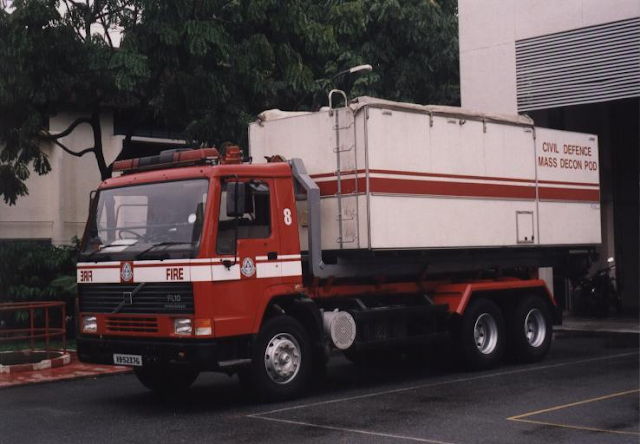
I would believe that this is the last one remaining here, unless I hear of other units still around. FL 10s were mainly used by our fire brigade (shown below) and as prime mover trucks. Information on heavy vehicles are generally harder to find, so apologies for not being able to write as much as I wanted. Interestingly, there was a Volvo Trucks plant in Malaysia and this unit could very well have come from there also. 

This is indeed a very left-field subject matter as I am sure no one would give a second look to trucks in general. While I am the first to actually write about this unique piece of history, I hope this has been informative in some way: I don't really expect people to go gaga over them but at least I have done my part in documenting its existence. If you are lucky, try to catch it on the move before it is gone forever!


18 May 2020

More than an old car #143: Volvo 850


I am not sure how much does the average person knows about Volvos, but perhaps you may have heard something about their brick/tank-like safety. To be honest, when I saw this previously, I did not really put much thought in it other than 'it's a old car'. After some research, I was quite surprised that this 1996 Volvo 850 SE was a unicorn!

Volvo had built up a reputation for making safe and reliable cars, but as a result of this it was often associated with a less-than-favourable image of snobbish intellectual elites. Sales started to slow down and it reported its first loss in history in 1990. Therefore, Volvo had to reinvent itself to remain relevant during that period.

When it was first introduced in 1991, it was launched with the slogan "A dynamic car with 4 unique innovations", namely the newly-developed 5-cylinder engine that powered the front wheels, Delta-link rear axle, Side Impact Protection System (SIPS) and a self-adjusting seatbelt reel for the front seats. The 850 still retained iconic cues such as the boxy, spacious interior and the emphasis on safety with SIPS, a system of honeycomb material used in the sills, B-pillar and doors that dispersed the shock of a side impact. It was originally available only in sedan form, with the wagon coming later in 1993. The 850 was facelifted in 1994, featuring thinner headlights, new indicators and bumpers. Sedans, previously known as the GLE, was renamed to SE too.

Volvo also made a limited-edition version known as the T-5R, featuring a more powerful turbocharged engine with unique wheels and interior modifications. From what I understand, there used to be a handful of them in Singapore but none have remained. This 850 SE was powered by a 1984 cc B5204FS i5 engine, allowing it to reach a top speed of 215 km/h with an acceleration of 8.6 seconds [0-100 km/h]. It was 4661 mm long and weighed 1500 kg, with a fuel consumption of 8.8 litres/100 km.

Production of the 850 ended in 1996 with 716,903 units made in total. The 850 was first sold locally in 1992 by SM Motors, our local Volvo dealer. This particular unit was once red before it underwent a makeover to look like the range-topping T-5R, from the iconic Cream Yellow paint to the more aggressive-looking front lip. I believe this car is still around although I have not seen it ever since I took this picture 3 years ago. This could very well be the only one left here, with not more than 5 as a reasonable estimate! I do not know whether you can see this again, but at least you will be aware of this unlikely classic roaming the roads!

5 February 2018

More than an old car #53: Volvo Amazon/122S


Previously, I discussed about the sturdy Volvo 240 series and how it cemented it's reputation as a tank in disguise. Volvo has a longer history than most of us think and I was pleasantly surprised to see this pristine 1966 Volvo Amazon 122S out of the blue!

The Volvo Amazon was first produced in 1956 and it took styling cues from US cars from the 1950s. For example, it had visible tailfins and pronounced "shoulders" [the surface between the top part and slightly below the side windows]. Originally, it was named the "Amason", which was derived from the female amazon warriors in Greek mythology. However, the German bike manufacturer Kreidler had launched a moped called the Amazone and had claimed sole right to the name. As a result, Volvo was only allowed to use the 'Amazon' name on in the Nordic markets--it was known in export markets as the less remarkable 122.

The Amazon/122 was available as a 4-door sedan, 2-door coupe and a 5-door station wagon. It was equipped with three-point seatbelts, and was the first car in the world to do so. A unique feature was that the handbrake was located right beside the driver's door, as it was anticipated that this would free up more space. The 122S was powered by a 1778cc inline-4 engine and mated to a 4-speed manual transmission, allowing it to reach a top speed of 148km/h with an acceleration of 14.4 seconds [0-60mph]. It weighed 1090kg and was 4.45m long.

Production ended in 1970, with more than 234,000 4-door sedans made. The Amazon has gained classic status, notwithstanding its visually pleasing shape, its excellent performance and its reliability despite its age. This specimen seems to be the only one in Singapore and it is up for sale. It seems to have its original registration number plate, giving it a nice vintage touch. Volvo may have a reputation for being driven by boring people eg lecturers and writers, but it is never boring driving a vehicle with so much character. This is one car that will turn more heads than the newer models today!

12 June 2017

More than an old car #19: Volvo 240 GLT


Say the words 'safest car' and chances are you might mention Volvo. Volvo has a large presence here, from the everyday models to police cars, and even the PMO's motorcade. Yet, did you know that some of its cars were made right here back in 1979? Local production ended very quickly in 1980 but 500 cars had been produced. The Volvo 240 GLT was one of them.

Volvo was founded in 1927 as a subsidiary of SKF, a Swedish ball-bearings manufacturer. Its name, which is Latin for 'I roll', was supposed to be for a certain type of ball bearing but was later patented for cars. Volvo was first bought over by Ford in 1999, and was later sold to China car manufacturer Geely in 2009. Volvo has always prioritised their reliability and solidity, and it was no surprise when they introduced safety measures which we take for granted: the three-point seat-belt, laminated glass and crumple zones are examples. As a result, it has won people over worldwide.

The 200 Series [of which the 240 GLT was part of] was introduced in 1974 in a number of variations. Initially, the naming was based on the number of doors and the trim level but this was changed in 1983 where all cars were simply called the 240. The 'GLT' in this case stands for "Grand Luxe Touring", which is basically a sporty premium version compared to the basic model. It was equipped with a 2664cc PRV 6-cylinder engine [a collaboration between Peugeot, Renault and Volvo]-- the maximum top speed was 150km/h and its acceleration was 17.5 seconds [0-100km/h]. It was 4.9m long and weighed 1370kg.

When production ended in 1993, more than 2.8 million had been made and it remains popular with enthusiasts and common folk alike. However, it is difficult to find one here despite how numerous it was, no thanks to the COE system. I have only seen a gold-coloured model even though I believe there are more. What attracted me was its boxy shape and how dated it looks, but hopefully the old-school charm can still work its magic on you!