13 January 2022

More than an old car #185: Nissan Serena


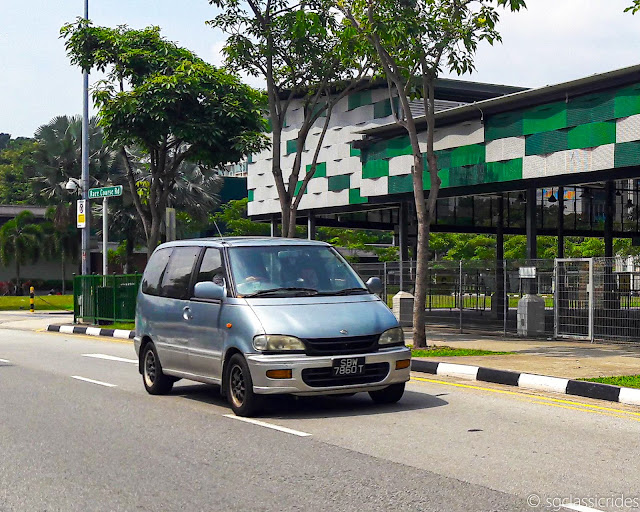
The 90s was an interesting period of flux: as the population grew, family needs also evolved and there was a greater need for people carriers to fit more inside them. At the same time, it had to be ideally affordable given the lower purchasing power during that time. This promoted the advent of multi-purpose vehicles (MPVs), and although car enthusiasts find them as exciting as watching paint dry, cars like this 1992 Nissan Serena C23 have cemented themselves as part of history whether people like it or not...

First introduced in 1991, it drew its roots from the Datsun Sunny/Cherry Cab back in 1969 and was launched as the fully remodeled version of the C22 Vanette, with internal designation of C23. Its name is derived from the Latin word 'serenus', and was intended to convey the image of a comfortable and enjoyable driving experience. Nissan's Aichi Manufacturing Division led the design and production: the vehicle has a semi-cabover structure with a small bonnet, but the engine was placed under the passenger seat. The shift lever was also mounted to the floor and it was also equipped with a combination sliding door and power windows, which was a world's first. Despite its rather unwieldy shape, it had a surprisingly low aerodynamic coefficient of 0.35.

Various grades and engine types were offered (both petrol and diesel). The more desirable 2.3 litre engine version was never sold in Japan, instead it was for export markets. A larger version of the Serena, known as the Largo also appeared in 1992. While the Serena was intended to be a people carrier, a van version was also produced for the European market: first in Spain and then by the UK-based LDV Group. In 1994, the Serena had a facelift with a different grille and bumper design, while internal changes were made to the instrument panels and aircon switch. Driver airbags were made standard in 1995 and another facelift occurred in 1997, with modifications done to the headlights and front grille. Passenger airbags also became standard-issue in 1998.

Interestingly, this unit sports a 1997 front fascia: when it was on sale in 2009, it still had the pre-facelift look. The Serena was powered by a 1998 cc SR20DE i4 engine, allowing it to reach a top speed of 170 km/h with an acceleration of 12.2 seconds [0-100 km/h]. It was 4315 mm long and weighed 1485 kg, with a fuel consumption of 11.1 litres / 100 km.

Production of the C23 Serena ended in 1999 though van production in Europe finally halted later on in 2001. Serenas were sold here by Tan Chong Motors in 1992, where they found favour with large families and business owners who desired an MPV for their clients. However, its dowdy image also led to much criticism and was voted worst new car on sale in Britain in Top Gear. This unit no longer exists as it was scrapped in 2019, and none of the C23 Serenas still remain here. However, some Malaysian units do make their way to Singapore from time to time...hopefully you will be able to see them about!


6 January 2022

More than an old car #184: Alfa Romeo Alfa 6

Happy 2022 to all my readers! It is my hope that on the 6th day of this year, life will be able to go back to some sense of normal and that you will be able to fulfill your New Year resolutions! This leads me on to a car which I have have been wanting to write about for a while now (where its name may or may not be coincidental): this 1982 Alfa Romeo Alfa 6!

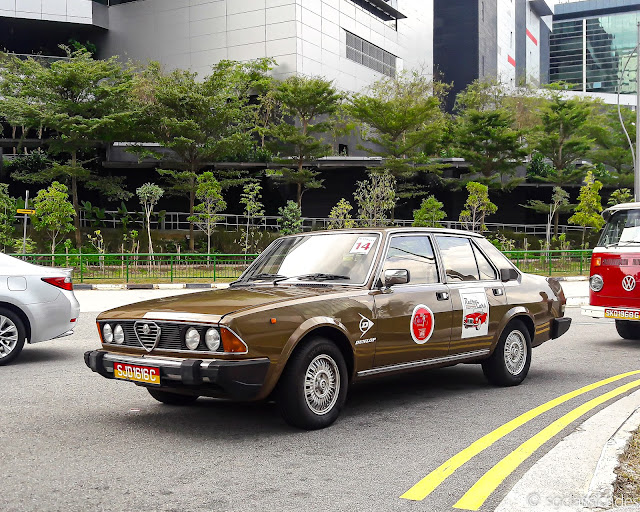
The Alfa 6, also known as the Alfa Sei (6 in Italian), was conceived back at the end of the 1960s and production was slated to begin in 1973. Alfa Romeo desired to return to the market segment of large 6-cylinder sedans, and wanted to position it as an Italian Rolls Royce so to speak. The new car (with internal code 119) was designed to share parts with the lower-end Alfetta: the overall design with its 4 round headlights and the C-pillar intake were clear indications. Interestingly, the Alfa 6 was designed earlier than the Alfetta, but due to the 1973 fuel crisis the car only debuted in 1979. 

It featured a 2.5 litre V6 engine designed by Giuseppe Busso with 6 single-body carburetors, power steering, central locking and braking circuits from BMW among other equipment. This made the 6 competitively priced compared to similar saloons of its time, where such equipment would have been costly to add on. It also featured new safety features such as a shock sensor in the boot that would cut off the fuel supply during a crash. 

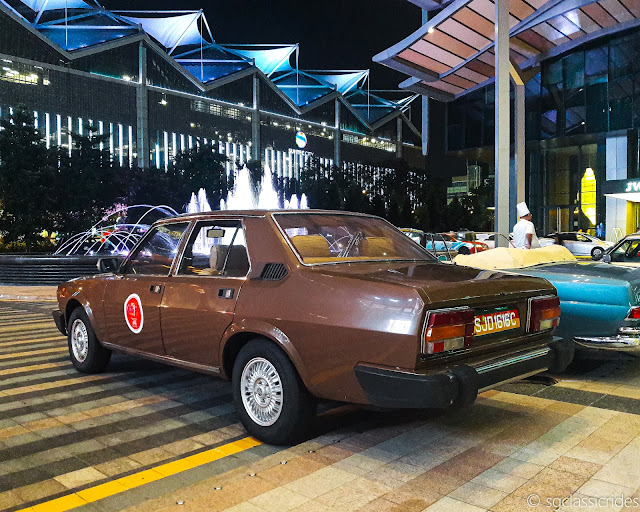
Unfortunately, the 6 was doomed from the start: the rear light clusters were deemed too large, the bumpers too dated and the C-pillar air intake was judged to be inelegant. On top of that, there were many issues such as a non-working speedometer, loose spotlights and badly-mounted door panels. The potent V6 engine with its carburetors (though powerful on paper) was tricky to work on and maintain for the average user. Even when Alfa Romeo tried to promote the robustness of the car body, it was dispelled by a bad accident from actor Gino Bramieri in 1981.

At the end of 1983, the 6 underwent a redesign: the quad round headlights were replaced with squarish ones, bumpers were now fully in plastic, the grille was changed and aerodynamic spoilers were fitted in the bumpers. The carburetored 2.5 litre engine was downsized to 2 litres, while 2.5 litre turbodiesel and fuel-injection variants were introduced. However, the 2-litre engine was noted to have poor fuel consumption and the image of the 6 as a rather pointless car was further reinforced. This unit is powered by a 2492 cc V6 engine mated to a 3-speed automatic transmission, allowing it to reach a top speed of 185 km/h with an acceleration of 11.5 seconds. It was 4679 mm long and weighed 1390 kg, with a fuel consumption of 12.7 litres/100 km.

Production of the Alfa 6 ended in 1986 with just 12,070 units leaving the Arese plant: it was a far cry from Alfa Romeo's target of 30,000 per year. Among them, 5,748 were the pre-facelift version like this unit. It is estimated that only about 400 of them still exist today: while exact figures for RHD units are not known, it is likely that the numbers are even fewer. 6s were sold in Singapore by City Motors Pte Ltd, the former distributor for Alfa Romeo where they retailed for an eye-watering $105,000 back in 1980; one was even owned by the Italian embassy. None of them still exist today: this particular unit was imported a few years ago. 

Getting to know about this ordinary-looking unicorn was a big surprise: I had no idea that this even existed until I saw it and this line of thought appears to be prevalent even among Alfa Romeo enthusiasts. Its poor sales and generally forgettable performance does not evoke any kind of memories. Furthermore, spare parts for the 6s are almost non-existent since Fiat destroyed everything that was related to the 6, Arna and 90 when they took over the plant. The fact that one of them made its way here is a miracle in itself, though it would be interesting to know why this was brought in. Now that you know that this is more than an old car, perhaps you may get to admire this unique survivor some day!


16 December 2021

More than an old car #183: Opel Manta A

With the year drawing to a close, I thought it was fitting to write about one of my archives from 2 years back: the rainy weather actually fitted the overall vibes somehow during this time. Seeing unknown classics is always gratifying, especially when no one has yet to bring in new units. It is interesting to see how the usual models are in demand but not like this 1971 Opel Manta A L!

Founded by Adam Opel in Rüsselsheim, Germany on 1862, Opel started off as a manufacturer of sewing machines. It began to make bicycles in 1886 and the first cars were designed in 1899. Opel was the first German car manufacturer to incorporate a mass-production assembly line and by 1928, it was Germany's largest car exporter and had a 37.5% market share. Opel was also instrumental in popularising rockets as a means of propulsion for vehicles, and thus played a significant role in the history of spaceflight and rocket technology. In 1931, General Motors fully acquired Opel and the highly successful Kapitan was introduced in 1935. Automobile production stopped in 1940 and munitions production began in 1942 for the war effort. 

After the war ended, the Opel factories were rebuilt by former employees. GM had also acquired Vauxhall and this led to a rationalisation of the Vauxhall/Opel range across Europe. By the 1980s, Vauxhall and Opel were one and the same. However, GM began making losses in the 1990s and it prompted them to enter an alliance with PSA Peugeot Citroen in 2012: the complete acquisition by PSA was finalised in 2017. 

The Opel logo changed over the years: initially sporting an AO logo, it was changed to a ring crossed by a flying thing in the 1930s. The current logo (with a ring and horizontal lightning) was developed at the end of the 1960s, which is both easily recognisable and reproducible. Opels were sold in Singapore since the 1940s and enjoyed moderate success: quite a few can be seen from old photos from that period. However, classic Opels do not appear to be as collectible as their fellow German brands even till today. Currently, Opels are more commonly seen on private hire cars and their numbers are decreasing every year.

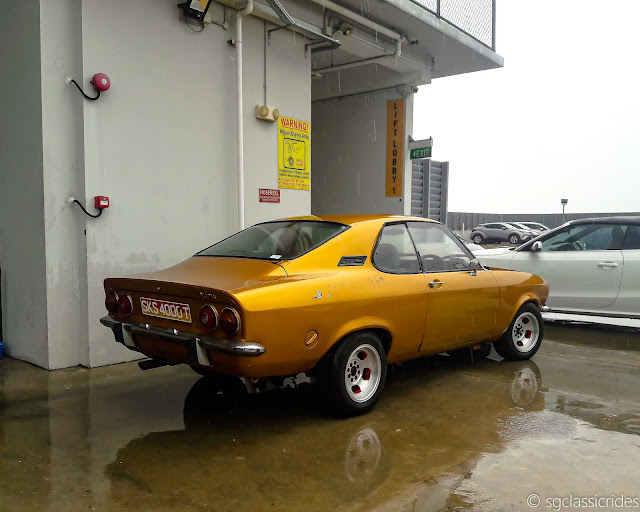
In the 1960s, Opel developed a competing model for the Ford Capri known internally as 'Project 1450': this was in response to the advent of 'pony cars' first introduced by Ford with its Mustang. Opel also noted the 'Stingray' name affixed to Chevrolet Corvettes and decided to adapt the manta ray to its newest offering. From the beginning, Opel marketed the Manta as a sporty men's car: the swooping, graceful body was unlike any other Opel even though it was partly based off the Ascona. The elongated hood with the 'sharknose' front reminiscent of BMW's E9, the rear section with its 4 round headlights and wide doors with frameless windows captured much attention from the public.  

Although it was available only in a 5-seater coupe form, there were 3 main engine types (1.2 litre, 1.6 litre and 1.9 litre). Various trims and special editions were also developed: for instance, the L (for Luxury) trim included chrome-plated tailpipes, pivoting windows for the rear passengers, cigarette lighters and an electric clock. This Manta A with the L trim was powered by a 1584 cc Opel CIH i4 engine, allowing it to reach a top speed of 154 km/h with an acceleration of 17 seconds [0-100 km/h]. It was 4343 mm long and weighed 945 kg, with a fuel consumption of 9.8 litres/100 km.

Production of the Manta A ended in 1975 with 498,553 units made, where it was replaced by the Manta B. Manta As were sold in Singapore in 1971 by Singapore Motors, although most reviews at that time were focused on the 1.9 litre variant. This unit is an original Singapore-registered car and it is believed to be the only one left here: apparently no one has imported any in currently. Based on old car listings, it has changed colour a few times from blue, to white and its current gold paint scheme. 

Coming across one of these rarities is always a pleasant surprise: one naturally wonders what adventures it has experienced and how it actually survived all these years. Considering that Opel does not seem to be desirable among classic car collectors, hanging on to one is a testament to the owner's passion and love for what it is. Perhaps you will be able to see it one day and admire this survivor for yourself!


4 December 2021

More than an old car #182: Maserati Indy


After a rather hectic week, it is a relief to have some time set aside for more writing. Having trawled through my archives, I was inspired to cover this rather unique 1972 Maserati Indy: it has been a while since I wrote about continental cars and I figured that though the trident brand is relatively well-acquainted with many (for good or for worse), few people would be aware of the rich history behind the older models..

The Indy was conceived as an alternative to the 1960s Ghibli, featuring a V8 engine and seating for 4 people. 2 coachbuilder prototypes were introduced at the 1968 Turin Motor Show, one by Ghia and the other by Vignale: Maserati already had established relationships with both coachbuilders as they had designed other cars for the company. The Vignale design was chosen and was launched subsequently at the 1969 Geneva Motor Show: its name was a reference to Maserati's 2 victories at the Indianapolis (Indy) 500 race in 1939 and 1940.

The genius of Vignale's design was evident in the Indy's side profile: the full-width window hatch flowed down to a cut-off tail incorporating the now-standard horizontal rear light clusters above a full-width rear bumper. Despite not possessing the long low line of the Ghibli, the use of retractable headlights helped to accentuate the flowing lines of the car. In 1970, a larger 4.7 litre engine was introduced and major changes were made to the dashboard: a grab handle was fitted and the aircon vents on the centre console were removed. Instead, it was replaced by gauges for temperature and fuel, and even an analogue clock.

In 1971, cars bound for the North American market were renamed to 'Indy America', and a 4.9 litre engine was also introduced. Externally, an extra grille was fitted on the hood and the Borrani wheels were increased in size to 15 inches. The Indy was available in both automatic and manual transmissions, and was rear-wheel drive despite the engine being located at the front of the car. This unit was powered by a 4136 cc V8 engine (instead of the 4719 cc version), allowing it to reach a top speed of 250 km/h with an acceleration of 7.3 seconds [0-100 km/h]. It was 4740 mm long and weighed 1650 kg, with a fuel consumption of 19.2 litres/100 km.

Production of the Indy ended in 1975 with no direct successor. A total of 1,104 units were made, of which just 74 were in RHD. The Australian registration suggests that this was 1 of 5 4.2-litre version with a manual transmission sold new in the country! This particular unit has a burgundy exterior with a cream interior, and has clocked about 63,000 miles currently. It was sold in 2016 for A$16,612, where it was acquired by a local classic car collector. Despite being exhibited a few times over the years, it has not been road-registered locally. Indys were not known to be sold in Singapore, though a 4.9 litre unit was test driven here in 1973. The automatic version was noted to have a quick start and the controls were smooth and responsive, along with the brakes. There was praise for the ample rear seat space, although the long seat belt and aircon vent positioning left much to be desired. 

Older Maseratis tend not to be well-recognised, perhaps because of its general lower presence in popular culture etc. Whatever it is, this obscurity is something that is right up my alley and I hope that this has been informative about its presence right here in Singapore. Perhaps you may be able to catch it at exhibitions or even registered on the road!

12 November 2021

More than an old car #181: Nissan AD Resort


In the midst of my posts, I have realised that I have not given much attention these few weeks to non-continental cars, partly due to work fatigue and overall ennui. Being aware of this, I went to take a look at my archives and found this rather remarkable 1995 Nissan AD Resort SLX!

First introduced in 1982, the AD Van was intended to replace the commercial delivery vans based on Nissan's other vehicles. Based off the B11 Sunny wagon, it was more squarish and utilitarian: despite being a van, it came with 4 side doors and a liftback hatch in the back. In 1990, the Y10 series appeared in the market: it was based off the B13 Sunny and a passenger version known as the AD Wagon was introduced in order for consumers to avoid the annual inspection in Japan. The Japan market also received a unique version known as the AD Max: it had 2 front doors, an extended height and double doors were fitted on the back in the 'fourgonette' style.

There was a facelift in 1993, where the squarish headlights were now integrated with the front grille and became more rectangular. It was around this time that the car was exported to Thailand and Malaysia, where it was called the AD Resort. The SEA market version had a larger 1.6 litre engine, and units sold in Thailand had many body styles to choose from owing to their love of pick-up trucks. Only the regular wagon was sold in Malaysia by Edaran Tan Chong Motor Sdn Bhd as far as I am aware. The AD Resort in Malaysia was powered by a 1597 cc GA16DE i4 engine, allowing it to reach a top speed of 170 km/h with an acceleration of 12.1 seconds [0-100 km/h]. It was 4175 mm long and weighed 1010 kg, with a fuel consumption of 9.5 litres / 100 km.

Production of the Y10 AD Resort ended in 1999, where it was replaced by the Y11 series. Curiously, the AD Resort was never sold in Singapore although it would have complemented the B13 Sunnys that were present here. It was purely coincidental coming across this Malaysian unit: I had thought that it was a Sunny wagon (which was technically not wrong) but some research led me to discover this rarity on the road. There are a small handful of the Y12 series AD wagons here, but they are registered under diplomatic plates. 

As to why wagons never really caught on here, it is noted that they were naturally more expensive despite having more storage space. It appears to be more of a status symbol, and the rise of MPVs have made wagons superfluous: what better car to get that could carry a regular family plus furniture from IKEA? Regardless, coming across this little obscurity from across the causeway was a nice surprise: hopefully you may see them when the borders re-open...


30 October 2021

Miscellaneous classics #8: Mercedes Atego


I guess it's one of those moments where I have to clear my backlog, and that this has been sitting in the archives for a long while. Being caught up with work also means that I have less time to work on the blog, so it would have to be something that does not take up much resources in planning on what to write. Speaking of this, I naturally thought on writing about the few commercial vehicles that I have seen, and I was reminded of this 2001 Mercedes Atego 1517/5360 that I saw some time ago!

The Atego (internal code W970) was introduced in 1998 as the successor to the LK series. It was made available in different cab sizes, from S to L high-roof version, along with different wheelbases between 3020 mm and 6260 mm. Different tonnages were available and designated in the following format: 7xx for 6.5 tonnes, 8xx for 8 tonnes and so on. The 'X's following the designation is the engine horsepower but given as a tenth. Thus, this particular unit thus has a tonnage of 11.99 tonnes based on its 15xx designation with a horsepower of about 170 hp, and its wheelbase was 5360 mm long.

In 2000, a heavy version of the Atego chassis was brought to the market, with designations 1533 and 1833. A year later, the Axor truck replaced the heavy Atego chassis and became a standalone model. The Atego, which remains in production today, went through a facelift in 2004 with wider indicators and a revised front end to be more aligned with the Actros. This Atego was powered by a 4249 cc OM904 94 engine, with a maximum power of 174 hp. It was 6900 mm long and had an unladen weight of 6080 kg, with a gross weight of 11990 kg.

Production of the first-generation Atego ended in 2004 with about 170,000 made, where it was followed by the second generation. It is likely that there are no first-gen Ategos left in Singapore, although a handful of second-generation units still see service under the fire brigade. This particular unit was owned by an art logistics company, which makes sense for it to be so huge. It was fortuitous running into this truck as I only took the picture since its number plate was relatively old. I was therefore pleasantly surprised to find out that it was already a classic this year. However, that also meant that its lifespan was up and sure enough, it had been scrapped.

To be honest, I was not expecting anyone to even know that this actually existed here, such is the general perception of heavy-duty vehicles. As always, I will continue to give these workhorses their much-deserved spotlight just because I would like to. Now that you have heard of this, I hope that you may be able to recognise it in the future..


15 October 2021

More than an old car #180: ZIS-110


With travel plans put on the back burner currently, I figured that it would be a good time to reminisce about my trip to South Korea. It has been a while since I wrote about a vehicle not in Singapore, and I was reminded of this unique rarity while scrolling through my archives. Given its novel background and history, this 1948 ZIS-110 would mot likely be your first exposure to a Soviet-era classic car!

The history of ZIS spans back to 1916, where it was first known as the Avtomobilnoe Moskovskoe Obshchestvo (AMO), or the Moscow Automotive Society. It was part of a government program to establish an automotive industry in Russia: it started out producing Fiat trucks under licence before designing its own vehicle, the AMO F-15 truck in 1924. The company had its name changed to Avtomobil'n'iy zavod Nomjar 2 - Zavod Imeni Stalina [ZIS] (i.e. Automotive Factory No. 2 - Factory named after Stalin) in 1931, after it was re-equipped and expanded with the help of the American firm A.J.Brant Company. As it was during the reign of Stalin, his name had to be incorporated in it somehow.

The first production car known as the ZIS-101 began in 1936: while different car models were made, the company continued to predominantly manufacture trucks and buses instead. Its name was changed in 1956 to Zavod imeni Likhachyova [ZIL], which was named after its former director Ivan Alekseevich Likhachov. However, as the years went by, its vehicles became severely outdated and the company went bankrupt in 2013. It continued to survive as a joint-stock company without producing any vehicles under the name MSC 6 AMO ZIL until its liquidation in 2019, by which time the original factory buildings had been demolished for residential usage.

The 110 was first conceived back in 1943 under the guidance of chief designer Boris Fitterman. Its design was heavily inspired by the pre-war Packard Super Eight 180, which Stalin received as a gift from Franklin D. Roosevelt. Stalin apparently loved the Packard so much that he wanted something similar on Soviet roads, and the task fell on lead designer Andrei Ostrovsev. While it has been claimed that the dies for the 110 were originally from the Packard, it is noted that the production of the 110 used the metric system compared to the imperial system in Packards, resulting in both cars being actually distinct from each other. Body panels were not transferrable and there were slight variations in lengths due to the varied systems used. However, it is undeniable that the decorative trim, fittings and interior design carried Packard DNA, so to speak.

On the exterior, the 110 was fitted with 2 rear lights even though traffic rules at that time only required 1 to be placed on the left. It also had headlight lamps, where the bulb itself was both a reflector and a diffuser: this was different from conventional headlights with separate components. It was also the first Soviet car with direction indicators (made in the American style), which could be turned on by switches on the dashboard or via the left steering column lever. 

The dashboard was fitted with the standard gauges (speedometer, thermometer etc), but an interesting feature was the speedometer needle changing colour at different speeds: it was green up to 60 km/h, yellow from 60-120 km/h and red above 120 km/h. The numbers on the speedometer scale also did not have the last zeroes i.e. "8, 10, 12" instead of "80, 100, 120". As the flagship Soviet car, the interior was fitted with a radio receiver, hydraulic windows and a cigarette lighter among other luxuries.

2 main body styles, namely a 4-door sedan and a 4-door convertible (phaeton) were produced although an ambulance version was also available. Sedans were painted in black, burgundy and blue, although 1 unit was painted in green and gifted to the then-Patriarch of Moscow Alexy I by Stalin. Phaetons were available in black, gray, gray-blue and beige. The 110s were primarily distributed to government branches and was out of reach for the typical peasant unsurprisingly, though some were also gifted to foreign communist leaders like Mao Zedong and Ho Chi Minh. Interestingly, some also saw use as inter-city taxis, where they were painted in dual-tone white and brown. An armoured version known as the ZIS-115 was commissioned by Stalin, which featured reinforced aviation armour and bulletproof glass.

The car was powered by a hefty 6002 cc inline-8 engine, allowing it to reach a top speed of 140 km/h with an acceleration of 23.1 seconds [0-60 mph]. Naturally, whoever owned it would probably not be terribly concerned with the eye-popping fuel consumption of 23 litres / 100 km. With a length of 6000 mm, height of 1730 mm and weighing in at 2575 kg, it was simply The Car to be in. There is a saying that goes "don't measure by the miles per gallon, but the smiles per gallon", which rings true for this instance, but I would probably be feeling like a literal god and forget about the dollars being converted to exhaust gases.

Production of the 110 ended in 1958 (or 1961 as some sources suggest) with just 2,083 cars made. It is estimated that about 200 still exist today, with half of them still on the road. This unit was noted to be a gift by the Soviets to Kim Il Sung, the first leader of the DPRK. It was captured by the ROK forces on 22 October 1950 near the Chongchon river in Pyongyang, where it was subsequently gifted to the widow of General Walton Walker. It made an appearance at the 1951 Los Angeles Motorama, but after that its history became quite murky. Nothing was heard of until 1982, where the UN Korean War Allies Association (UNKWAA) discovered it in the possession of a car collector in New Jersey. The UNKWAA returned the vehicle in 2013, where it has since resided in the War Museum of Korea in Seoul. 

It goes without saying that none of them existed in Singapore: in fact the only time a Russian car brand entered the local market was the short-lived Lada between 1977 to 1981, and subsequently in the 1990s under Togliatti Cars. The lack of maintenance knowledge (and trying to decipher potentially useful manuals in Cyrillic) effectively puts these Soviet-era cars out of reach from even the most enthusiastic collector in this part of the world. The fact that there was one right here in Seoul was a big surprise as I had never heard of its existence before...I hope that this has been a fresh insight to Soviet classic cars, especially one as illustrious as this. Hopefully, you may be able to see it some day!