26 September 2020

Miscellaneous classics #6: Volvo FL 10

Spotting old cars has become something like second nature to me, and I am sure there are others out there who also possess this keen eye to detail for cars in general. However, to date, I have never seen any peer that has remotely featured the 'uncool, loud and dirty' workhorses. It has been a long while since I wrote about atypical classic vehicles, and I figured why not be a trendsetter yet again and introduce this unlikely behemoth of a 1998 Volvo FL 10 tow truck/wrecker! 

The FL series is Volvo's smallest truck and is thus suitable for construction work, local and regional distribution and garbage collection. It was introduced in 1985 in response to decreasing global competitiveness in the heavy truck market. Its name stands for 'Forward Control Low-Level Cab' and was available in various drivetrain configurations. This unit is a six-by-four (6x4), meaning that it has a drivetrain of 3 axles (6 wheels) delivering power to 2 wheel ends on 2 axles (4 wheels).

As expected from Volvo, the FL trucks featured top-notch safety systems, such as a Z-Cam wheel brake. Furthermore, the spacious cab length of 250 cm and an advanced cab suspension provided much comfort for the driver. The FL 10 was powered by a humongous 9603 cc D10 inline-6 diesel engine, allowing it to reach average speed of 79 km/h, with an acceleration of an eternally-long 68 seconds [0-60 mph]. However, as with commercial vehicles here, its speed limit is restricted to 60 km/h. It weighed 10900 kg, with a maximum laden weight of 24000 kg and had a fuel consumption of 37 litres/100 km. Judging from its size, I would presume it to be around 7 m long.

Production of the FL 10 ended in 1998, making this unit possibly one of the last of its kind before it was succeeded by the FM series. However, FL trucks still remain in production though with smaller engines. This particular unit, owned by Yishun Towing, was registered on March 1999 and it will no longer exist after 2022 when its COE expires. It has seen regular action towing all kinds of vehicles, such as this picture below. I was drawn to it by its squarish angles and it looked quite run-down, and was therefore gratified to see that it was indeed as old as it looked.

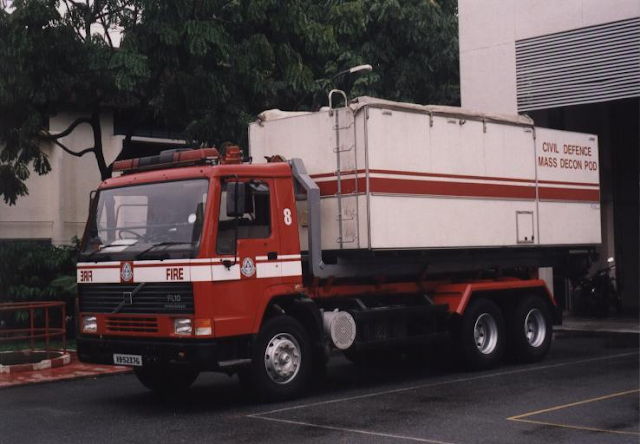
I would believe that this is the last one remaining here, unless I hear of other units still around. FL 10s were mainly used by our fire brigade (shown below) and as prime mover trucks. Information on heavy vehicles are generally harder to find, so apologies for not being able to write as much as I wanted. Interestingly, there was a Volvo Trucks plant in Malaysia and this unit could very well have come from there also. 

This is indeed a very left-field subject matter as I am sure no one would give a second look to trucks in general. While I am the first to actually write about this unique piece of history, I hope this has been informative in some way: I don't really expect people to go gaga over them but at least I have done my part in documenting its existence. If you are lucky, try to catch it on the move before it is gone forever!



12 September 2020

More than an old car #153: Alfa Romeo Alfetta


Alfa Romeo (AR) has remained a prominent brand among the classic cars circle. Naturally, some models are more well-received than others, but today I would like to give a shoutout to this comparably obscure 1976 Alfa Romeo Alfetta Berlina!

The Alfetta was conceived in the face of increased competition from new stylistic trends, and it was recognised that customers would not want the design to deviate too much for their liking. Designed in-house by Centro Stile Alfa Romeo and led by Giuseppe Scarnati, its name was a throwback to AR's sporting glories in the 1951 F1 Grand Prix in a bid to convince customers that the brand was still as strong as ever.

Introduced to the public in 1972, the Alfetta adopted a squarish look but retained the iconic twin round headlights and grille, along with 3 chrome bars flanking it. The rear, however, was quite high: it contributed aerodynamic advantages and large boot space, although it could not be fully exploited as the bodywork could be damaged. The interior was also true to the AR tradition: the driving position aimed to be as comfortable as possible, the instrument panels could be read easily and there was more space given to the front seats by rerouting the gearbox. 

The Alfetta underwent a facelift in 1975, featuring a single pair of headlights. In 1977, new engine ranges were introduced along with the introduction of rectangular headlights that remained until the end of production (with the exception of the Quadrifoglio Oro between 1982-1984). Along the way, changes were made to the bumpers and rubber strips were added as well. This unit was powered by a 1570 cc Twin Cam i4 engine, allowing it to reach a top speed of 175 km/h with an acceleration of 11.5 seconds [0-100 km/h]. It was 4240 mm long, weighed 1040 kg and had a fuel consumption of 11.9 litres/100 km. 

Production of the Alfetta Berlina ended in 1984 with more than 448,000 made, of which 77,103 were the 1.6 litre version. This was 1 of 2 that exists here, with the other being a recent import from 1978. Interestingly, it had been deregistered for quite some time and was awaiting a new windscreen. Unfortunately, I am aware that it had been scrapped/exported recently as the lay-up period had been exceeded. Alfettas were sold here in 1974 by City Motors Sdn Bhd, with a starting price of S$22,490. As can be seen, the steering wheel has seen better days and it sports rare classic Fondmetal wheels: while it bears a strong resemblance to the iconic BBS rims, I have never seen any other car sporting this particular brand.

Given how uncommon it is, I understand that most people would not have been aware of it, especially this unit that hasn't seen the road for a while now. While this has disappeared forever, please do keep a lookout for the other unit: now at least you would know what you are looking at!


5 September 2020

More than an old car #152: Subaru Impreza WRX


Subarus have always remained a hot favourite among enthusiasts, who more often than not go about modifying it to greater heights. Although it has been associated with the image of 'boy racers' here, it was not long ago that Subaru churned out rather nondescript vehicles until the advent of the Legacy. This 1999 Subaru Impreza WRX GC8 was a progenitor to the success of the brand worldwide and is a testament to how a breakthrough product could do so much for a company!

The Impreza was first introduced in 1992 and was intended to be part of Subaru's plan to target the global car market. Its name is based off 'impresa', which is an antiquated word that refers to an emblem. It featured a soft image with rounded corners and the chassis was adapted from the 1st-generation Legacy. As Subaru became heavily involved in the World Rally Championship (WRC), high-performance versions of the Impreza were given the designation WRX (World Rally eXperimental). 

The WRX cars differed from its regular brothers by featuring all-wheel drive, stiffened suspensions and turbocharged engines. On top of that, the more extreme WRX STi (Subaru Technica International) was also launched in 1994, where it remains a sought-after classic today. A facelift was done in 1996 and in 1998, with modifications done to the headlamps and the dashboard. All WRX cars feature the chassis code GC8 (for coupes and sedans) or GF (for 5-door hatchbacks), followed by a letter from A to G. Throughout its lifetime, many variants and 'special editions' have been released and it may be hard to keep track. 

This particular unit is more accurately known as a GC8F Impreza WRX Type RA 555 Limited: the 'F' indicates that it was made in 1999, the Type RA is a stripped-down version of the WRX in the Japanese market featuring reduced soundproofing, no air-conditioning, manual windows and more robust engines. '555' is a cigarette company that became an icon when it featured prominently in famous rally driver Colin McRae's Impreza in 1993. Incidentally, this is number 214 out of 1000 limited-edition cars spun off to celebrate Subaru's stellar performance in the WRC. It was equipped with a 1993 cc EJ20 H4 engine, allowing it to maintain an acceleration of 4.9 seconds [0-100 km/h]. It was 4340 mm long and weighed 1240 kg.

Production of the GC8 Impreza ended in 2000, where it was replaced by the GD/GG series. I understand that there are around 10 GC8s that still exist here, although none of them are the 555 Limited edition. Impreza WRXs were sold here since 1994 and they have remained beloved over the years. It demands one's fullest attention on the road and handsomely rewards the owner with raw power, making it a favourite for performance-enhancing modifications. While finding a bone-stock unit is like finding a needle in a haystack, I am aware of a grey unit that is evidently well-travelled. 

The Sonic Blue paintwork with gold wheels is an iconic image associated with Imprezas, and I regret not taking more pictures of it back then. While such car meets are still a long way from materialising due to the current pandemic, it was really nice to come up close with a rare legend. If you are lucky, you may be able to spot it some day!

21 July 2020

More than an old car #151: Honda Vamos


I have a soft spot for unconventional-looking cars simply because it demands you to look at them. Whether or not it rubs you the other way is subjective, but this 1970 Honda Vamos would make you yearn for more!

The Vamos was first introduced in 1970, where it was officially known as 'Vamos Honda'. Its name is derived from the Spanish word, meaning 'to go', and it was certainly an unusual conveyance to do just that. The car was intended to be a Swiss Army knife of sorts, as Honda claimed it was suitable for security purposes, construction sites, factory transportation and farm management among other uses. Beneath its rudimentary appearance, the Vamos incorporated safety features such as protective guard pipes (which served as doors) higher than the occupants' centre of gravity, a roll bar, lap seatbelts as standard and a partly tempered glass windscreen. The spare tyre in front also doubled as a shock absorber in case of emergency. Uniquely, it used a MacPherson strut front suspension and a De Dion tube with half leaf springs in the back.

It was offered in 3 different body types: a 2-seater (Vamos 2), 4- seater (Vamos 4) and a 4-seater with a full-length canvas top (Vamos Full Holo). Interestingly, the Vamos was offered in 4 colours: McKinley White, Caravan Green, Andes Yellow and Alpine Blue, although most were sold in green. The Vamos shared its engine with the N360 and Z360 sister cars, and was supposed to compete with the Suzuki Jimny and the limited-edition Daihatsu Fellow buggy. Due to the open cab configuration, all instrumentation and switches had to be both water- and dust proof.

It was powered by a 354 cc air-cooled i2 engine, allowing it to reach a top speed of 90 km/h. It was only 2,995 mm long and weighed 520 kg, with a load capacity of 350 kg. Owing to its small size, fuel consumption was also very favourable at 25 km/litre. 

Production of the Vamos ended in 1973, with only 2,500 units made. The Vamos name was resurrected in 1999 for a totally unrelated micro/kei van. Honda had intended to produce 2,000 units per month, but general unpopularity due to the lack of off-road performance despite its appearance greatly impacted sales. It is likely that even fewer still survive, with the overwhelming majority still in Japan. The fact that one actually made its way here is seriously impressive given how obscure it is even to car enthusiasts. A similar unit was sold for almost 2.1 million yen (S$27, 230), which goes to prove that such oddities do not come cheap.

While it remains unregistered, it is interesting to see what plans the owner has for this car. Despite its exposed nature, it can definitely attract eyeballs since very few cars are designed like that in the first place. If you are lucky, you may get to see it on the roads some day!


More than an old car #150: Triumph GT6


2 years ago, I thoroughly enjoyed myself at the classic car concours held at the Fullerton Hotel, and I am sure we never thought that car events would be forced to a halt today. It may be a long while before we are able to feel the pleasure of admiring these pieces of history displayed for all to see, but let me indulge in some nostalgia with this 1967 Triumph GT6!

In 1963, the Standard-Triumph Motor Company commissioned the renowned car designer, Giovanni Michelotti to design a 'grand tourer' for its latest offering, the Triumph GT4. The prototype was stylistically pleasing, but the added weight due to the new body resulted in poor performance from the then-current 4-cylinder engine. Some time later, a more powerful 6-cylinder engine was used as a replacement, resulting in the GT6 (GT model and 6-cylinder engine). It was also called the 'poor man's E-Type': you could see the hints in the sleek fastback design and the opening rear hatch. While strictly for 2 occupants, a small rear seat could be ordered, big enough for small children.

The interior featured a wooden dashboard which housed a full range of instruments, with carpets and heater included as standard. Despite the superior performance when compared against its direct competitor, the MG BGT, the rear suspension was heavily criticised. It was unable to live up to the expectations of Triumph owners, who took issue with its propensity to break apart during hard cornering. As the GT6 was designed with the US market in mind, Triumph had to nip the problem in the bud.

In 1969, the Mk 2 was released with obvious facelifts done and an improved suspension. Shortly afterwards in 1970, the final iteration, the Mk 3, was released. The Mk 1 GT6 was powered by a 1996 cc i6 engine, allowing it to reach a top speed of 171 km/h with an acceleration of 12 seconds [0-60 mph]. It was 3632 mm long and weighed in at an impressively light 864 kg.

Production of the GT6 ended in 1973, with 15,818 Mark Is made. It is understood that a majority of them were in LHD for the US market, making RHD versions quite rare too. This immaculate example is currently the only one in Singapore, as it was never sold here officially back then. However, at least 1 Mk 3 existed here in 1977 based from old newspaper ads that I found. The wire wheels are a classic touch and the red paint hints at its power under the hood. It doesn't appear on the roads often except during events, but the fact that this still lives on after so long is a testament to its timeless appeal even despite its obscurity. Hopefully, you will be able to see it soon!

13 July 2020

More than an old car #149: Mercedes W108/W109


Mercedes has often been associated with elegance and wealth, and this reputation has been well-entrenched back in the 1930s. It is therefore of no surprise that this 1966 W108 300 SEb and the 1972 W109 300 SEL 3.5 are stalwarts of this proud tradition!

The W108/W109 first debuted at the Frankfurt Auto Show in 1965, featuring three W108s (250 S, 250 SE, and 300 SEb) and a sole W109 (300 SEL). Made only in sedan form, it succeeded the preceding W111/W112 as a result of changing fashion trends: while the styling cues was still by famed designer Paul Bracq, the W108/W109 lost the distinctive fintails although the windscreen was noticeably widened.

Initially, the W108 was designated for the standard wheelbase while the W109 had a longer one, and the smaller inline-6 engines were assigned to the W108 only, with the exception of the 300 SEb. Other than that, they looked alike externally. Both models eventually featured the larger V8 engines in 1967 (for W109) and 1970 (W108). The W109 had more luxurious items than the W108, such as burled walnut dashboards, automatic transmission, and power windows along with optional air conditioning system. Furthermore, the W108 had steel coil springs while the W109 featured self-leveling air suspension.

The W108 300 SEb was powered by a 2996 cc M189 i6 engine, allowing it to reach a top speed of 195 km/h with an acceleration of 12 seconds [0-100 km/h]. It was 4900 mm long and weighed 1575 kg, with a fuel consumption of 18 litres/100 km. On the other hand, the W109 300 SE 3.5 had a 3499 cc M116 V8 engine, allowing it to reach a top speed of 210 km/h with an acceleration of 9 seconds [0-100 km/h]. It was 5000 mm long and weighed in at 1670 kg, with a fuel consumption of 13.2 litres/100 km.

Production of the W108/W109 ended in 1972, where it was replaced by the W116 series. Out of the 383,361 built, only 2,737 were the 300 SEb and 9,483 were the 300 SEL 3.5. The more common 250 and 280 S were sold by Cycle and Carriage, where they were assembled locally at a factory in Hillview. The 300 SELs, however, were specially imported.

Both units happen to be very rare in the world, making them pleasantly surprising spots. I understand that the red W108 (most likely an import) has recently changed colour to white. While you have a higher chance of spotting a W108 in Singapore, the W109s are more desired and thus less common to pick out. However, it exudes class no matter which angle you look at it, and it is no surprise that W108/W109s were often associated with the rich and famous. I hope that you will be able to see these beauties some day!

29 June 2020

More than an old car #148: Ford Mustang


Today's feature was a request by one of my followers who wanted to see/read about Ford Mustangs. I realised that it was high time to feature this legend after covering about other less well-known cars. Incidentally, this 1966 Ford Mustang is the only picture that I have so far...

The Mustang was conceived over a period of 18 months from September 1962 to March 1964, under the direction of renowned automobile executive Lee Iacocca. Ford's three design studios (Ford, Lincoln-Mercury and Advanced Design) were tasked to create proposals for the new vehicle, with these goals in mind: it would seat four, have bucket seats and a floor mounted shifter, weigh no more than 2,500 pounds (1,100 kg) and be no more than 5 m long, sell for less than US$2,500, and have multiple power, comfort, and luxury options.

The Ford design team produced the winning prototype under the guidance of Joe Oros, L. David Ash, Gale Halderman, and John Foster. Oros desired that the car should appeal to both women and men, have a Ferrari-like front end with the motif centered on the front and a sporty, European-like design. Its name was derived from an early prototype, which was inspired by the North American P-51 Mustang fighter plane. To decrease developmental costs, the Mustang used components from the Ford Falcon and Fairlane, although the body was entirely different. Although the hardtops accounted for the highest sales, a convertible and a fastback version was also designed.

The Mustang was first made available 4 months before the start of the 1965 production year, and although they were marketed as 1965 models, enthusiasts still refer to them as the 1964½ model year. The 1966 Mustang differed from the previous year by a new front grille (slotted pattern instead of 'honeycomb' styling), the lack of 4 bars extending from the 'corral' (horse logo), and the presence of 3 horizontal bars on the emblem in front of the rear tyre.

It was powered by a 4727 cc (289 cubic inch) Ford Windsor HiPo V8, allowing it to reach a top speed of 209 km/h with an acceleration of 6.6 seconds [0-100 km/h]. The HiPo engine was a more powerful version of the standard 289 block, with modifications done to the components that allowed it to produce a power output of 271 hp. It was 4613 mm long and weighed 1333 kg, with a hefty fuel consumption of 17.8 litres/100 km.

Production of the 1st-generation Mustang ended in 1973, with nearly 500,000 hardtops made between 1964 to 1966 alone. I believe that this unit is one of about 209 units converted to RHD by Ford Australia, and was imported here some time in 2017. I am aware of another unit in red which rarely appears. No Mustangs were ever sold in Singapore until in 2016, where the S550 (6th-gen model) was officially produced in RHD and sold by our authorised Ford dealer.

The 1st-gen Mustang has always been a mainstay in popular culture and is well-recognised by many. Although it is unfortunate that we never had them previously, it is nice to see that people have appreciated its value well enough to bring it to our shores. The Mustang also heralded the rise of the 'pony car' and the subsequent fascination by adolescents worldwide. Hopefully, you will be able to see this legend for yourself one day!