In my years of car spotting, I have come across various curiosities and rarities. This particular 1986 Aston Martin V8 Zagato was all the more special, especially when I never knew it existence until then! Further research revealed more info about it's history, which made it a lot more incredible to behold!
Zagato is a coachbuilding company founded by Ugo Zagato in 1919. Zagato used his knowledge of aeronautics to designed sleek, light bodies for race cars in the 1920s. The cars that he designed saw great success in racing, and his reputation grew throughout. Various manufacturers looked to Zagato for special designs and one-off creations. Zagato also expanded to make custom-built cars, and continues to exist today by producing its own cars.
Aston Martin first collaborated with Zagato in 1964, with the creation of the DB4 GT. When the Aston Martin show stand was placed near that of Zagato during the 1984 Geneva Motor Show, a proposal was raised to rekindle this partnership. Aston Martin and Zagato wanted to produce a supercar capable of taking on the fastest cars in the world: a top speed of 186 mph and a 0-60 sprint in less than five seconds was thought to be sufficient. Interestingly, before the V8 Zagato officially debuted, Aston Martin used a 1978 V8 Vantage as a test mule: most of the interior trim and rear seats were removed, and the windows were fitted with Perspex. The test mule was noted to be as fast as a standard V8 Zagato.
A styling sketch was presented in 1985 and this was surprisingly sufficient for customers to snap up all 50 units that were earmarked to be made. Deposits of £15,000 were needed from prospective customers in order to secure a car, but the initial price, quoted as £87,000, quickly rose to £95,000.
The car featured both Zagato and Aston Martin design signatures, with a hint of the famous ‘double-bubble’ Zagato trademark on the roof and the stylished angular shaped grille. Its design was stout and aggressive, and rode on unique Zagato designed Speedline 16-inch wheels. A convertible version, known as the Volante, was subsequently introduced in 1987.
Production cars were powered by a 5341 cc 580X V8 engine, allowing it to reach a top speed of 310 km/h with an acceleration of 5.1 seconds [0-100 km/h]. It was 4390 mm long and weighed 1250 kg, with a very thirsty fuel consumption of 24.5 litres / 100 km.
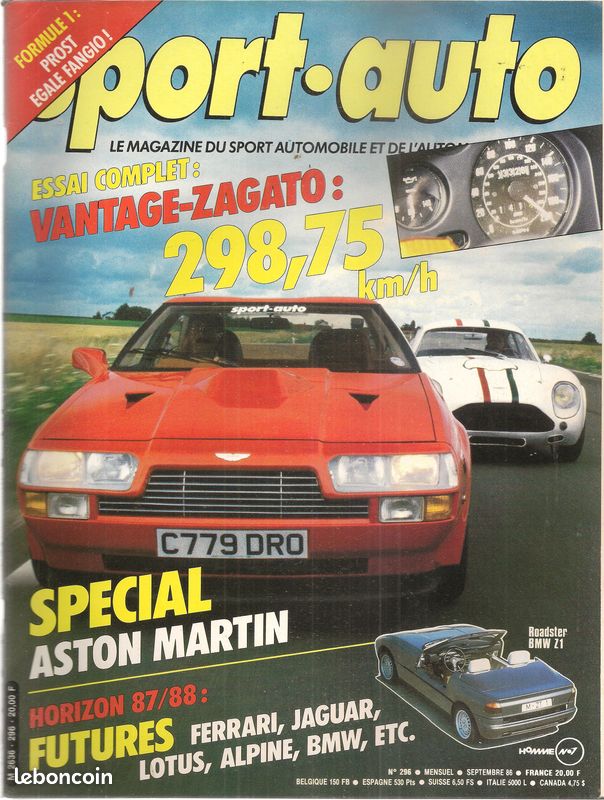
Production ended in 1989 with 52 saloons and 37 convertibles made, with LHD/RHD split as 32/20 for the saloons. This unit with chassis number V8ZHL20010 and registered C779 DRO is a very unique prototype: it featured a more powerful engine putting out around 430-440 bhp while standard ones were 410 bhp. It was also fitted with a special non-production exhaust system, front and rear spoilers and also did not feature a passenger side mirror as seen above. 20010 was 1 of 4 pre-production specials, all of which were finished in Gladiator Red paintwork.
On 8 July 1986, it reached a top speed of 298.75 km/h (185.8 mph) with an acceleration of 4.8 seconds [0-60 mph] on an empty highway near Paris (with the permission of French police). C779 DRO was extensively road tested by many magazines in period and was also displayed at the Geneva Motor Show in 1986.
Subsequently, C779 DRO was exported to Indonesia in Oct 1986 after it finished duties as the prototype Zagato. It was refurbished with a new engine fitted, and the headlight grilles were reinstalled back. At some point in time, a Zagato decal and black roof were added (they were not original). Interestingly, C779 DRO disappeared off the radar, until it inexplicably appeared here a few years ago! The last I saw, its engine was removed (possibly being overhauled) and the car vanished again a few months later.
It is quite unbelievable that a car with so much heritage even appeared on our roads, although no V8 Zagatos were sold in Singapore back in the day. Curiously, Aston Martin did not seem to make efforts to acquire C779 DRO back. I believe you may be wondering just why and when it made its way to Singapore, although your guess is as good as mine. While I do not know if it is still locked up in a garage somewhere, it is my wish for it to be back on the road and hopefully you may see it!