30 October 2020
Historic classic rides #4: Toyota Mark II
24 October 2020
More than an old car #157: Ferrari Dino 246
It has been a while since I wrote on luxury classics, and what better car to focus on than these exquisite legends from the Ferrari line, the Dino 246!
The 206 GT under the Dino marque was the predecessor to the 246, and was first introduced in 1967. The small-engined Ferrari came about due to regulations in Formula 2 racing, where the engines used had to be production-based and produced in quantities of less than 500 per year. At that time, Ferrari had to enter into an alliance with Fiat as it was unable to meet that figure. While initially shunned by purists, it gradually won over the target audience.
The 246 GT, introduced in 1969 at the Turin Show, was almost identical to the 206 GT except with a longer wheelbase, increased engine size, a change in location for the fuel filler cap on the left sail panel and a wider diameter for the exhaust pipes. There were 3 iterations of the 246, known as the 'L' series (1969-1970), 'M' series (1971 only) and 'E' series (1971-1974). 'E' series cars had its quarter bumpers that finished short of the grille opening, circular cooling ducts and the rear number plate light was now a rectangular unit mounted on the boot lid. Initially available in coupe form only, a targa top version known as the GTS was introduced in 1972, where it can be easily distinguished by a black removable roof panel and lack of rear quarter windows.
Both the 246 GT and GTS were powered by a 2418 cc Dino V6 engine, allowing them to reach a top speed of 235 km/h with an acceleration of 6.2 seconds [0-100 km/h]. While both were 4235 mm long and were very thirsty with a fuel consumption of 15.5 litres / 100 km, the GT was 1080 kg while the GTS was 1100 kg.
Production of the 246 ended in 1974 with 3,761 made, of which only 488 GTs and 235 GTSs were in RHD. I understand that there are at least 3 units here, all in Rosso Chiaro and 1 of them is still on regular plates! The GT is from 1973 while the GTS is a 1974 unit. While both units in the pictures are imports, a small number of them were brought in back in the 1970s by Hong Seh Motors and I am sure prices must have been out of reach for the common man. Prices for the 246 have been steadily appreciating as more people have recognised its beauty and heritage.
The rough burbling of the potent V6, packaged within smooth flowing lines that pays homage to the original Ferrari line is not something you come across everyday. Coupled with the fact that they can be counted with just one hand here, the coolness factor inevitably shoots through the roof. I really hope that you can see this stylish beauty yourself some day, for to be honest, words cannot adequately describe what I actually feel!
17 October 2020
More than an old car #156: Suzuki Baleno

As mentioned previously, I have always focused on both exotic and non-exotic classic cars, for both play an important role in forming the history as you know it. It thus gives me great pleasure to introduce this rather nondescript 1998 Suzuki Baleno, which you might not have noticed back then...
The Baleno (Italian for 'flash'), also known as the Cultus Crescent in Japan, was first introduced in 1995 as a successor for the popular supermini Cultus/Swift. It marked Suzuki's first foray into the competitive compact car market and was marketed as a distinct model, although it shared many internal components with its smaller sibling. Initially available as a 3-door hatchback and a 4-door sedan, a wagon version (a first for Suzuki) was introduced in 1996.
A facelift was carried out in 1998 for Japan cars, featuring a rounder grille and larger headlights, along with a renaming to Cultus. At the same time, a larger 1.8 litre engine was also introduced to the range. The Baleno was powered by a 1298 cc G13BB i4 engine, allowing it to reach a top speed of 160 km/h with an acceleration of 12.5 seconds [0-100 km/h]. It was 4195 mm long and weighed 890 kg, with a fuel consumption of 6.6 litres/100 km. Interestingly, while the 1.3 litre engine was supposedly exclusive to the 3-door hatchback, the sedans sold in Singapore had them too.
Production of the Baleno ended in 2002 for the Japanese market with a total of 122,978 units sold, although it was made as late as 2007 in India. The hatchback was phased out in 2000, followed by the sedan in 2001 and the wagons in 2002. It was succeeded by the Aerio/Liana, and also the Chevrolet Optra which was imported and sold by Suzuki. It was sold in Singapore from 1998 by Champion Motors, which still remains as our Suzuki dealer and was retailing at S$86,950 for the sedan and S$96,950 for the wagon.
I understand that there is a blue pre-facelift wagon still around and it is most likely the last one standing. This sedan is long gone unfortunately, but it is still impressive that the owner had kept it for so long. This is an example of a classic that would have flown under the radar for many of you, and even I was quite lucky to snap a shot while it was at a red light. Though I never saw it again, I feel that it is good enough that this picture even exists, and I hope that this has been informative for you!
10 October 2020
More than an old car #155: Saab 9000

Things have become more busy from now on and thus I may not post that frequently...however I have literally hundreds of cars in my archives that I would really like to write about, so I seek your patience! Let us focus on this rather unique 1988 Saab 9000 CC that I came across recently!
The genesis of the 9000 first began in 1974 as a replacement for the Saab 99, known as New Generation Saab. The project was delayed and restarted in 1977 as an intended merger with Volvo, known as the X29. When the merger failed, Saab then began talks with Fiat-owned Lancia. It was first released to the public in 1984, and it represented Saab's foray into the executive car market after receiving positive feedback from the earlier 900 model. Saab shared a platform with Fiat and as such, its body was also designed by Giorgetto Giugario. Despite the 9000's similarity to its Italian cousins (Fiat Croma, Lancia Thema), only 7 car parts were interchangeable. This was partly due to the radically different front end for crash protection purposes.
The 9000 was initially available only as a 5-door hatchback known as the CC (Combi Coupe), although a variety of engines and special versions were offered. In 1987, a sedan version was introduced, known as the CD (Corps Diplomatique). A facelifted liftback was also introduced in 1991, known as the CS (Combi Sedan) featuring new grilles, headlights and a modified rear end. The 9000 CC was powered by a 1985 cc B202 i4 engine, allowing it to reach a top speed of 190 km/h with an acceleration of 9.4 seconds [0-100 km/h]. It was 4620 mm long and weighed 1320 kg, with a fuel consumption of 8.6 litre/100 km.
Production of the Saab 9000 ended in 1998 where it was succeeded by the 9-5. A total of 503,087 were made, of which 216,385 were the 9000 CC liftback. It was sold here back in 1987 by Minerva Motor Pte Ltd, at a price of S$147,150 [S$279,028 in today's money]. Local reviews praised its ride comfort and luxurious looks, although there was a tendency for understeer when driven around corners. Another gripe was its higher price compared to German competitors.
This unit could very well be the only one left in Singapore, as Saab 9000s were not as highly regarded as its well-established competitors in the Mercedes W124 and BMW E34. Evidently, it has not moved for quite some time as seen by the thick layer of dust on it, even though its lifespan had been extended. While you may not be able to see this one on the roads any time soon, I hope this has been informative in bringing these cars closer to home!
3 October 2020
More than an old car #154: Hyundai Accent
Having featured quite a handful of exotic vehicles, I figured that I should not ignore the usual bread-and-butter cars that would have played a more visible role in one's life. I'm not sure if any of you or your parents have owned this 1998 Hyundai Accent X3 before though....
The Accent model was first introduced in 1994 as a replacement for the Excel. It was the 1st Korean car to be developed with 100% proprietary technology as Hyundai seeked to solve the inconvenience of giving royalties to Mitsubishi, with whom they had a long-standing relationship. Its name means "to emphasise" and also happened to be the abbreviation of the decidedly less cooler "Advanced Compact Car of Epochmaking New Technology".
It was released in sedan, coupe and 3/5-door hatchback form, and underwent a facelift in 1997 with modifications to the front end and the taillights. For the first time in a Korean small car, it featured Anti-lock Braking System and a driver's airbag, although they were still considered as add-on options. Surprisingly, the Accent was quite popular overseas such as in Australia, where it was the most successful imported vehicle in the country's history. The car was powered by a 1495 cc G4HK DOHC 16V i4 engine, allowing it to reach a top speed of 180 km/h with an acceleration of 10.8 seconds [0-100 km/h]. It was 4115 mm long and weighed 987 kg, with a fuel consumption of 6.8 litres/100 km.
Production of the Accent X3 ended in 1999, where it was replaced by the LC generation. The Accent was first sold here in 1994 by Komoco Auto, which is still our local Hyundai dealer today. The facelifted Accent was retailing at a price of S$69,990 in 1998, which would be S$93,881 in today's money. This particular unit could very well be the last one left here as plenty were scrapped for newer cars. Compounded with the reality that Korean cars are not seen as being collectible, it really shows how much the owner treasures this classic. What is more amazing is that it is in stock condition, down to the original hubcaps.
While it may not necessarily attract much attention compared to other well-established brands, it deserves to hold its head up high for being an absolute survivor. As I have always intended to adopt an egalitarian approach in my features, I hope that this has been an eye-opener if you were not aware of this previously. Now hopefully, you will be able to see past its drab appearance and appreciate the overall package!
26 September 2020
Miscellaneous classics #6: Volvo FL 10
Spotting old cars has become something like second nature to me, and I am sure there are others out there who also possess this keen eye to detail for cars in general. However, to date, I have never seen any peer that has remotely featured the 'uncool, loud and dirty' workhorses. It has been a long while since I wrote about atypical classic vehicles, and I figured why not be a trendsetter yet again and introduce this unlikely behemoth of a 1998 Volvo FL 10 tow truck/wrecker!
The FL series is Volvo's smallest truck and is thus suitable for construction work, local and regional distribution and garbage collection. It was introduced in 1985 in response to decreasing global competitiveness in the heavy truck market. Its name stands for 'Forward Control Low-Level Cab' and was available in various drivetrain configurations. This unit is a six-by-four (6x4), meaning that it has a drivetrain of 3 axles (6 wheels) delivering power to 2 wheel ends on 2 axles (4 wheels).
As expected from Volvo, the FL trucks featured top-notch safety systems, such as a Z-Cam wheel brake. Furthermore, the spacious cab length of 250 cm and an advanced cab suspension provided much comfort for the driver. The FL 10 was powered by a humongous 9603 cc D10 inline-6 diesel engine, allowing it to reach average speed of 79 km/h, with an acceleration of an eternally-long 68 seconds [0-60 mph]. However, as with commercial vehicles here, its speed limit is restricted to 60 km/h. It weighed 10900 kg, with a maximum laden weight of 24000 kg and had a fuel consumption of 37 litres/100 km. Judging from its size, I would presume it to be around 7 m long.
Production of the FL 10 ended in 1998, making this unit possibly one of the last of its kind before it was succeeded by the FM series. However, FL trucks still remain in production though with smaller engines. This particular unit, owned by Yishun Towing, was registered on March 1999 and it will no longer exist after 2022 when its COE expires. It has seen regular action towing all kinds of vehicles, such as this picture below. I was drawn to it by its squarish angles and it looked quite run-down, and was therefore gratified to see that it was indeed as old as it looked.
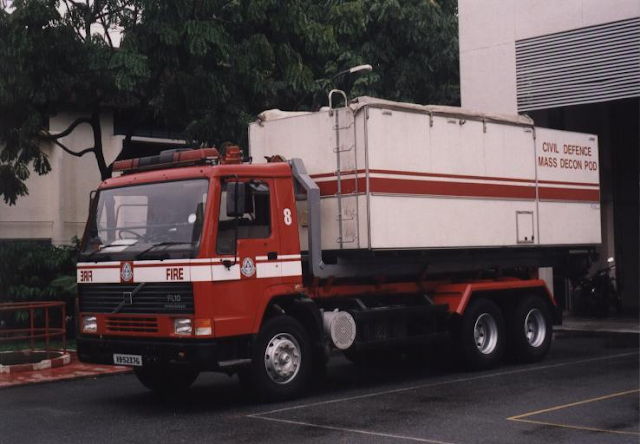
I would believe that this is the last one remaining here, unless I hear of other units still around. FL 10s were mainly used by our fire brigade (shown below) and as prime mover trucks. Information on heavy vehicles are generally harder to find, so apologies for not being able to write as much as I wanted. Interestingly, there was a Volvo Trucks plant in Malaysia and this unit could very well have come from there also.
This is indeed a very left-field subject matter as I am sure no one would give a second look to trucks in general. While I am the first to actually write about this unique piece of history, I hope this has been informative in some way: I don't really expect people to go gaga over them but at least I have done my part in documenting its existence. If you are lucky, try to catch it on the move before it is gone forever!