23 June 2023

More than an old car #209: Subaru XT


Through my years of spotting and writing about old cars, there have been certain vehicles that stand out to me more than others: partly due to its rarity, uniqueness and the setting that I saw it. I still remember that back in 2019, I was made aware of an impromptu display at the official Subaru dealership (though I cannot remember what it was for). Apart from the top-of-the line Subaru S models (S208, S207 and S206), there was the SVX which I wrote about previously, and this 1986 Subaru XT GL which I had no idea existed until then!

First appearing at the 1985 Detroit Motor Show, it received much attention due to its extreme wedge-shaped exterior. Extensive wind tunnel testing further lowered its drag coefficient to 0.29, making it one of the most aerodynamic vehicles of its time. Many features such as a tilt angle of the front and rear windows of 28 degrees, flat bottom underfloor, retractable door handles, pop-up headlights and rubber spoilers in front of each wheel contributed to its success in aerodynamics. As a nod to the aircraft division of Subaru's parent company, Fuji Heavy Industries, the interior featured a joystick-shaped shifter, pod-mounted controls for lighting and wipers and a striking L-shaped steering wheel.  

https://blogger.googleusercontent.com/img/b/R29vZ2xl/AVvXsEj_z2FOgg-ojexqfdG_4IkB3kW8LjewegjcxjtEzVWNfETvx5NzO4DMkBp-Je-napankSIyS_qUN4YLwviDOZP1DqZoxP8a7lJ-w7FmdWxvXWCDEcM-p0lkHrPT9EamMCZchZgh2Vp91AJV/s640/1987AX7SUBARUALCYONEVR+19.jpg

It was launched as the Alcyone in Japan (named after the brightest star in the Pleiades star cluster and the inspiration for Subaru's logo), the XT in North America and the Vortex in Australia/New Zealand. The North American market XT was sold in three models: the base-model DL, the better-equipped GL, and the top-of-the-range GL-10. Initially, only a 1781 cc H4 engine was available (in turbo and non-turbo guises). In mid-1987, the XT underwent a facelift with revised front and rear bumpers, along with the reverse lights being incorporated in the centre taillight panel. A larger 2672 cc H6 engine was also made available, known as the XT6. Full-time 4-wheel drive was also introduced solely for the XT6 variant.
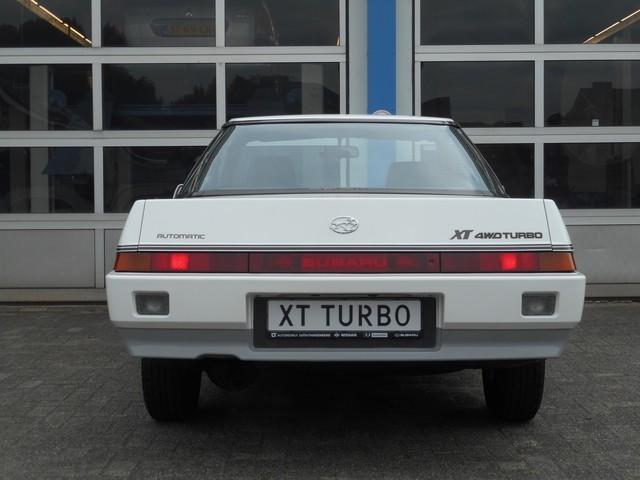
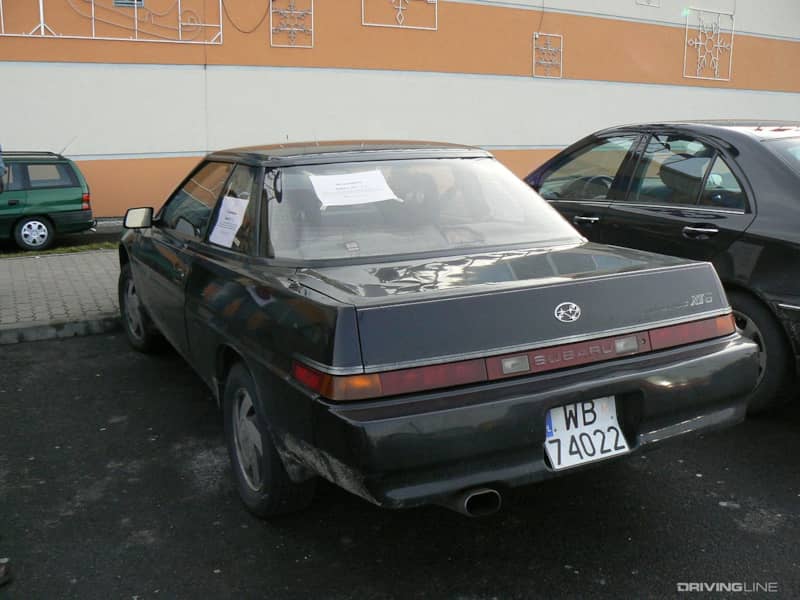
https://cdn-fastly.thetruthaboutcars.com/media/2022/06/30/8818876/rare-rides-a-subaru-xt-turbo-4wd-from-1985.jpg?size=720x845&nocrop=1https://www.drivingline.com/s3/drivingline.prd/media/2313622/1280px-black_subaru_xt6_-_002.jpg?quality=70&mode=pad&copymetadata=true&w=800

The pre-facelift (left) and post-facelift (right)

While the XT was primarily aimed for the export market, it was noted that the appreciation of the yen during that time made it unappealing. Coupled with the 'eccentric' design, it was unable to compete with other sport coupes and sales were sluggish from the time of its release. The XT was powered by a EA82T 1781 cc turbocharged H4 engine, allowing it to reach a top speed of 200 km/h with an acceleration of 8.5 seconds [0-100 km/h]. It had dimensions of 4450 x 1690 x 1335 mm and weighed in at 1165 kg, with a fuel consumption of 8.5 litres / 100 km.

Production of the XT ended in 1991 with 98,918 made in total. While it was available only as a 2-door coupe, there was a one-off convertible made known as the Ficce Special: unfortunately it is last known to be in a run-down state. The facelifted XT Turbo 4WD was sold in Singapore in 1988 by Motorimage (who is still the Subaru dealer today). However, none are known to be left: this particular unit was imported from the US and subject to a ground-up restoration, where it currently remains in Motorimage's collection. 

XTs tend to remain as a forgotten child, in spite of its revolutionary looks. Coupled with the relative lack of know-how, they do not tend to get the love that it deserves. While I am not sure if this XT will ever appear again, at least you would know of its existence here so far from home!


More than an old car #208: Kia Mentor


It is funny how things pop up when you least expect it: I was just passing by the area yet again just to see what was up, when I saw this rather unusual-looking car. At first, I was actually unable to figure out what this was, and did a double take when I realised that it was a rare 2000 Kia Mentor!

The genesis of Kia Motors began in 1944, when Kim Cheol-ho founded Kyunsung Precision Industry, which eventually produced South Korea's first bicycle in 1951. Its name was changed to Kia Industries in 1952; 'Kia' roughly translates to 'Rising from (East) Asia'. It produced small passenger cars up to 1981, where it was forced to manufacture light trucks completely under the dictator Chun Doo-hwan. Kia rejoined the automobile industry in 1986, in partnership with Ford, where it produced Mazda-derived vehicles for both domestic and export usage. Kia declared bankruptcy in 1997 during the Asian Financial Crisis, and was acquired by Hyundai 1 year later. Currently, Kia has drawn much admiration for its latest offerings and is fast shedding the unreliable image of Korean cars.

The Kia Sephia was introduced in 1992 as a means for Kia to regain its competitiveness in the mid-size saloon market. It took inspiration from the Mazda Familia (which Kia had reservations on) and the cooperation with Ford to produce a unique model, which incidentally became quite popular among the public. On top of the sedan, Kia also rolled out the Sephia Leo, a 5-door hatchback model: this subsequently led to the genesis of the Mentor (known in Korea as the Shuma) in 1997.

Shuma means 'the best/strongest' in Latin, and the car was intended to compete with the Hyundai Tiburon. Its 4-headlight configuration drew much suspicion of plagiarism from the Toyota Celica ST185 and Ford Taurus. Despite having a poor interior design, the Shuma won the French Design Award for Excellence in 1999. Curiously, a non-operational red stop lamp was installed on the car boot; many owners subsequently remodeled the wiring to make it light up. It was also the first compact hatchback imported into North America under the Kia brand, and was also the personal vehicle of former Kia chairman Kim Seon-hong.

However, it failed to differentiate itself from the Sephia II, resulting in low sales. On top of that, Kia ran into financial difficulties, leading to cuts in resources and salaries; this had a knock-on effect on the morale of the design and engineering teams. Few people also remember this car and it is considered one of Kia's representative failure models.

The Mentor was powered by a 1498 cc Kia B5 inline-4 engine, allowing it to reach a top speed of 180 km/h, with an acceleration of 13.8 seconds [0-100 km/h]. Its dimensions of 4475 x 1711 x 1413 mm put it in the mid-size category. Interestingly, it had a relatively poor fuel consumption of 7.9 litres / 100 km, and this was compounded by its weight of 1100 kg.

Production of the Mentor/Shuma ended in November 2000, where it was replaced by the Spectra Wing hatchback. The Mentor was sold in Singapore in 1998 by Auto Asia (S) Pte Ltd, where it retailed at S$77,900. However, some time later it launched a promotion and advertised the car at $59,900: despite undercutting the competition, it was not a wise move as Auto Asia ran into financial troubles and eventually went into receivership just 1 year later. Many potential customers banded together to take legal action against Auto Asia to recover their deposits, and it was forced to sell the cars below cost. Cycle and Carriage then took over Kia operations, and this unit, registered in 2001, was sold by C&C.

Many of them were exported/scrapped even before the 10-year COE cycle was up. This lone survivor must have been reliable enough to serve the owner, to the point of extending its COE lifespan 3 times. Old Korean cars were not desirable enough for people to keep it for long, but this unicorn still looks to be well-cared for: it was in the workshop for aircon problems. Admittedly it look really generic and lacks road presence, but here's to hoping that it will continue to be on the road in the years to come!


14 June 2023

More than an old car #207: DMC Delorean

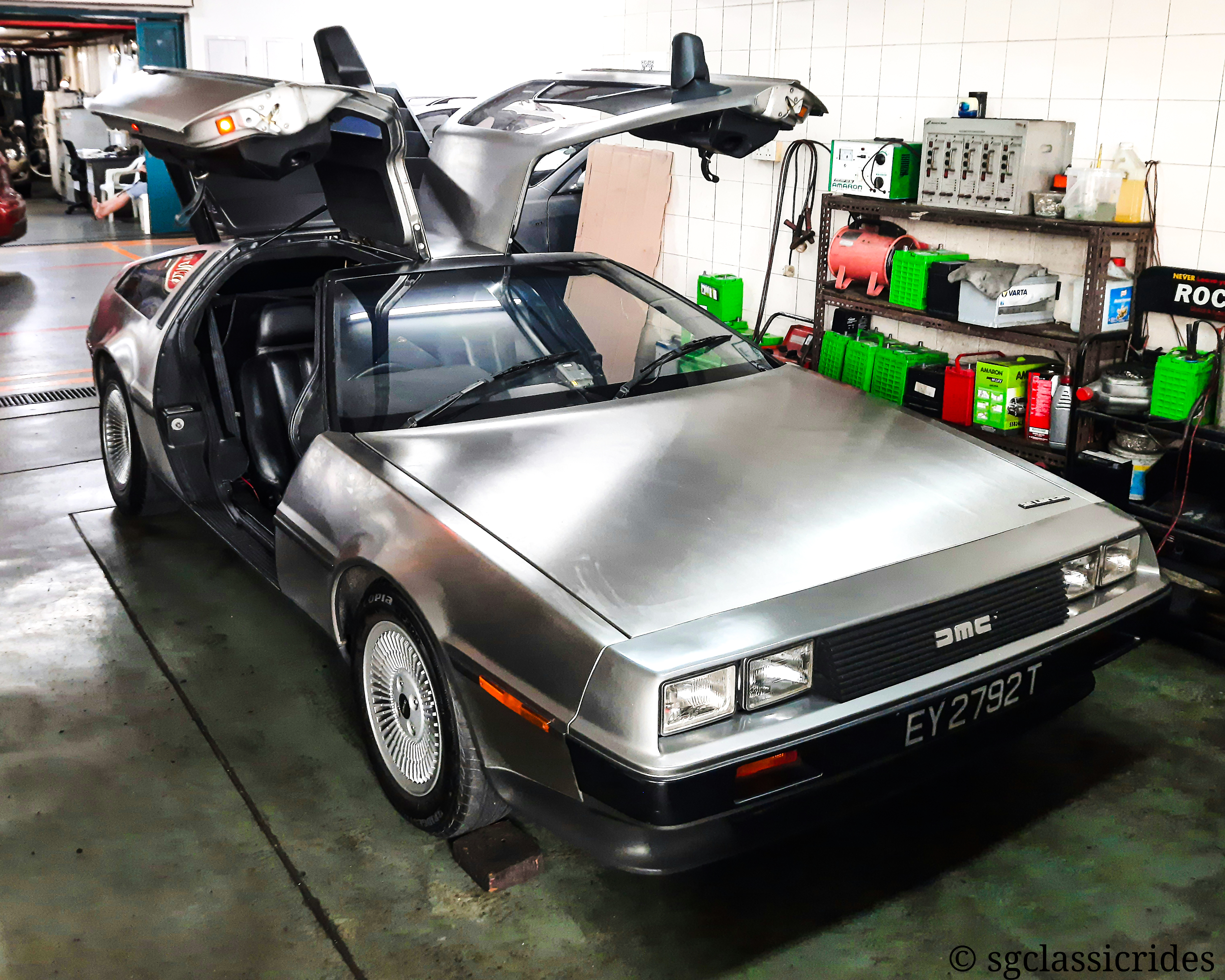
Ever since I watched the Back to the Future series as a child, I had always been fascinated by the legendary 'time machine car' that was used to travel to different eras. It got me wondering whether it existed in Singapore, but it was not until many years later that I found that there was actually one here. However, it already had a reputation for being difficult to spot, and I could only envy the people that were able to see it back then. Fast forward to a few months ago, when I came across an Instagram story showing it at a workshop. Naturally I booked it to the place and was finally able to corner this 1981 DMC DeLorean at long last!

The DeLorean Motor Company (DMC) was set up by John Zachary DeLorean in 1975, who had already been well-known as a capable engineer, business innovator, and youngest person to become a General Motors executive. He was able to raise business capital through numerous business loans and partnerships, including The Tonight Show host Johnny Carson. DeLorean also sought lucrative incentives from governments and economic organizations to pay for manufacturing facilities by looking to build his first factory in an area of particularly high unemployment. The British Government was keen to create jobs in Northern Ireland to reduce sectarian violence, and offered DeLorean about 60% of startup costs. As a result, all DMC cars were made in the Dumurry plant, south-west of Belfast.

By late 1981, DMC was facing cash flow problems due to lower-than-expected sales and unfavourable exchange rates, among many factors. DeLorean attempted to lobby the British government for aid, but was refused unless he was able to find a matching amount from other investors. Furthermore, DeLorean was also arrested in 1982 for conspiring to smuggle $24 million of cocaine to the US. While he was eventually acquitted on all charges, his reputation was irreparably damaged and the company went bankrupt shortly after. In 1995, Stephen Wynne, a British car mechanic from Liverpool, created a separate company based in Texas, using the DeLorean Motor Company name. Wynne acquired the trademark on the stylized DMC logo, along with the remaining parts inventory of the original DeLorean Motor Company. There has been discussion about DMC Texas building an upgraded version of the original DeLorean to mark the 40th anniversary, but no details have been released.

When details surrounding the DeLorean were first announced in the mid-1970s, there were numerous plans and rumors that the DeLorean would have many advanced features, such as a unit-construction plastic chassis, a mid-engine layout, an airbag, and ultrawide Pirelli P7 tires; none of these would materialize in the production vehicle. Appearing in October 1976, the first prototype was was initially known as the DSV-1, or DeLorean Safety Vehicle. As development continued, the model was referred to as the DSV-12, before changing to DMC-12, the "12" deriving from the target list price of $12,000 upon release. However, the 'DMC-12' name was never used in sales or marketing materials for the production model.

The body design of the DeLorean was designed by Giorgetto Giugario of Italdesign, who drew on one of his previous concepts. All DeLoreans were paneled in brushed stainless steel, except for 3 cars that were plated in 24-karat gold from the factory. The unique gullwing doors were designed by Grumman Aerospace, and the car was fitted with small cutout windows as the full-size windows would not have fitted in the door panels. When the car was first released, it received complimentary reviews due to its commendable fuel economy. However, the car was susceptible to quality control problems and DeLorean had to issue 4 recalls before these issues got resolved.

It was powered by a 2849 cc ZMJ-159 V6 PRV engine, allowing it to reach a top speed of 210 km/h with an acceleration of 8.7 seconds [0-100 km/h]. It had dimensions of 4267 x 1988 x 1140 mm and weighed in at 1233 kg, with a fuel consumption of 11.2 litres / 100 km. Despite its objectively poor performance, the DeLorean was chosen by the Back to the Future director Robert Zemeckis because it offered mobility and a unique design; the gull-wing doors would appear like an alien UFO to a 1950s family. Interestingly, the titular time machine was originally conceived as a stationary device; at one point it was a refrigerator. 88 miles per hour (142 kilometers per hour) was chosen as the time travel speed because it was easy to remember and looked "cool" on the speedometer.

Production of the DeLorean ended in 1982, though the remaining units that were acquired by Consolidated International after DMC's bankruptcy were branded as 1983 models. Actual records were lost, but DeLorean owners have deduced that an estimated 8,975 units were made. The DeLorean was initially intended for the US market and were all made in LHD. DMC was aware as early as April 1981 of the need to produce RHD versions, and it was decided to engage the services of Wooler-Hodec, an English company to carry out the conversion. 30 units were delivered to them, but only about 20 were converted before Wooler-Hodec closed down.

This particular unit is noted to be made in August 1981 and was originally sold by Swift Dodge in Sacremento, CA. It is currently 1 of about 46 RHD DeLoreans, though it appears to have been converted (though not by Wooler-Hodec) at some point before it was registered here in 1983. However, it does have the 140 mph speedometer and windscreen wipers in the right-facing direction.

The first mention of this unit in the local news was in 1985, where the first owner, a Mr John Collingwood, put it on sale for S$120,000. Over the years, it has changed ownership multiple times and the last mention was in 2011, where it was on sale for S$220,000. In 2009, it was sent to DMC Texas for a full restoration; the car was given a Stage II engine treatment and 'high-performance' suspension. An old forum post in 2012 also revealed issues with the electronics, 'spongy' braking, tyre rubbing when full-locking and iffy handling. Currently, it is understood to be in a private collection: this unit is also rarely driven, having done about 19,000 miles over the past 40 years. 

It was by pure chance that this DeLorean appeared in the car workshop, where it was getting checked for wiring issues. As one of the most elusive road-registered cars, being able to spot it after so long was a glorious moment. Being able to see the actual 'time machine' car up close and marvel at its revolutionary looks was an experience that I will not forget. I am not sure if you will have the chance to see it on the road, but I still hope you do!

3 June 2023

More than an old car #206: Volkswagen Jetta Mk 1


I believe many people would be familiar with VW, given the continued popularity of the Beetle and the Kombi van. However, I would think that there would be a lower awareness for these 1981 VW Jetta GLis, and what are the chances of seeing the last 2 units in Singapore together!

VW was experiencing much success in the North American market with the well-known Golf, but it was observed that consumers still preferred a traditional three-box configuration (i.e. a sedan-style format). The Jetta was thus born when VW stylists essentially added on a new boot to the Golf to produce a larger saloon. Its name is derived from the Atlantic 'jet stream' during a period when VW named its vehicles after prominent winds and currents (eg the Scirocco and the Bora), though it was later revealed that VW did not really name cars based on a theme.

Introduced to the world at the 1979 Frankfurt Auto Show, it was available as a 2-door and 4-door sedan, with a myriad of engine and transmission choices as well. To distinguish the Jetta from the Golf, the interiors were made more upscale such as velour seats. While Jettas in many places came with composite headlamps, US-market versions were sold with four rectangular sealed beam lamps. As an early adopter of passive restraint systems, VW also equipped Jettas with automatic seat belts.

Early reviews showed that the car handled precisely and the large boot space was noted to be generous, but there were some complaints about the lack of rear head room and heavy steering. In Singapore, all Jettas sold was the 4-door GLi variant. The Jetta GLi was powered by a 1588 cc inline-4 engine, allowing it to reach a top speed of 178 km/h with an acceleration of 9.6 seconds. It had dimensions of 4190 x 1630 x 1395 mm and weighed just 855 kg, with a fuel consumption of 8.6 litres / 100 km.

Production of the 1st-generation Jetta ended in 1984 with more than 571,000 made, although the South African variant (known as the VW Fox) continued to be made until 1999. Jettas were sold in Singapore in 1981 by the former VW dealer Champion Motors, where it retailed for S$55,749. Given the relative closeness of their registration numbers, it would not be improbable to think that both units had been sold within weeks of each other! 

Although owned by different people, it is impressive that both cars have outlasted their fellow siblings, and at a time when VW in the 80s did not really have the retaining power as before. The fact that they remain on regular plates is the icing on the cake, although the current car ownership climate may make this sight a forgotten memory. Hopefully, you will be able to catch them on the roads (doesn't matter if together or not)!

30 April 2023

More than an old car #205: Essex Super Six


It has been a long while since I actually wrote about a super old car, and I was moved to write about this 1928 Essex Super Six after chancing upon an old Facebook post back then...

Founded in Detroit, Michigan in 1910, the Hudson Motor Car Company took its name from Joseph L Hudson, who provided the finances that enabled a group of experienced ex-Olds Motor Works employees to start a new automobile manufacturing venture. Incorporated in February 1909, Hudson built its first car in July of that same year and 12 months later had sold 4,000 units, the industry's best first-year sales record to date. Although the firm would later become famous for its record-breaking Super Six range, Hudson's first product was a four-cylinder car, as was that of companion marque Essex, which was introduced in 1918.

Essex pioneered low-cost closed coachwork in the United States, its four-seater sedan being only slightly more expensive than the tourer in 1922 and marginally cheaper by 1925. Essex's big news for 1924 was the switch from four to six cylinders. The new sidevalve power unit started life at an unusually small - for the United States - 2.1 litres capacity before being enlarged to 2.4 litres part way through the year. Renamed 'Super Six' for 1927, the Essex gained a larger (2.5-litre) and more powerful engine that year and four-wheel Bendix mechanical brakes the year after. Stylistically, the Essex looked broadly similar to its Hudson parent, albeit on a smaller scale.

The car was powered by a 2511 cc inline-6 engine, which had a power output of 17 hp. Considering that it was in the 1920s, this would have been relatively powerful back in the day. It was 3975 mm ling with a wheelbase of 2807 mm.

The Essex name was dropped in 1933 and subsequent cars were sold as the Terraplane. More than 1 million were made, of which some 229,887 were from the 1928 model year. Essexes were sold in Singapore as early as 1927, where a sedan retailed for $2,050 Straits dollars by Straits Motor Garage at their showroom in 41 Orchard Road. Today, the stretch of car showrooms is long gone and replaced by the Istana Park. 

This unit is understood to have been imported some time back and had a change in number plate to its current one. More interestingly, this particular car was also featured in the popular local drama series 'The Little Nyonya'! It has not gone on the road ever since I saw it 3 years ago, but such is the fate of the vast majority of pre-war cars here. It may or may not make further appearances, but hopefully you will have the chance to see it one day!


18 March 2023

Miscellaneous classics #10: Scania 3-Series P113


I realised that it has been a very long time since I wrote about a commercial vehicle. While I am aware that it may not be very 'sexy' or good-looking, this 1995 Scania 3-Series has been on my spotting bucket list for a long while! I always have a weakness for boxy/squarish vehicles, and it was a goal of mine to see one of these Scanias so that I could write about it. Being able to come across this unique registered truck (and one which I could run my checks) was entirely coincidental on that day: the truck was no longer there when I passed by the area again 1 week later.. 

AB Scania-Vabis was formed in 1911 as the result of a merger between Södertälje-based Vabis and Malmö-based Maskinfabriks-aktiebolaget Scania. Vagnfabriks Aktiebolaget i Södertelge (Vabis) was established as a railway car manufacturer in 1891, while Maskinfabriks-aktiebolaget Scania was established as a bicycle manufacturer in 1900. Vabis was running into financial difficulties unlike Scania, and the senior management of Scania made the offer for a merger. Development and production of engines and light vehicles were set to Södertälje, while trucks were manufactured in Malmö. The company's logo was redesigned from Maskinfabriks-aktiebolaget Scania's original logo with the head of a griffin, the coat of arms of the Swedish region Scania (Skåne), centered on a three-spoke bicycle chainset. Initially the headquarters were located in Malmö, but in 1912 they were moved to Södertälje.

Scania-Vabis had produced cars up till 1919, where it focused completely on trucks and buses, including bus chassis. After WWII, Scania-Vabis expanded its dealer network and country-wide specialist workshop facilities, enabling it to maintain a huge market share. It also turned towards the export market and by 1960, exports were 50% of output. Subsidiaries continued to be established in places such as Brazil and the Netherlands, and in 1968 the company was rebranded as just Scania. Scania is currently wholly owned by the VW Group ever since VW acquired a stake in 2000. 

The Scania 3-Series was introduced in 1987, succeeding the 2-Series and was available in a variety of engines and body types. The most notable changes were a redesigned bumper and front fascia incorporating a lower-drag grille design. This P113 was powered by a 11,021 cc DS11 inline-6 engine, with a power output of 320 hp. The concrete pump is noted to be from Schwing GmbH, and was apparently made in 1996; both components must have been fitted together to be registered in time on Nov 1996. Its maximum weight including the concrete pump topped the scales at 32,000 kg

Production of the 3-Series ended in 1998, where it was replaced by the 4-Series. While there are plenty of Scania trucks and buses here, older vehicles tend not to be kept for long under our rules. This particular unit continues to survive because it is registered as a 'restricted usage' vehicle, identified by the green-red plate. It cannot be driven on public roads at all times, so these have to be towed from place to place. I also understand that one cannot just register any car under this scheme in order to exempt it from scrapping: the ones I have come across so far are usually related to construction or special usage. Although it may not be as eye-catching as a typical classic car on the road, I hope that this has given an insight on this special truck...maybe you could be lucky to spot it some day!

4 February 2023

More than an old car #204: Honda Accord Euro R (CL1)


I know that it has been a long while since I posted on the blog (and Instagram to a lesser extent). Being caught up with work (which has been hectic as of late), as well as general ennui turns out to be pretty disruptive. While I can't promise that content will return to the regularity of 2022, I will still do my best to introduce classic cars in Singapore for as long as I am able to (which should be quite long since I will always have a soft spot for them)! I saw this 2001 Honda Accord CL1 Euro R in 2020, back when Covid was gathering in force. The fact that I only started to write about it does show something, isn't it?

The 6th-generation Accord was released in 1997 and interestingly, it was released for 3 different markets (Japanese, North America and Europe) with some differences among them. Model codes CF and CL (JDM models) had smaller headlights, tailights, grilles and front bumpers compared to NA/Asia/Oceania (CG). A coupe version was also sold in Europe and the US but not in Japan. However, Japan received the Accord station wagon (which was a fair enough trade-off). The European models (with CG and CH codes as well) featured a more pointed grille compared to the other markets. A sister model known as the Torneo was also announced (of which we have just one remaining)!

Honda Accord 6th generation.jpg オセアニア仕様セダン フロント

欧州仕様セダン クーペ リア

Different versions of the Accord: Japanese, Asia and Europe, along with the pretty interesting coupe

In 2000, the sports-grade Euro R (CL1) was unveiled: while you could be forgiven for viewing the Euro R as a Type R for Accords, the Euro R was more comfort-oriented and could fit 4 adults comfortably. Interestingly, Accord Type Rs exist for the Euro market. The CL1 Euro R was fitted with a exclusive H22A engine, Recaro bucket seats, Momo steering wheel and an aluminum shift knob. A unique specification called the Euro RX featured a special body colour, a rear spoiler and privacy glass among other add-ons.

The CL1 Euro R was powered by a 2156 cc H22A inline-4 engine, allowing it to reach a top speed of 243 km/h with an acceleration of 7.1 seconds [0-100 km/h]. Its dimensions of 4680 x 1695 x 1405 mm puts it firmly in the mid-size category. Despite weighing in at 1330 kg, its fuel consumption of 8.6 litres/100 km was still respectable. 

Production of the 6th-generation Accord ended in 2002 where it was succeeded by the more popular CL7 series. This Euro R (chassis CL1-110866) is the last one remaining here as the other 20 cars have been exported out. It was a single-owner car before it was acquired by a dealer, and was sold 1 week later with an asking price of S$168,000 (although it was likely sold at a lower price)! It is easy to overlook it as unremarkable (even by classic car standards), but do not be fooled by its nondescript appearance. Hopefully, this has given some insights on the variety of old cars on our roads and I hope you will be able to spot this unlikely classic one day!