16 March 2020

More than an old car #136: Porsche 911


Mention the numbers "911" and other than the US hotline number for the police, one would also be reminded of the car as well. 911s have always remained popular in Singapore, with an estimated 40% of all Porsche cars being this model across all generations. Old 911s still retain their old-school charm and inside their shell lies power and enjoyment, ready to be tapped by the intrepid driver. I was thus pleasantly surprised to come across this 1979 Porsche 911 SC just chilling out near my house!

The 911 traces its roots to sketches drawn by Ferdinand Alexander 'Butzi' Porsche (the founder's grandson) back in 1959. At that time, the 356 had been released to much critical acclaim and helped to make Porsche an established brand. However, it was also recognised that the 356 was becoming outdated and the engine was becoming more costly to make. With that in mind, Butzi ordered a new design to be conceived while meeting certain criteria, such as being able to fit at least 1 set of golf clubs in the car boot, still resemble the 356 in shape and having the engine at the rear. Together with Erwin Komenda, the lead designer for Porsche at that time, both men came up with the timeless fastback styling that continues to be recognised all over the world.

The prototype, known as the Porsche 901, was unveiled to the public at the Frankfurt Motor Show in 1963. However, Peugeot subsequently filed a complaint on the basis that in France, it had exclusive rights to name its cars using the "_0_" format (where the blanks are numbers). In order to avoid re-branding its cars in the French market, it was renamed to 911. 82 units of 901s were already made by 1964 before the name changed went into effect, making them extremely valuable today.

Cars considered as a "classic 911" were made up till 1989, with many generations in between. In 1978, a new version of the 911 was introduced, known as the '911 SC (Super Carrera)'. Up till this time, it had undergone a major facelift, with the addition of front and rear bumpers and was known as the G-series. Originally, Porsche intended the 911 SC to be the last 911 model, and were touting its 928 model as its flagship. However, due to strong sales of the 911, it was decided to inject new life in subsequent 911 cars, which turned out to be the right decision. It was powered by a 2993 cc 6-cylinder boxer engine, allowing it to reach a top speed of 225 km/h with an acceleration of 7 seconds [0-100 km/h]. It was 4291 mm long and weighed 1160 kg, with a fuel consumption of 17 litres/100 km.

Around 58,914 units of the 911 SC were made and this is one of the few units that still remain, more remarkably on normal plates! 911 SCs were first sold in Singapore in 1981 by Ngo Hock Auto Spares Co. Pte Ltd, our first distributor of Porsche vehicles here. It retailed for S$146,557 [S$267,707 in today's money], which was quite a fair sum back then. Singapore units were equipped with air-con, headlight washers and power windows. Reviews back then praised its superb driving capabilities, although it cautioned about the possibility of oversteer for less experienced drivers. This unit has been "backdated", meaning that it has been modified extensively to look like a late 1960s 911. The centrally-located exhaust is a big giveaway: actual 911s have the exhaust pipe coming out from either the left or the right.

I last saw this unit 5 years ago at the same place, and it is nice to know that it is still around. The difference is that I was able to take a better shot with my camera, I hope it looks nicer now...! 911s have always remained legendary status in the classic car world and seeing one in the wild near my area was an added bonus. Even till today, the modern 911s still pay homage to its ancestors by adopting the well-known shape, matched with superior performance and sheer driving pleasure. There are a handful of old 911s still around and they appear once a while, do catch them if you can!


9 March 2020

More than an old car #135: Datsun Bluebird 310


It is always a pleasure to find classics that I had never thought would exist here, especially older Japanese cars. People often wax lyrical about the golden age of Japanese motoring in the 80s and 90s, but I decided to show love to them as well, such as this 1963 Datsun Bluebird 310 DeLuxe!

Introduced in 1959, the 1st-generation Bluebird was also known as the 310 series, following its previous 110 and 210 series cars. Interestingly, its name is derived from the 1908 play L'Oiseau bleu (The Blue Bird) by the Nobel-Prize winning playwright Maurice Maeterlinck. The then-president of Nissan Motors, Katsuji Kawamata, named it as such after changing it from 'Snowbird', which was slang for 'drug addict'. As with cars of that era, it adopted styling cues from larger US cars

Initially released in sedan form, an estate version was introduced in 1960. In 1961, the engine was upgraded and cars were known as the 311. In the same year, a facelift was done to the front grille and the headlights and it was known as the 312, along with a larger engine upgrade: Nissan learnt from the success of the VW Beetle and felt that a more powerful car could be a game-changer. The 310 was available with a variety of trims, the highest being the DeLuxe which sported a full-length stainless steel strip on the body. It was powered by a 1189 cc E-1 i4 engine, allowing it to reach a top speed of 120 km/h with an acceleration of 24 seconds [0-100 km/h]. It was 3915 mm long and weighed 900 kg, with a fuel consumption of 11 litres/100 km.

Production of the Bluebird 310 ended in 1963 with about 210,000 units made. They were sold in Singapore from 1959 by Tan Chong Motors, back when we were still part of Malaya. It sold for RM 5,975 [S$11,432 in today's money], which was a manageable price at that time. This unit was recently imported from Japan and is currently on sale, although there does not seem to be any takers yet.

It is indeed a very quirky little car to own, and the fact that not many Japanese cars from the 1960s survive does speak volumes about its durability. On the other hand, this unit is most likely one of the few that still exists worldwide. Will there be any takers? Who knows, maybe you may consider getting this when it is still available!

26 February 2020

Historic classic rides #3: Renault 12


For this particular historic piece, I try to cover cars that existed here previously but have gone the way of the dodo. It is more interesting to see the large variety of classics we had previously, but unfortunately were unloved for some reason or another to keep them till today. This 1972 Renault 12 TL is a prime example of an unexpected classic that you would not have seen before!

The Renault 12 was first conceived in 1964, where it was known as Project 117. Some of the criteria included having a roomy interior, reliable for export markets, economical and easy to produce. It was supposed to be a new model that bridged the gap between the Renault 8 and Renault 16. The body styling took cues from the 16, though the engine was placed in front of the wheels instead. Initially available only as a 4-door sedan in 1969, a 5-door estate and 3-door van version were introduced in the 70s. The TL trim featured door armrests, separate reclining seats and even a vanity mirror. It was powered by a 1289 cc Cleon-Fonte i4 engine, allowing it to reach a top speed of 148 km/h with an acceleration of 15 seconds [0-100 km/h]. It was 4348 mm long and weighed only 950 kg, with a fuel consumption of around 14 litres/100 km.

Production of the 12 ended in 1980 where it was succeeded by the more successful 18. Around 2.5 million units were made, where it was built in places such as Romania, Oceania and South America. While it received praise in European markets for its spacious, comfortable interior, styling cues and low fuel consumption, it was criticised in the US market for being too noisy, having heavy steering and a less-than-ideal ventilation system. In Singapore, the R12 first appeared in 1970, where it was sold by Progress Motors Limited.

As of today, none are known to exist here and it seems like no one has tried to import one too. It is a quirky car that looks really normal, and I often wonder why people do not really hold on to French classics compared to German ones. It was able to transport people in comfort, reliable and even helped to save fuel...I would love to see one in Singapore someday. Not many people would remember that this car existed, and I certainly did not know about it had I not come across this archive picture. I hope this has been an interesting trip down memory lane, do let me know if you want to see a specific car being covered here!

17 February 2020

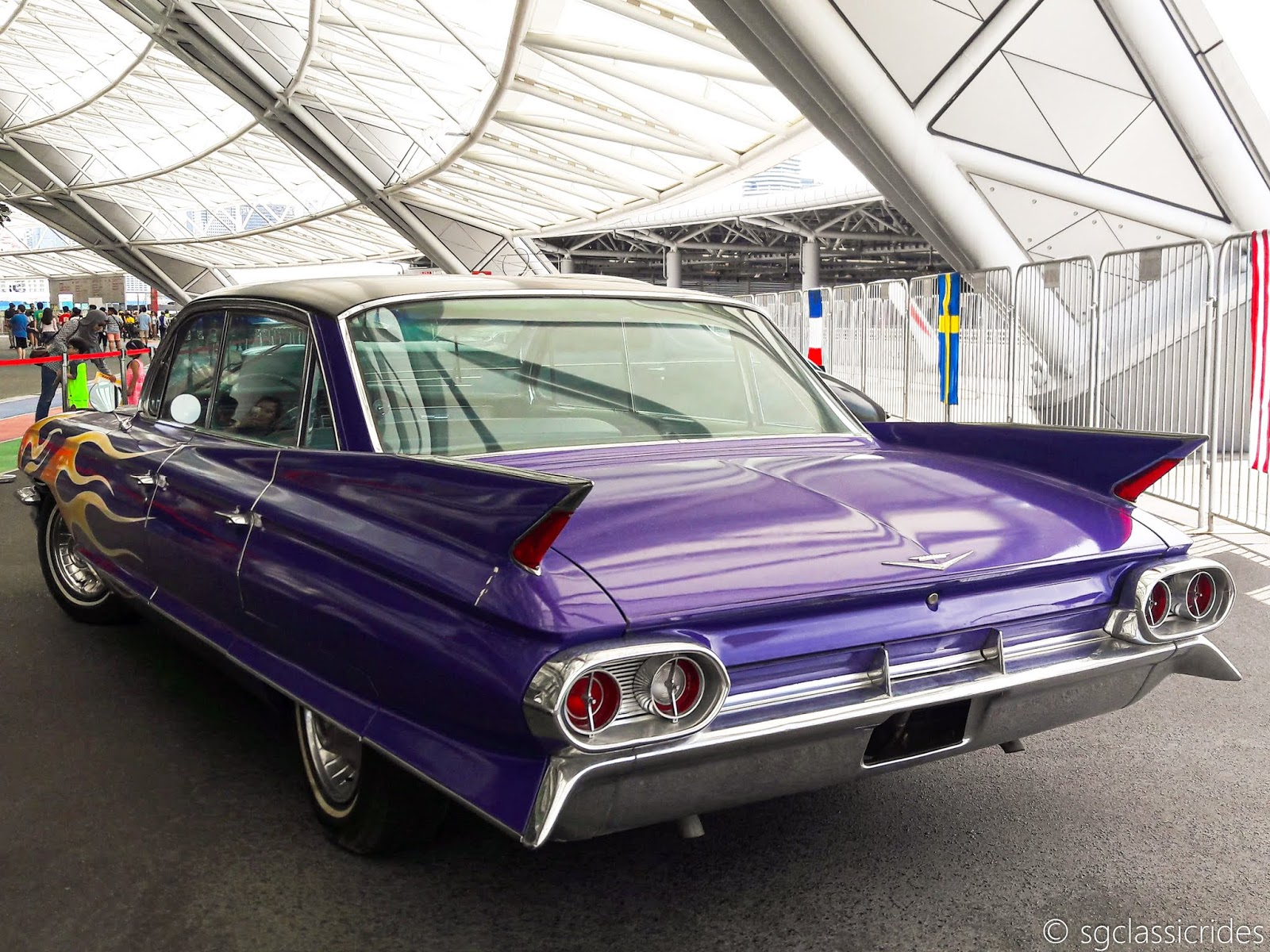
More than an old car #134: Cadillac de Ville


It has been a while since I wrote about American classic cars, mainly because they are so rare to come across. Compared to the mainly European models here, they are of a class of its own, with their ostentatious fins and overall presence that demands you to look at them. I had the pleasure of seeing this 1961 Cadillac de Ville sedan for a few times, before the occasions to take proper pictures presented itself!

The Cadillac Automobile Company was established in 1902, after a dispute between Henry Ford of the Ford Motor Company and his investors. The company was originally planned to be liquidated, but Henry Leland, then an engineer and inventor of his company, advised otherwise. The remaining backers of Ford proceeded to reorganise and built a new car using a single-cylinder engine that Leland had designed. The company was named after 18th-century French explorer Antoine Laumet de la Mothe-Cadillac, and incidentally Cadillac is a town in southwestern France. In 1905, the company merged with Leland's own corporation, and the Cadillac Motor Company was later purchased by the General Motors (GM) conglomerate in 1909.

Cadillac focused on making vehicles for the upper class, and it proceeded to introduce large-capacity engines in its goal to become the "Standard of the World". Throughout its existence, it pioneered the iconic American automobile look with the use of tailfins, wraparound windshields and extensive use of chrome. With the advent of the oil crisis in the 1970s, Cadillac cars were downsized but still provided much luxury to its customers. Currently, its latest offerings are based on the design philosophy of "Art and Science", which incorporates crisp edges with the latest technology. Its logo underwent numerous changes throughout its history, but main features include a coat of arms, a laurel wreath (aristocracy and victory) and the colours black (superiority), gold (riches), red (boldness), silver (virtue), and blue (valor).

The de Ville, first introduced in 1958, was a full-size luxury car that was the replacement for the Series 61. Its name is derived from the French "de ville", meaning "of the town". Previously, the cars (both coupe and sedan versions) sold were known as the 'Series 62 de Ville'. The de Ville cars turned out to be more popular than the base-model Series 62, necessitating a model separation in 1959. 

For the 2nd generation models, it underwent a major re-styling and re-engineering: the grille now slanted towards the bumper and the hood lid and was between dual headlights. It was distinguished from the very similar Series 62 by badges on the front fenders and a front centre armrest. Although the fins were markedly downsized, the new lower flare mouldings further accentuated the elegance and refinement of the entire car. Further complementing the look were the oval housings containing the rear lights, which were separated by a rectangular-patterned grille. Even the wheels were not spared in terms of styling: they featured 24 curved chrome ribs in a recessed area with the logo standing out in the middle. It retailed for US$5,498 excluding options back in 1961, which costs around S$63,303 in today's money.

3 body styles were available, namely coupe, cabriolet and sedan. There were 2 different types of sedans offered: a 4-window and a 6-window option. 6-window cars, like this unit, had rear quarter windows and the rear windscreen did not wrap around as much as the 4-window variant. All 1961 cars were powered by a 6384 cc (390 cubic inch) OHV V8 engine, allowing it to reach a top speed of 199 km/h with an acceleration of 10.8 seconds [0-100 km/h]. As with American cars of that era, everything was massive: it was 5639 mm long and weighed 2136 kg, with a fuel consumption of 23.5 litres/100 km

Production of the 2nd-generation de Ville ended in 1964 where it was replaced by the 3rd-generation series, with only 26,415 units made for the 1961 model year. This unit is not any ordinary Cadillac, but an icon that used to be displayed on top of the Hard Rock Cafe along Cuscaden Road! It was used to welcome the opening of the cafe in 1993, and was subsequently exposed to the elements for more than 23 years until it was taken down in 2016, when renovation works were being done. I found an article that detailed how the iconic flames were hand-painted along with the purple paint [it was originally white]. Furthermore, the engine had to be removed so that it could be hung. After an extensive restoration, it now looks as good as new and I was fortunate to capture it at a classic car exhibition recently. 

Series 62s, but not de Villes were originally sold in Singapore back in 1960 by United Motor Works Ltd, the then-distributor of GM cars in Malaya. None have survived till today as the humongous engine capacity made it very unattractive to maintain and preserve on the road. Classic American cars are unicorns in themselves, since very few were available in RHD format. The very few that exist here originated from Australia, which also has a restrictive policy of requiring its cars to be in RHD. Self-conversions are not allowed and basically the car has to be originally in RHD before it is allowed to be registered here. This particular unit is not going to be on the road any time soon, but I hope that with this information now, you would be more aware of this rare beauty on our shores!


How it looked like back then...picture credits to Straits Times.


13 February 2020

More than an old car #133: Mazda 121


It's not very often that one comes across cute classic cars such as the beloved Mini. However, there are quite a handful of these pint-sized vehicles such as this 1991 Mazda 121 Funtop!

The Autozam Revue, also known as the Mazda 121 in export markets, was first introduced to the public in 1990. Autozam, founded in 1989, was a marque of Mazda, much like how Lexus and Scion are 'sub-brands' of Toyota. It aimed to bring car shops nearer to consumers, and specialised in the sale of mini cars such as the Mazda Carol. Furthermore, it was the distributor of Lancia and Autobianchi cars too. However, as a result of poor economic conditions brought about by the Japanese asset price bubble, Autozam was reabsorbed back under Mazda and the brand name disappeared in 1998. While Autozam stores still exist, they only sell Mazda products instead of their own brand.

The 121 was available as a 4-door sedan only, but some had an optional canvas sunroof and hence known affectionately as the Funtop. 3 different engines were offered along with either manual or automatic transmission. The 121 did not gain much popularity in Japan given the focus on female drivers, as a result of its cute styling and advertising. However, it could fit 4 adults and 2 suitcases comfortably due to its significant trunk space. It was powered by a 1323 cc B3-MI i4 engine, allowing it to reach a top speed of 155 km/h with an acceleration of 15 seconds [0-100 km/h]. It was 3800 mm long and weighed only 890 kg, with a fuel consumption of 7.4 litres/ 100 km.

Production of the Mazda 121/Autozam Revue ended in 1998, where it was replaced by the 4th generation 121 also known as the Demio. Only 57,723 units were made, which caught me by surprise since they were sold regularly in Singapore from 1991! This should be one of the last units remaining: most were scrapped as the owners upgraded to bigger, more practical rides. I was aware of this unit's existence, and was thus fortunate to see it when I had my digital camera. Who wouldn't fall in love with its unique shape? It also seems like a joy to have one and draw eyes wherever one goes. I hope that you'll be able to spot this unique survivor one day!

3 February 2020

More than an old car #132: Mercedes W114/W115


Singaporeans love their Mercedes, partly due to their high-end status and because they look really nice. It is time to turn back the clock and see these 1971 Mercedes W114/W115 back in their heyday!

The W114/W115 was introduced in 1968, as a replacement for the W110. It was marketed as the New Generation Models, hence their ID plates received the designation '/8' due to the 1968 launch year. It was revamped from the previous generation, where it received an improved, simpler suspension system. The car body was designed by Paul Bracq, a decorated automotive designer: the subtle tail-fin design from the W110 could still be observed. However, the simpler body shape meant that more additional options were available, such as a car radio, electric windows and headrests. As such, a car fully equipped with these add-ons could be 3 times as expensive as a no-frills version. In 1973, it received a facelift, with modifications done to the grille, headlights and bumpers among others.

W114s received the more powerful inline-6 engines while W115s were geared for utilitarian usage, hence it featured inline-4 engines. Initially available as a sedan or limousine (Pullman), the coupe version was introduced in 1969 featuring a 'pillarless' window design (ie there is no bar blocking the driver window and the smaller window at the back). A variety of engines were offered, from 2 litre to 2.8 litre engines, and a choice of petrol or diesel.


The W114 250CE coupe had a 2496 cc M114 i6 engine, allowing it to reach a top speed of 185 km/h with an acceleration of 10.8 seconds [0-100 km/h]. It was 4685 mm long and weighed 1390 kg, with a fuel consumption of 13.6 litres/100 km.
The W115 200 sedan had a 1988 cc M115 i4 engine, allowing it to reach a top speed of 160 km/h with an acceleration of 15.2 seconds [0-100 km/h]. It was 4685 mm long and weighed 1330 kg, with a fuel consumption of 12.3 litres/100 km.
The W114 230 limousine had a 2292 cc M180 i6 engine, allowing it to reach a top speed of 175 km/h with an acceleration of 14 seconds [0-100 km/h]. It was 5335 mm long and weighed 1525 kg, with a fuel consumption of 14.6 litres/100 km.

Production of the W114/W115 ended in 1976, where it was replaced by the W123 series. A total of more than 1.9 million cars were made, of which 288,785 were the 200 sedan21,787 was the 250CE coupe and only 1,082 were the 230 limousine. There are quite a handful of W114/W115 cars in Singapore, where they were sold by Cycle and Carriage from 1968. Recently, there are increasing numbers of units that have been imported such as this 250CE coupe. Their timeless design continues to attract people, and it is impressive that they have survived for so long. If you happen to see one, just take the time to admire it and see how different they are from the cars of today!


28 January 2020

More than an old car #131: Subaru SVX


Years of car-spotting has shown me that despite the restrictive rules regarding car ownership here, there are plenty of rare gems hidden all over the island. Thus, when I was aware that this 1991 Subaru Alcyone SVX was on display over the weekend, I had to make my way down and check out this unicorn myself!

The SVX was a all-wheel drive coupe and was Subaru's first entry into the luxury/performance market. Its name is derived from Alcyone, the brightest star in the Pleiades constellation (as stylised in the Subaru logo), and the acronym for 'Subaru Vehicle X'. It was unveiled to the public at the Tokyo Auto Show in 1989. Designed by Giorgetto Giugario, it notably featured a 'window-within-a-window' configuration, supposedly inspired by the glass-to-glass canopy of a fighter jet. Taking cues from its predecessor, the XT, it featured softer lines and its windows was split 2/3 from the bottom, similar to the Lamborghini Diablo and Delorean DMC.

At that time, the all-wheel drive system was revolutionary, especially when Japanese sports cruisers were few and far between. It provided firm grip on loose/slippery surfaces, and made for a fun drive when paired with its low drag coefficient of 0.29. Unfortunately, the AWD system was also its Achilles' heel: it caused the car to become heavier than its competitors and the cooling system was sometimes unable to cope with the additional effort. All SVXs were equipped with a 3318 cc EG33 flat-6 engine, allowing it to reach a top speed of 235 km/h with an acceleration of 8.6 seconds [0-100 km/h]. It was 4625 mm long and weighed 1610 kg, with a fuel consumption of 10.3 litres/100 km.

Production of the SVX ended in 1997, amidst the collapse of Japan's bubble economy and overall poor sales. A total of 24,379 units were sold, of which around 7,000 were in RHD. They are comparatively rare today and one would be hard-pressed to find one even in the main target of the US market. This unit is the only one in Singapore where it belongs to Motor Image, our local Subaru dealer. SVXs were never sold here officially to my knowledge, and I was fortunate to be able to see this when it was on display some time back.

It was quite surprising to see that we have such an oddity here, especially when it does not get displayed often. On one hand, it would be nice if there were registered units here but at least this is better than nothing. I do not know when it will make an appearance again, but I really hope you get to see it soon and appreciate its quirkiness!