Showing posts with label cadillac. Show all posts

12 March 2021

More than an old car #167: Cadillac Fleetwood


The past few weeks has been busy, but I am still thankful to have this private space to write on what I am passionate about. Having been asked to cover some rare cars, I am still fascinated by the variety of unicorns here, such as this 1980 Cadillac Fleetwood Series 75!

The Series 75 was a series of full-size (ie very large) cars produced by Cadillac from the 1930s till the 1980s. When they were first introduced, they featured body styles by Fleetwood, a coachbuilder that had been absorbed by General Motors in 1931. The 'Fleetwood' name was thus applied to Cadillacs later on in history to signify a higher trim than the pedestrian Series 62/Deville. A modern equivalent would be the Mercedes Maybach models compared to the regular S-Class cars, but the size of typical American cars back in the day could match, or even exceed the Rolls-Royces of today.

In 1977, the '10.5th' generation Series 75s were introduced: online data do not really recognise it as a separate generation but a continuation of the 10th generation 75s. The main difference was a decrease in engine and overall size. In 1981, the engine was given a unique 'modulated displacement' system designed by Eaton Corporation, which in layman's terms meant that the engine cylinders could be deactivated. This was supposed to help the car run effectively under light load conditions, but it proved to be too much to handle for the onboard computer: this engine was dropped after just 1 year. This unit was powered by a 6030 cc (368 cubic inch) L62 V8 engine (not the special engine), allowing it to reach a top speed of 171 km/h with an acceleration of 15.2 seconds [0-100 km/h]. It was 6205 mm long, weighed 2161 kg and had an incredibly thirsty fuel consumption of 19.9 litres/100 km.

Production of this '10.5 generation' ended in 1984, where it was replaced by the even more-downsized 11th generation. Interestingly, this unit was an actual Singapore car: it was a 'barn find' that had been registered briefly, before it got cast aside by the owner and never put up for sale. The car was left untouched for some 20 years before it got bought over by a group of local collectors. Restoration seems to be in progress as it looks better than when I saw it 2 years ago. However, given the dearth of spare parts, getting it on the road again would be an interesting project. Cadillacs in general existed in small numbers during the 80s, back when RHD conversions were tacitly allowed. However, the difficulty in maintaining American cars and exorbitant taxes led to their extinction. 

Having seen it up close, I can attest to how huge it is. It would definitely be a head-turner if it ever goes out on the road: all other cars would look positively tiny beside it. However, its length is also a curse: HDB carparks would become out-of-bounds to such a behemoth. I have no idea when it will ever be registered, but if it happens, you would not be able to miss this one!


17 February 2020

More than an old car #134: Cadillac de Ville


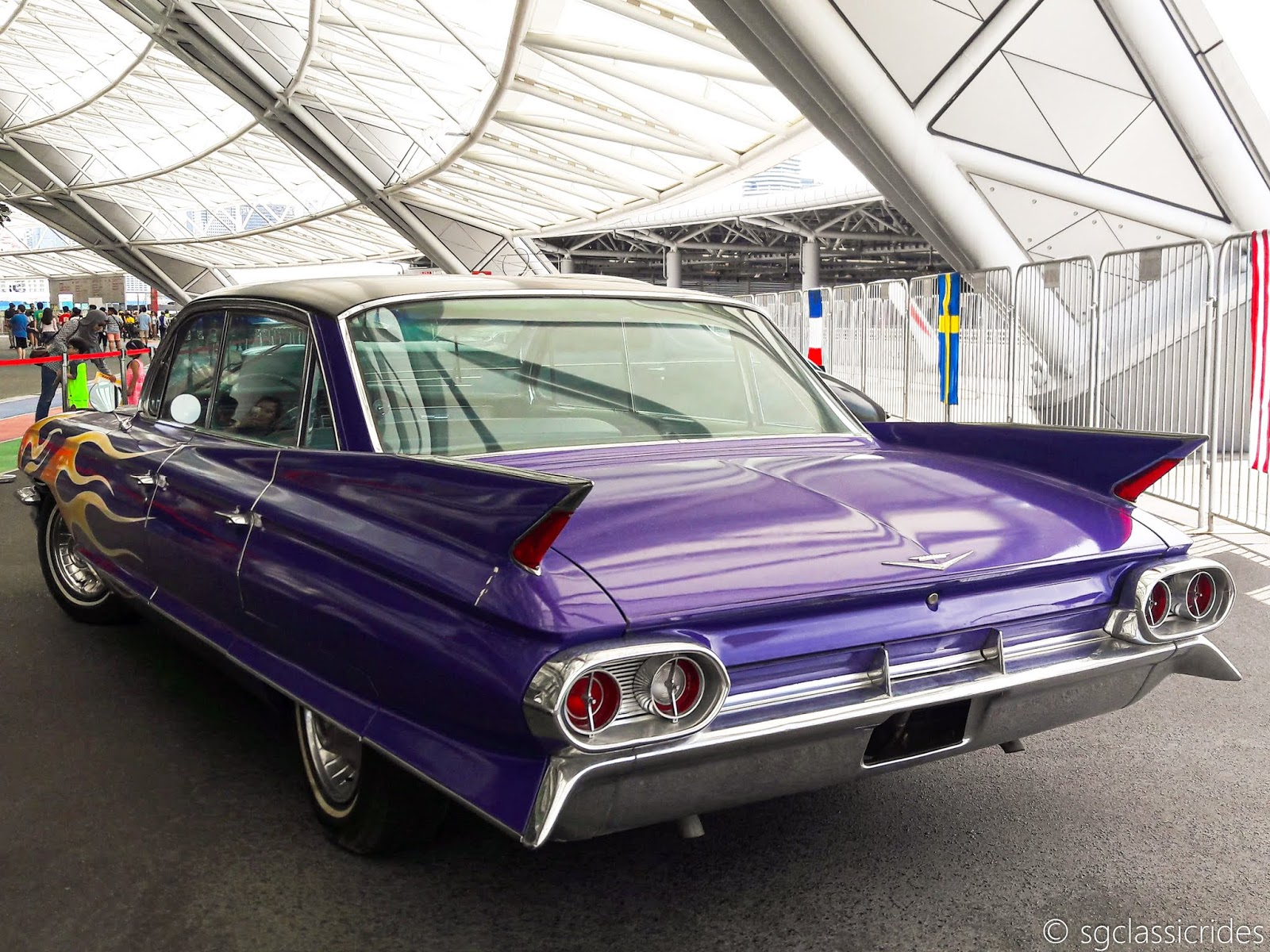
It has been a while since I wrote about American classic cars, mainly because they are so rare to come across. Compared to the mainly European models here, they are of a class of its own, with their ostentatious fins and overall presence that demands you to look at them. I had the pleasure of seeing this 1961 Cadillac de Ville sedan for a few times, before the occasions to take proper pictures presented itself!

The Cadillac Automobile Company was established in 1902, after a dispute between Henry Ford of the Ford Motor Company and his investors. The company was originally planned to be liquidated, but Henry Leland, then an engineer and inventor of his company, advised otherwise. The remaining backers of Ford proceeded to reorganise and built a new car using a single-cylinder engine that Leland had designed. The company was named after 18th-century French explorer Antoine Laumet de la Mothe-Cadillac, and incidentally Cadillac is a town in southwestern France. In 1905, the company merged with Leland's own corporation, and the Cadillac Motor Company was later purchased by the General Motors (GM) conglomerate in 1909.

Cadillac focused on making vehicles for the upper class, and it proceeded to introduce large-capacity engines in its goal to become the "Standard of the World". Throughout its existence, it pioneered the iconic American automobile look with the use of tailfins, wraparound windshields and extensive use of chrome. With the advent of the oil crisis in the 1970s, Cadillac cars were downsized but still provided much luxury to its customers. Currently, its latest offerings are based on the design philosophy of "Art and Science", which incorporates crisp edges with the latest technology. Its logo underwent numerous changes throughout its history, but main features include a coat of arms, a laurel wreath (aristocracy and victory) and the colours black (superiority), gold (riches), red (boldness), silver (virtue), and blue (valor).

The de Ville, first introduced in 1958, was a full-size luxury car that was the replacement for the Series 61. Its name is derived from the French "de ville", meaning "of the town". Previously, the cars (both coupe and sedan versions) sold were known as the 'Series 62 de Ville'. The de Ville cars turned out to be more popular than the base-model Series 62, necessitating a model separation in 1959. 

For the 2nd generation models, it underwent a major re-styling and re-engineering: the grille now slanted towards the bumper and the hood lid and was between dual headlights. It was distinguished from the very similar Series 62 by badges on the front fenders and a front centre armrest. Although the fins were markedly downsized, the new lower flare mouldings further accentuated the elegance and refinement of the entire car. Further complementing the look were the oval housings containing the rear lights, which were separated by a rectangular-patterned grille. Even the wheels were not spared in terms of styling: they featured 24 curved chrome ribs in a recessed area with the logo standing out in the middle. It retailed for US$5,498 excluding options back in 1961, which costs around S$63,303 in today's money.

3 body styles were available, namely coupe, cabriolet and sedan. There were 2 different types of sedans offered: a 4-window and a 6-window option. 6-window cars, like this unit, had rear quarter windows and the rear windscreen did not wrap around as much as the 4-window variant. All 1961 cars were powered by a 6384 cc (390 cubic inch) OHV V8 engine, allowing it to reach a top speed of 199 km/h with an acceleration of 10.8 seconds [0-100 km/h]. As with American cars of that era, everything was massive: it was 5639 mm long and weighed 2136 kg, with a fuel consumption of 23.5 litres/100 km

Production of the 2nd-generation de Ville ended in 1964 where it was replaced by the 3rd-generation series, with only 26,415 units made for the 1961 model year. This unit is not any ordinary Cadillac, but an icon that used to be displayed on top of the Hard Rock Cafe along Cuscaden Road! It was used to welcome the opening of the cafe in 1993, and was subsequently exposed to the elements for more than 23 years until it was taken down in 2016, when renovation works were being done. I found an article that detailed how the iconic flames were hand-painted along with the purple paint [it was originally white]. Furthermore, the engine had to be removed so that it could be hung. After an extensive restoration, it now looks as good as new and I was fortunate to capture it at a classic car exhibition recently. 

Series 62s, but not de Villes were originally sold in Singapore back in 1960 by United Motor Works Ltd, the then-distributor of GM cars in Malaya. None have survived till today as the humongous engine capacity made it very unattractive to maintain and preserve on the road. Classic American cars are unicorns in themselves, since very few were available in RHD format. The very few that exist here originated from Australia, which also has a restrictive policy of requiring its cars to be in RHD. Self-conversions are not allowed and basically the car has to be originally in RHD before it is allowed to be registered here. This particular unit is not going to be on the road any time soon, but I hope that with this information now, you would be more aware of this rare beauty on our shores!


How it looked like back then...picture credits to Straits Times.